
April 10, 20269 min read
Crowdfunding vs. Angel Investors: What Indian Founders Must Know Before Choosing a Capital Path
By Aman Singh
Angel Investing

Key Takeaways
Disclaimer: The information shared here is for educational purposes only and should not be taken as financial advice. Since every business operates under different conditions, we recommend speaking with a qualified financial advisor before making key business decisions.
Ever wondered how some startups go from a simple idea to rapid growth, even before attracting big venture capital firms? In many cases, the secret lies with angel investors.
In today’s startup ecosystem, angel investors play a pivotal role in bridging the gap between bootstrapping and institutional funding. They often take the first bet on unproven ideas, helping founders validate concepts, build traction, and set the stage for future investment rounds. For early-stage entrepreneurs, understanding the pros and cons of working with angel investors can be the key to making smarter, more sustainable growth decisions.
When a startup is just an idea on paper, traditional lenders or venture capitalists rarely take the risk. That’s where angel investors step in, individuals who invest their own personal funds into promising early-stage businesses in exchange for equity or convertible debt.
These investors aren’t just writing checks; they’re often betting on the founder’s vision, energy, and potential to disrupt an industry.
Angel investors are typically high-net-worth individuals, successful entrepreneurs, corporate leaders, or professionals who understand what it takes to build a business from the ground up. Many of them invest not only for financial returns but also to mentor upcoming founders, share their expertise, and stay connected to emerging innovation.
Angels usually come in during the pre-seed or seed stage, when startups are still refining their products, building early teams, or testing market fit. This is a crucial period where capital is hardest to find, and angel funding often becomes the difference between an idea stalling and a business taking off.
Also Read: Top 8 Government Grants for Startups in India 2025
Securing funding from an angel investor isn’t just about pitching a great idea; it’s about building trust, proving potential, and showing a clear path to growth. The process involves several key stages that take a startup from initial contact to a finalised investment deal.
The journey typically begins when a founder pitches their startup through a presentation, a demo, or an introduction within an investor network. A strong pitch includes a solid business plan, market analysis, revenue model, and a clear explanation of how the funds will be used.
If the investor is interested, initial meetings follow, where both sides assess fit and alignment. Once the angel sees value and potential, discussions move toward valuation, shareholding structure, and exit expectations. The process concludes with a formal investment agreement, which legally defines the terms, equity share, and rights of both parties.
Angel investors typically invest using one of two structures:
Each structure has its pros and cons; equity deals provide clarity upfront, while convertible notes offer flexibility for both founders and investors.
Before funds are transferred, investors perform due diligence to validate the startup’s claims. This involves reviewing:
This step is essential to ensure the business is sound, scalable, and transparent, protecting both the founder and the investor from future complications.
Imagine a health-tech startup, MedEase, developing an AI-driven platform for virtual diagnostics. The founder presents the concept to an experienced angel investor from the healthcare industry.
Impressed by the innovation and market demand, the investor offers ₹40 lakhs for a 15% equity stake. After a round of due diligence confirming market potential and a strong team, both parties sign an agreement. Within weeks, the funds are disbursed, allowing MedEase to hire developers, finalise the prototype, and prepare for its pilot launch.
What began as a concept now transforms into a funded venture, all thanks to a well-structured angel investment.
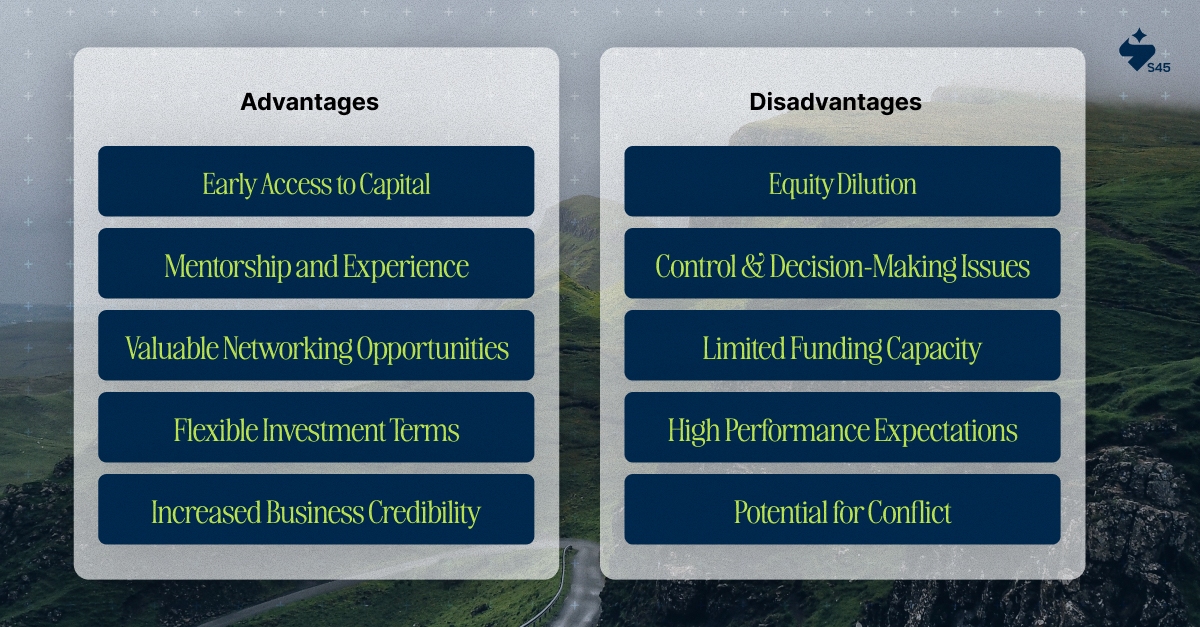
Angel investors offer far more than just financial capital; they bring knowledge, mentorship, and credibility that can help early-stage startups thrive. Let’s explore the key advantages of working with them.
Angel investors are often the first source of external funding for startups struggling to raise money through banks or venture capital.
Most angel investors are experienced entrepreneurs or professionals who understand the journey of building a business. Their guidance can be just as valuable as their funding.
An angel’s network can open doors that would otherwise take months or years to reach.
Unlike institutional investors, angels are known for their personalised and founder-friendly approach to funding.
A reputable angel investor brings more than money; they bring validation and visibility to a startup.
Angel investors, in essence, are catalysts of early growth, providing the mix of capital, confidence, and connections that can set a startup on the right trajectory.
While angel investors can accelerate a startup’s journey, their involvement also comes with trade-offs. Founders must weigh these carefully to ensure the partnership aligns with their long-term vision. Below are some of the main challenges to consider.
Accepting angel funding means giving away a portion of your ownership in exchange for capital.
Angel investors often seek some level of influence in how the business is run, particularly in strategic or financial decisions.
While angel investors are generous in early stages, they typically cannot match the large-scale funding capacity of venture capital firms.
Angels invest their own money, and that personal stake can lead to strong expectations for quick returns.
As with any partnership, differences in communication style, strategy, or expectations can lead to misunderstandings.
While these challenges don’t outweigh the benefits for every startup, it’s crucial to choose the right angel investor, one who aligns with your vision, respects your autonomy, and adds value beyond just capital.
When planning your startup’s financial strategy, it’s important to understand how angel investors stack up against other funding sources. Each option, whether venture capital, bank loans, or bootstrapping, comes with its own benefits, expectations, and trade-offs. The key is choosing the one that fits your business stage, growth plan, and risk appetite.
Angel investors usually step in early, when startups are still developing products or testing markets. They invest personal funds and often act as mentors. Venture capitalists, on the other hand, typically invest later, once the startup has traction, revenue, and proven scalability.
Aspect | Angel Investors | Venture Capitalists (VCs) |
Stage of Investment | Early-stage (pre-seed to seed) | Growth stage (Series A and beyond) |
Source of Funds | Personal wealth | Institutional pooled funds |
Investment Size | Smaller (₹5 lakh – ₹2 crore) | Larger (₹5 crore and above) |
Involvement | Personal mentorship, flexible terms | Formal oversight, structured governance |
Exit Expectations | Long-term, patient returns | Defined exit timeline (3–7 years) |
Angel investors believe in your potential and guide you through early uncertainty, while venture capitalists look for proven performance and scalability before investing big.
Both angel funding and bank loans provide capital, but they differ in how risk and repayment are handled. Angels invest equity capital; they share your risk and profit only if your startup succeeds. Banks, on the other hand, offer debt capital, which must be repaid with interest, regardless of how your business performs.
Aspect | Angel Investors | Bank Loans |
Funding Type | Equity-based (no repayment) | Debt-based (fixed repayment) |
Collateral Requirement | Not required | Usually required |
Risk Level | Shared risk (investor profits only if business grows) | The founder bears full repayment risk |
Control Impact | Partial equity dilution | Full ownership retained |
Flexibility | Negotiable terms | Strict repayment schedule |
Angel funding offers breathing room and partnership, while bank loans provide independence but higher financial pressure.
Bootstrapping, self-funding your business, offers full control and ownership, but limits how fast you can scale. Angel investors, however, provide the capital and network needed to grow faster, at the cost of sharing a slice of equity.
Aspect | Angel Investors | Bootstrapping |
Ownership | Shared (equity given to investor) | 100% founder-owned |
Speed of Growth | Faster with external capital | Slower due to limited funds |
Decision Making | Shared or influenced by an investor | Fully independent |
Risk Exposure | Shared with the investor | Entirely on the founder |
Networking & Mentorship | Access to expertise and networks | Limited to the founder’s circle |
Bootstrapping gives independence but limits expansion speed, while angel investors can accelerate growth through capital, connections, and mentorship.
Also Read: How to Become an Angel Investor in India: A Beginner’s Guide
Angel investment can be a game-changing opportunity for many early-stage businesses, but it’s not a one-size-fits-all solution. Before you start reaching out to investors or preparing a pitch deck, it’s crucial to ask yourself whether this type of funding truly fits your goals, personality, and business model.
Angel investors don’t lend money; they invest in exchange for ownership. That means you’ll be sharing a part of your company and its future profits. If maintaining complete control is your top priority, angel investment might not feel comfortable for you.
Angels are drawn to businesses that can grow quickly and reach larger markets. If your startup has strong demand potential, innovative offerings, or room to expand beyond local boundaries, it’s likely to attract their interest.
The best angels don’t just bring funds; they bring experience, networks, and valuable business insights. If you’re looking for guidance, mentorship, and introductions that can accelerate your growth, angel investors can be ideal partners.
Accepting external funding means you’ll be accountable to someone else’s expectations. You’ll need to share progress reports, financial updates, and strategic decisions transparently. If you’re comfortable with that responsibility, you’re ready for this step.

Attracting an angel investor takes more than just a great idea; it requires preparation, clarity, and genuine relationship-building.
1. Build a Strong Business Foundation: Show that your startup solves a real problem with a clear business model and a defined market. Early traction, even small wins, helps prove your idea’s potential.
2. Create a Compelling Pitch Deck: Keep your pitch short, clear, and story-driven. Focus on the problem, your solution, market opportunity, business model, team, and financial plan.
3. Network with Intention: Connect through startup events, incubators, and online investor communities. Genuine relationships often open doors faster than cold emails.
4. Emphasise Scalability and Vision: Demonstrate how your idea can grow beyond local markets, through technology, expansion, or partnerships, to show long-term potential.
5. Be Transparent and Coachable: Investors value honesty and adaptability. Be open about challenges and receptive to feedback; it builds trust and confidence.
6. Follow Up Consistently: Keep potential investors updated with progress milestones. Regular communication shows growth and persistence, both key traits angels respect.
Building a company ready for public markets takes more than ambition; it requires institutional discipline, regulatory precision, and execution excellence. S45 partners with Indian founders and leadership teams to prepare, structure, and execute IPOs using a technology-first, evidence-driven approach.
S45 is not a capital provider or a startup club. It is an IPO readiness and capital markets execution platform designed to help companies move from private scale to public credibility faster, cleaner, and with fewer risks.
Book a call with S45 to evaluate your IPO readiness and understand how their platform can help you move confidently from private growth to public markets.
Discover more insights on similar topics