
April 7, 202610 min read
How to Secure Funding for Social Enterprises in India?
By Aman Singh
Startup Funding

Disclaimer: This content is for educational purposes only and should not be considered as financial advice. Every business situation is unique, and we recommend consulting with qualified financial advisors before making important business decisions.
Most founders who come to the public markets conversation have already raised capital. Some raised it well. Many raised it in a way that creates real problems three, four, five years later, dilution they didn't anticipate, governance rights they didn't negotiate, SEBI disclosures they can't cleanly explain.
It starts at the beginning. The difference between seed and angel investors is one of the most misunderstood concepts in Indian entrepreneurial finance. Not because the definitions are complex, but because the practical implications, on your cap table, your governance structure, your compliance trail, and ultimately your IPO readiness, are treated as afterthoughts.
They are not afterthoughts. They are architecture.
If you are a promoter or CFO preparing a high-growth Indian enterprise for the public markets, understanding angel investment vs seed funding is foundational. Not for the capital alone, but for what those funding rounds say about your enterprise to institutional investors, merchant bankers, and SEBI reviewers down the line.
Angel funding is early-stage capital provided by individual high-net-worth investors using personal funds, typically in exchange for equity or convertible instruments. In India, the concept has a formal regulatory overlay under SEBI's Alternative Investment Fund (AIF) Regulations.
Under SEBI's revised AIF Regulations (September 2025), investing in a SEBI-registered Angel Fund now requires that the investor be an Accredited Investor. For individuals, accreditation requires:
Angel investors operating outside a fund structure remain informal and individually negotiated.
The key characteristic of angel and seed funding at the angel stage is informality. That informality can be an asset early on. It becomes a liability when your company goes public.
Tools like S45 are increasingly used by founders to bring structure to early-stage documentation and investor data, reducing friction as they transition toward institutional capital and public-market readiness.
Suggested Read: Who Are Angel Investors? Relevance in 2025
Seed funding is the next stage of formalized external capital. It is typically larger, more structured, and involves institutional or semi-institutional investors: venture capital funds, seed-stage AIFs, family offices, or formal syndicates.
Parameter | Angel Funding | Seed Funding |
Investor Type | Individual HNI / informal | VC fund / AIF / institutional |
Ticket Size | Rs. 10 lakh to Rs. 25 crore | Rs. 50 lakh to Rs. 30 crore+ |
Documentation | Light term sheet, convertible note | Formal SHA, investor rights agreement |
Governance | Minimal board rights | Board seat or observer rights |
Due Diligence | Limited | Financial, legal, technical |
SEBI Regulation | AIF Regulations (if via Angel Fund) | AIF / SEBI ICDR downstream implications |
The difference between seed and angel funding is not simply scale. It is about the formalization of your governance architecture. Seed investors typically demand:
These contractual obligations become part of the DRHP disclosure and require clean representation at the IPO stage.
Here is where the difference between seed and angel investors stops being academic and becomes operational.
Indian IPOs do not fail because of bad businesses. They fail or are delayed because of broken workflows that trace back to decisions made years earlier. Poorly documented angel rounds. Seed investors with contractual rights that conflict with SEBI's ICDR requirements. Cap tables that cannot be cleanly represented without 18 months of restructuring.
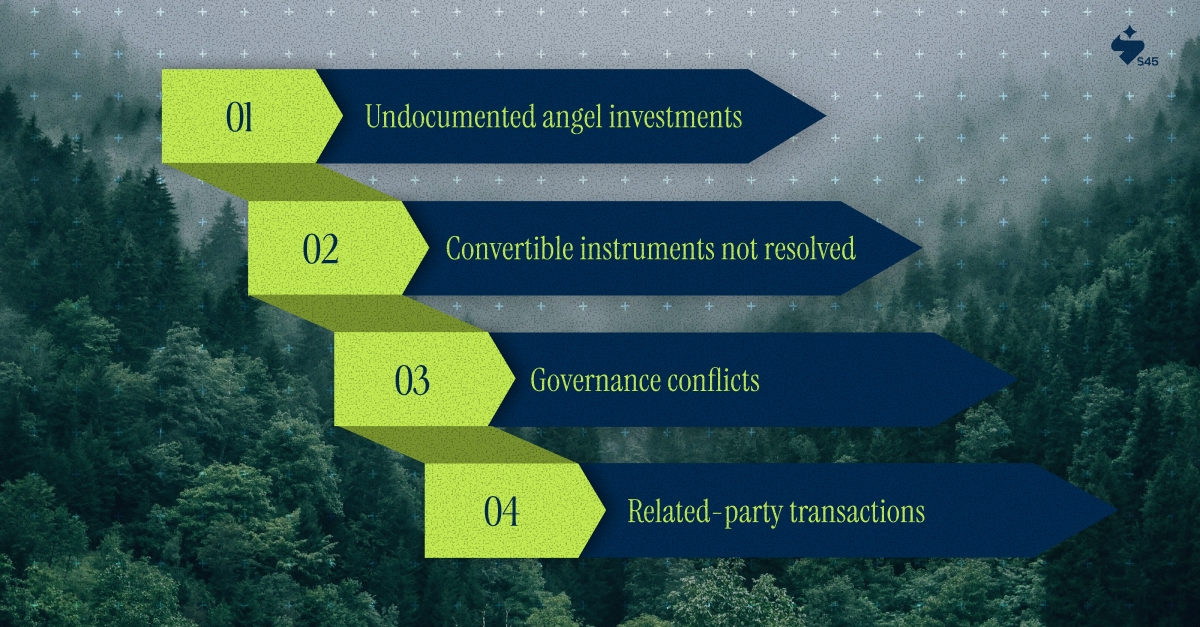
The chaos gap in Indian capital markets is not a technology problem or a regulatory problem. It is a workflow and discipline problem that starts at the first check written into your company.
Also Read: Angel Investors vs Venture Capital: Key Differences Explained
Every number in a DRHP must show its math. Every disclosure must be traceable. Every equity allotment, every valuation, every investor right must be linked to a document, a board resolution, or an ROC filing.
This is not a best practice. It is an SEBI requirement.
When the difference between seed and angel investors matters most is at the disclosure stage:
Institutional clarity at the IPO stage is built on documentation discipline at the angel and seed stages. Founders who treated early rounds as informal arrangements consistently face the most friction during SEBI review.
S45's IPO Readiness Scan specifically traces a company's funding history for documentation gaps, disclosure risks, and governance conflicts before a single page of the DRHP is drafted. That upstream work is what separates a 90-day DRHP process from a 9-month one.
The regulatory landscape for angel vs seed fund capital has changed meaningfully. Founders must understand the current compliance architecture.
SEBI's September 2025 circular introduced several structural changes:
These regulatory changes have a direct implication for companies preparing for public markets:
Compliance is not friction. Compliance is structured. The founders who treat SEBI regulations as craftsmanship, building their governance and documentation from day one, are the ones whose IPOs run on schedule.
The conventional answer is that angel investment precedes seed funding. In the Indian context, the reality is messier, and understanding the actual sequencing is important.
Pre-seed / Angel Stage:
Seed Stage:
Pre-Series A / Series A:
The difference between seed and angel funding is not just chronological. It is structural. Each stage should build on the documentation and governance discipline of the prior stage. When it does not, the company arrives at the public markets with layers of undocumented history that must be excavated, resolved, and disclosed.
Also Read: How to Become an Angel Investor in India: A Beginner’s Guide
If you are running a ₹80 crore to ₹800 crore revenue enterprise and thinking about the public markets, the angel investment vs seed funding question translates into three practical concerns:

Every investor from your angel round onwards will appear in your DRHP. Their identity, their shareholding, their relationship to the promoter group, and any material agreements must be disclosed. Undocumented angel investments are the single most common cause of IPO preparation delays in mid-market Indian companies.
Seed fund investors frequently negotiate rights, anti-dilution, drag-along, tag-along, information rights, and board representation that were appropriate for a private company but raise compliance questions at the IPO stage. These must be reviewed against SEBI's ICDR and LODR requirements before the DRHP is filed.
The valuation at which angel and seed investors entered your cap table establishes the baseline against which your IPO pricing will be evaluated. If those valuations were not formally documented at the time of investment, recreating a defensible valuation trail for SEBI review is time-consuming and exposes the pricing logic to challenge.
S45's AI-driven DRHP drafting process incorporates evidence-linked disclosures from the earliest stages of IPO preparation, tracing the funding history, mapping the cap table, and identifying governance conflicts before drafting begins. That is execution precision at the infrastructure level, not at the finishing stage.
If you are a promoter or CFO deciding which type of early-stage capital to raise, or advising a company on its capital structure, here is the operational framework:
The difference between seed and angel investors is not just a definitional question for founders in their early days. It is a capital markets architecture question that compounds over the life of your enterprise. Every angel check that was deployed informally, every seed round that was loosely documented, every governance right that was granted without considering SEBI ICDR implications, these create friction at the IPO stage, measured not in days but in months.
Indian enterprises with ₹80 crore to ₹800 crore in revenue are candidates for the capital markets. Their funding history is their institutional biography. It will be read, reviewed, and scrutinized by SEBI, by investment bankers, and by institutional investors. It must be written with the same discipline that the public markets demand.
The founders who understand this early build enterprises that reach the public markets cleanly and on schedule. Those who treat early-stage funding as purely a capital conversation, not a compliance and governance one, pay for it later.
If your enterprise is approaching public market readiness and you need clarity on how your existing capital structure and funding history position you for an IPO, connect with S45 for a structured IPO Readiness Assessment before you commit months and reputation to the process.
Discover more insights on similar topics