
April 10, 202611 min read
Angel vs. Seed Funding: What Every Indian Founder Must Know Before Raising Capital
By Abhishek Bhanushali
Startup Funding

Disclaimer: This content is for educational purposes only and should not be considered as financial advice. Every business situation is unique, and we recommend consulting with qualified financial advisors before making important business decisions.
If you have started thinking about your company's next major capital event, whether that is a pre-IPO round, an SME Exchange listing, or a full Main Board IPO, you already know where the process starts to fracture.
It starts with spreadsheets. Multiple versions of the same financial model were passed between your CFO, your auditor, and a merchant banker who joined three months ago. It continues with DRHP drafts where the risk factors do not align with the financial disclosures. It escalates when SEBI sends comments that expose inconsistencies you could have caught six months earlier, except no one in your advisory chain was looking at the full picture at the same time.
This is not a small-company problem. This is the operating reality of new venture finance and startup funding for entrepreneurs in India, regardless of whether you are at Rs. 80 crore in revenue or Rs. 800 crore. The mechanics of Indian capital markets demand institutional-grade evidence, not intent. They reward preparation built on traceable data, not decks built for first meetings.
The entrepreneurs who navigate this well are not smarter. They are better organized, earlier. They understand that the capital markets do not care about your growth story unless that growth story is defensible, document-by-document, line-by-line.
The term "chaos gap" describes a specific failure mode in Indian IPO preparation: the distance between a company's readiness to grow and its readiness to go public. This gap is almost never about the underlying business. It is almost always about the infrastructure surrounding it.
Most mid-market Indian companies approaching public markets for the first time share a common problem structure:
The result is not just a delay; it is a compounding risk. Every additional month of preparation increases the probability of a market-timing miss, a regulatory comment requiring rework, or a pricing conversation held with less institutional leverage.
This is where S45, India's AI-native investment bank, frames its core operating thesis: the chaos gap is not inevitable. It is a workflow problem that institutional infrastructure can solve.
Must Read: How to Get Funding Help for Startups: Beyond VC Rounds to Public Markets
Before any conversation about IPOs, founders need clarity on where they sit within the Indian venture finance ecosystem, and what each stage of that ecosystem demands from them.
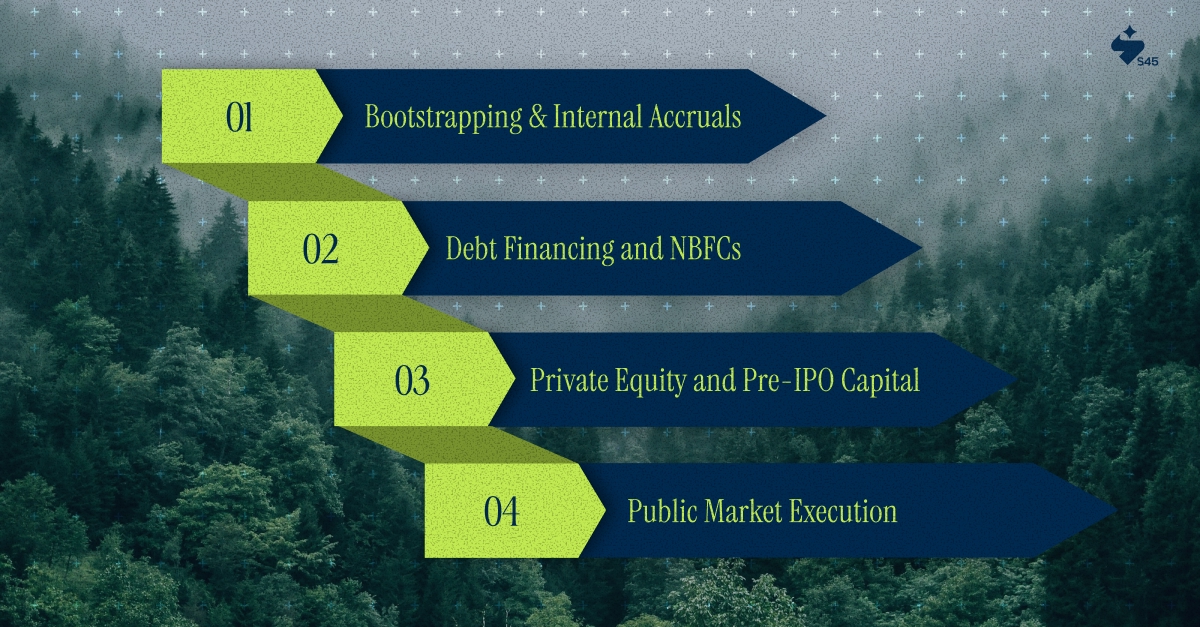
The Funding Lifecycle for Indian Enterprises:
New venture finance and startup funding for entrepreneurs in India follows a reasonably predictable arc, though mid-market companies often enter it from the middle rather than the beginning:
Most Indian SMEs and family-run enterprises fund their early growth through reinvested profits and promoter capital. This is not a limitation; it is often the foundation for the clean balance sheet that public markets later reward.
Working capital lines, term loans, and structured debt from banks and NBFCs constitute the dominant financing layer for companies with Rs. 80-500 crore in revenue. The quality of this debt structure, concentration, tenure, and collateral, becomes directly visible in the DRHP and is scrutinized by institutional investors during IPO roadshows.
Growth-stage PE firms and pre-IPO investors are increasingly active in the Indian mid-market. Deals in this range typically involve minority stakes with governance rights, board representation, and exit clauses tied to a listing event.
Whether through BSE SME, NSE Emerge, or the Main Board, the IPO is not just a fundraise; it is a transformation of the company's capital structure, governance architecture, and public accountability framework.
Understanding this stack is foundational to new venture finance and startup funding for entrepreneurs who want to build toward the public markets rather than simply raise money opportunistically.
One of the most persistent misconceptions in Indian capital markets is that SEBI compliance is a box-checking exercise, something your legal team handles in the final stages of preparation.
This misunderstanding is expensive.
The SEBI (Issue of Capital and Disclosure Requirements) Regulations, 2018, commonly referred to as ICDR, establish the foundational documentation and disclosure architecture for all Indian IPOs. The SEBI (Listing Obligations and Disclosure Requirements) Regulations, 2015, LODR, govern ongoing obligations post-listing.
For SME listings specifically, SEBI's December 2024 amendments introduced significant tightening:
These are not bureaucratic hurdles. They are signals of what institutional investors and SEBI expect: stable profitability, responsible capital deployment, and promoter commitment to the long term.
Founders who begin engaging with SEBI requirements only after hiring a merchant banker consistently face the same set of problems:
Each of these issues is resolvable. None of them is easy to resolve under a listing timeline. Companies that treat regulatory architecture as a design input, not a post-hoc fix, move through the process faster and with fewer bruises.
The concept of evidence-linked growth is central to how institutional capital evaluates Indian enterprises. Whether you are negotiating with a PE firm at Series B or sitting across from SEBI reviewers during DRHP scrutiny, the standard is the same: every claim must be traceable to a verifiable source.
This is not about having clean financials. It is about having a documentation ecosystem where:
Institutional investors, QIBs, anchor investors, and FIIs conduct rigorous due diligence. They will find the gaps between what is claimed and what is documented. Finding those gaps before SEBI does, and before the roadshow begins, is the difference between a clean listing and a corrected one.
This discipline applies equally to new venture finance and startup funding for entrepreneurs at earlier stages. A PE firm evaluating a pre-IPO investment is essentially running a lighter version of the same scrutiny. The companies that build evidence infrastructure early, from accurate MIS reporting to structured board minutes, arrive at IPO prep with a six-month head start.
Suggested Read: How Much Funding Does a Startup Need in India?
The conversation about AI in investment banking has been plagued by vagueness. Generative AI is described as "transformative" and "disruptive" without specifying exactly what it changes and what it does not.
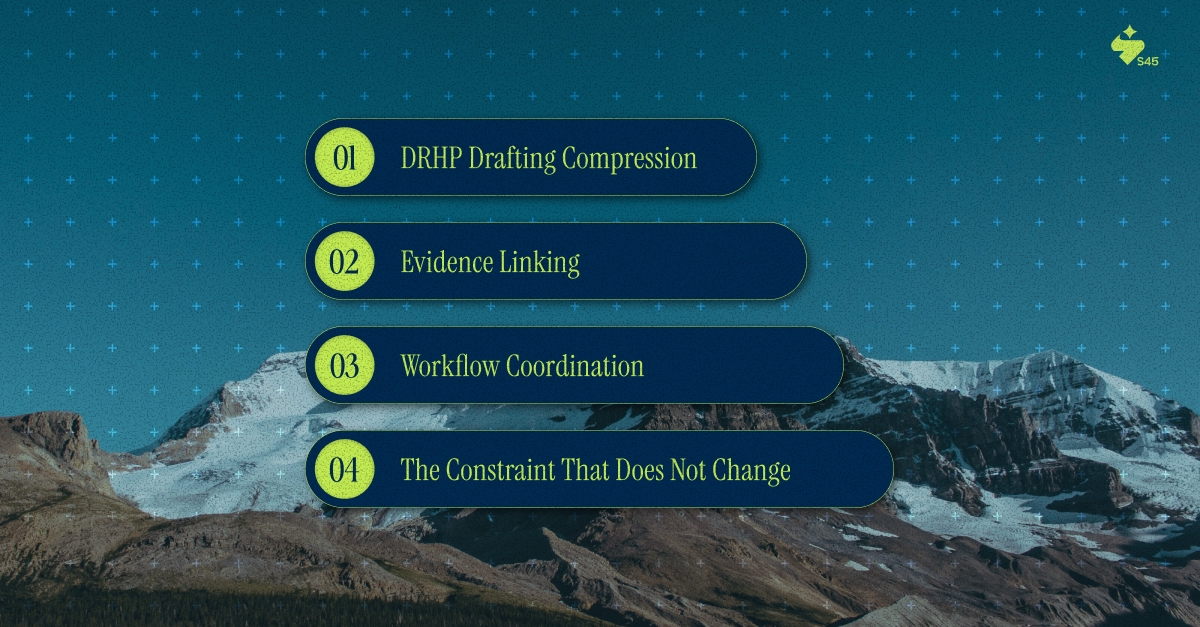
The honest answer, from an execution standpoint, is more limited and more useful.
AI-assisted drafting tools can accelerate the production of DRHP sections, risk factors, business descriptions, and financial summaries by drawing on structured data sources and prior regulatory filings. What previously required six to eight weeks of drafting can be compressed to two to three weeks when the underlying data is well-organized, and the AI system is calibrated to SEBI ICDR requirements.
AI systems trained on SEBI disclosure patterns can flag inconsistencies between financial data and narrative disclosures before human reviewers catch them. This reduces SEBI comment cycles and shortens the overall approval timeline.
Multi-party IPO preparation, involving auditors, legal counsel, merchant bankers, and company management, generates enormous volumes of documentation that must be version-controlled and cross-referenced. AI-driven workflow tools eliminate the manual coordination overhead that typically causes two- to four-week delays during mid-preparation.
AI cannot replace banker judgment on pricing logic, cannot navigate the human dynamics of SEBI comment responses, and cannot design a liquidity architecture for post-listing trading. These require experienced sector bankers who have sat in the room when an IPO breaks and know exactly what to do next.
The architecture that works is AI for operational leverage, banker judgment for outcome ownership. Firms that lead with AI as a product feature without the institutional depth to back it up are selling infrastructure theatre, not capital markets execution.
Most IPO preparation discussions end at listing. The question of what happens to the company's capital structure, shareholder base, and trading liquidity after listing day is treated as someone else's problem.
It is not.
The price band set during book-building is not just a transaction number. It establishes:
For SME Exchange listings specifically, where market-making is mandatory for three years post-listing under SEBI regulations, the liquidity design question is even more consequential. Companies that list with underdeveloped secondary-market architecture, a thin float, concentrated retail ownership, and no institutional anchor often end up with a technically successful IPO and a practically illiquid stock.
Pricing discipline is not about leaving money on the table. It is about building a capital structure that supports the company's next fundraising, whether that is a QIP, a rights issue, or a migration to the Main Board.
The phrase "end-to-end IPO support" has been cheapened by overuse. Every merchant banker in India claims it. The operational reality differs significantly.
Full-cycle execution, in the sense that matters for founders navigating new venture finance and startup funding for entrepreneurs in the public markets, means:
Before committing to a listing timeline, a structured readiness assessment identifies the specific gaps in financial documentation, governance architecture, regulatory compliance posture, and capital structure that will create friction during DRHP preparation or SEBI review. This is not a high-level health check; it is a forensic gap analysis with a prioritized remediation plan and a realistic timeline.
The DRHP is not a marketing document. It is a legal instrument that serves as the foundation for every investor's decision and every regulatory interaction throughout the IPO process and beyond. AI-assisted drafting, when combined with institutional banker review, compresses the timeline from mandate to DRHP filing from four to six months to thirty to forty-five days.
The choice between BSE SME, NSE Emerge, and the Main Board is not purely a size decision. It is a strategic capital structure decision that affects promoter dilution, post-listing governance obligations, and future fundraising optionality. Companies in the Rs. 80-300 crore revenue range have legitimate reasons to consider both tracks, and the decision requires sector-specific comparables rather than generic advice.
Building the anchor investor book, managing the retail and QIB allocation balance, designing the post-listing liquidity infrastructure, and coordinating with market makers are the elements that determine whether a listing creates durable institutional value or a one-day price event with no follow-through.
S45's operating model is built around owning these outcomes from readiness through liquidity, not handing off at DRHP filing and calling it done.
The emotional cost of IPO preparation is real and largely undiscussed.
Founders who have built companies for ten, fifteen, or twenty years are asked during the IPO process to compress their story into a regulatory document that strips nuance in favour of precise disclosure. They are asked to accept governance structures, independent directors, audit committees, and SEBI reporting obligations that feel like constraints on the control that got them to this point.
They are not wrong to feel the tension. They are wrong to let it become a source of resistance.
One of the most common IPO preparation failures is the founder who intuitively understands that something is wrong with how the process is being managed but lacks the institutional framework to diagnose and correct it. This founder delays decisions, questions every draft, and ultimately extends the preparation timeline by months, not out of bad faith, but out of unresolved anxiety about losing narrative control.
The resolution is not reassurance. It is information architecture. Founders who are given a complete, honest picture of where their company's documentation gaps are, what the specific SEBI risk exposure is, and what the realistic pricing range looks like based on sector comparables, consistently make faster and better decisions than founders who are managed.
The banker's job is not to protect the founder from uncomfortable information. It is to deliver it clearly and help structure the response.
New venture finance and startup funding for entrepreneurs in India has entered a phase of meaningful sophistication. The public markets, and particularly the SME Exchange ecosystem, represent a viable, strategically important capital destination for mid-market Indian enterprises that have historically been underserved by both venture capital and traditional investment banking.
But sophistication cuts both ways. SEBI's tightening of SME IPO norms, the increasing scrutiny of institutional investors, and the compressing windows of favorable market conditions mean that companies approaching public markets without institutional-grade preparation are facing longer timelines, more comment cycles, and worse pricing outcomes than their preparation-disciplined counterparts.
The core disciplines remain consistent: evidence architecture over narrative ambition, regulatory design as a structural input rather than a final-hour checklist, and pricing logic built on comparable data rather than founder aspiration.
If your enterprise is in the Rs. 80-800 crore revenue range and public markets are a credible two-to-four year horizon, the preparation conversation should be happening now, not when the merchant banker is engaged.
Connect with S45 for an IPO Readiness Scan. Before committing a year of management bandwidth and organizational capital to the listing process, get an institutional-grade assessment of exactly where you stand, what needs to change, and what a realistic timeline looks like.
Discover more insights on similar topics