
March 23, 202610 min read
How Professionals Moving from Consulting to Private Equity Institutionalize Mid-Market Firms
By Aman Singh
Growth & Development

Business growth often depends on a company’s ability to evolve, adapt, and expand with discipline. Mergers and acquisitions (M&A) enable this evolution by helping businesses combine strengths, acquire new capabilities, and create long-term value.
When executed with the right strategy and governance, M&A can:
This article explores how well-planned M&A strategies can support sustainable, scalable growth for Indian enterprises, while highlighting both advantages and challenges.
To appreciate the benefits, let us begin with the basics.
A merger takes place when two or more companies unite to form a single, stronger organisation.
An acquisition occurs when one company purchases another to gain control, access to technology, or enter a new market.
Companies pursue mergers and acquisitions to:
Type | Purpose | Example Scenario |
Horizontal Merger | Combine competitors in the same sector | Two textile exporters merge to expand global market share |
Vertical Merger | Integrate different stages of the value chain | A manufacturer acquires a distributor to control delivery timelines |
Conglomerate Merger | Diversify across unrelated industries | A food processing firm acquires a packaging company |
India’s growing economy, policy reforms, and increasing institutional participation have made M&A a preferred growth path for ambitious SMEs.
These transactions are no longer limited to large corporations; mid-sized enterprises are increasingly adopting M&A to strengthen governance, scale efficiently, and prepare for IPO-readiness.
Also Read: Indian Startup Valuations and Funding Trends
Mergers and acquisitions are powerful tools for transformation. They allow businesses to combine strengths, reduce inefficiencies, and accelerate growth without losing strategic control.
Below are some of the most significant benefits of mergers and acquisitions, particularly relevant for Indian enterprises seeking to build sustainable, long-term scale.
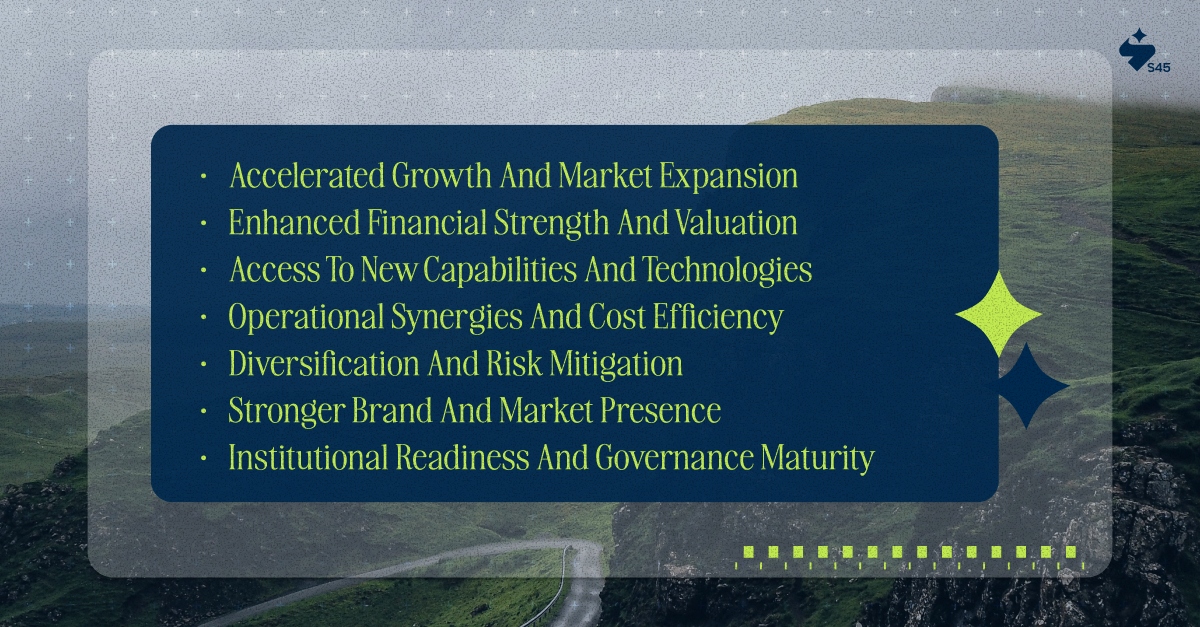
M&A provides an immediate pathway for expansion that would otherwise take years to achieve through organic means.
Key advantages include:
Example: A mid-sized engineering firm is acquiring a regional competitor to strengthen its footprint across South India.
At S45 Club, founders are guided to evaluate such expansion opportunities with structured due diligence and sustainable scaling frameworks, ensuring growth is strategic, not speculative.
When two financially sound businesses merge, they create stronger balance sheets and improved access to capital.
Key outcomes:
For SMEs, these advantages are critical when preparing for IPOs or institutional partnerships.
Also Read: How to Achieve Sustainable Business Growth Strategies
Many mergers and acquisitions are driven by the need to innovate.
M&A helps businesses:
Capability Area | How M&A Adds Value |
Technology | Adopts advanced solutions faster |
Talent | Gains experienced professionals |
Research & Development | Speeds up innovation |
Operations | Introduces efficient, scalable processes |
Through its mentorship network, S45 Club connects entrepreneurs with sector experts who help evaluate capability-driven M&A opportunities, aligning them with long-term growth goals.
Combining complementary resources often results in cost reduction and better utilisation of assets.
Operational synergies can emerge in:
These efficiencies help businesses maintain profitability even while expanding.
Example: A food manufacturer is acquiring a packaging supplier to reduce dependency and production delays, improving margins and delivery timelines.
M&A allows companies to diversify into new sectors or markets, reducing dependency on a single revenue source.
Benefits include:
Diversified firms often show stronger resilience and investor appeal, especially in cyclical industries like manufacturing and trading.
M&A can enhance brand perception and market dominance by combining credibility, visibility, and reach.
Key outcomes:
With the right positioning, guided by platforms such as S45 Club, founders can use M&A to strengthen brand trust while retaining their company’s legacy.
Perhaps one of the most valuable benefits is the opportunity to build robust governance frameworks.
Post-merger integration often encourages:
For SMEs preparing to transition toward institutional or public markets, this maturity is essential.
While mergers and acquisitions offer many advantages, they also bring complexities that require foresight and planning. Understanding these challenges helps businesses prepare better and sustain value after the deal.
When two organisations come together, their cultures, management styles, and values may differ.
Common issues include:
If left unaddressed, these factors can slow integration and reduce overall efficiency.
M&A success depends on how effectively the two entities integrate operations, systems, and people.
Integration gaps can appear in:
Platforms such as S45 Club help entrepreneurs plan integration phases through structured governance models and experienced mentors, ensuring post-merger alignment from day one.
In some cases, businesses expect more value from the merger than is realistic.
This may result in:
Accurate due diligence and realistic forecasting are essential before finalising the transaction.
Financing mergers or acquisitions can stretch working capital or create short-term cash flow pressure.
Typical risks include:
Every merger or acquisition must comply with legal, tax, and competition regulations.
Key compliance challenges:
At S45 Club, founders are encouraged to treat governance as a value multiplier, not a hurdle. The platform’s network of legal and financial advisors helps SMEs approach compliance proactively and confidently.
Acknowledging these challenges allows entrepreneurs to navigate M&A with awareness and discipline, transforming potential risks into structured learning opportunities.
Also Read: SME Growth and Challenges in India Over Last Decade
The success of any merger or acquisition depends on what happens after the agreement. Effective planning, governance, and integration are crucial to convert potential into lasting performance.
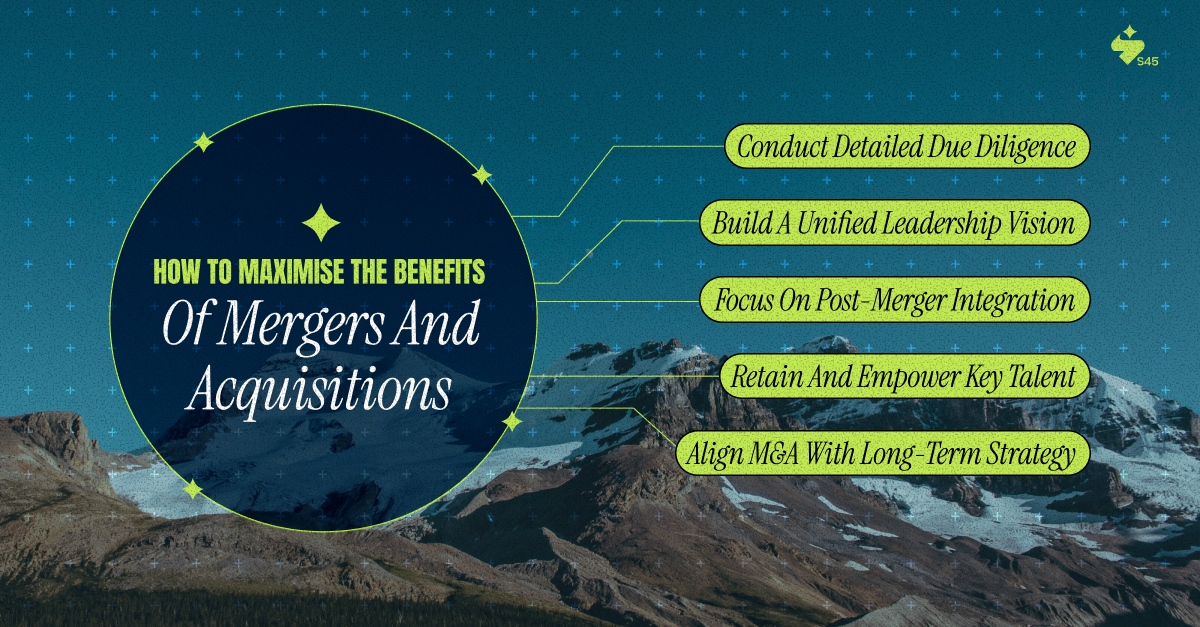
Thorough due diligence protects both buyer and seller. It should assess:
Leadership unity determines the pace of integration.
Steps to strengthen alignment:
Integration begins before the deal closes.
Best practices include:
Integration Focus | Action Step |
Governance | Establish joint oversight teams |
Finance | Consolidate systems and controls |
Culture | Encourage collaboration and shared goals |
Operations | Harmonise production and delivery processes |
Human capital is often an overlooked success factor. To maintain continuity:
Each merger or acquisition should fit within the company’s strategic roadmap.
Questions leaders should ask:
Through its mentorship and capital frameworks, S45 Club helps entrepreneurs align short-term transactions with long-term strategic vision, ensuring that every decision contributes to scalable, sustainable growth.
M&A success relies on disciplined execution, strong leadership, and clear communication. When supported by structure and expert guidance, it becomes a transformative tool for purposeful, lasting growth.
While large-scale mergers often dominate headlines, they offer valuable insights for growth-oriented businesses.
Learning Point | Relevance to SMEs |
Strategic Fit | Ensure the target business strengthens your roadmap and core strengths |
Governance Upgrade | Use the deal as a catalyst to raise governance, leadership, and investor readiness |
Brand & Market Leverage | Combine assets to strengthen presence, credibility, and scale |
Mergers and acquisitions are powerful strategic tools when approached with clarity, purpose, and discipline. For businesses seeking scale, the right M&A move can deliver market expansion, stronger capabilities, improved governance, and investor appeal.
Equally, the journey demands enlightened leadership, rigorous planning, and integration capability.
As you consider an M&A pathway, keep the following in view:
If you are an entrepreneur ready to elevate your business and build a legacy, we at S45 Club stand ready to guide you, from base camp to global heights.
Discover more insights on similar topics