
March 23, 202610 min read
How Professionals Moving from Consulting to Private Equity Institutionalize Mid-Market Firms
By Aman Singh
Growth & Development

Have you ever felt that running a growing business leaves you with more questions than answers?
In India, about 21% of mid-sized and large consumer companies now use advisory boards to bring external expertise into decision-making.
Rapid growth brings new challenges like financial planning, scaling teams, and managing risks, which internal resources alone can’t always solve.
This is where the business advisory committees step in, offering structured guidance without the binding authority of a formal board.
In this guide, you’ll learn the functions of a business advisory committee, why they matter, and what to avoid.
A business advisory committee is a group of external experts and professionals who guide leaders on key decisions. Unlike the Board of Directors, they do not have governance power or legal responsibility.
While boards focus on compliance, accountability, and protecting shareholders, advisory committees support strategy, operations, and leadership with flexible, experience-driven input. It makes them especially useful for SMEs and startups, which often create such committees to shape growth strategies, search for new markets, or refine business models.
By combining external knowledge with internal vision, advisory committees act as a sounding board for founders and managers. They provide clarity without the rigid structures of governance. Now, let’s understand their functions in driving sustainable business success.
A business advisory committee is a sounding board for leaders. The functions of a business advisory committee support growth by offering structured advice across multiple areas that influence performance, culture, and sustainability.
Here are the 10 major functions of a business advisory committee and how they work in practice:
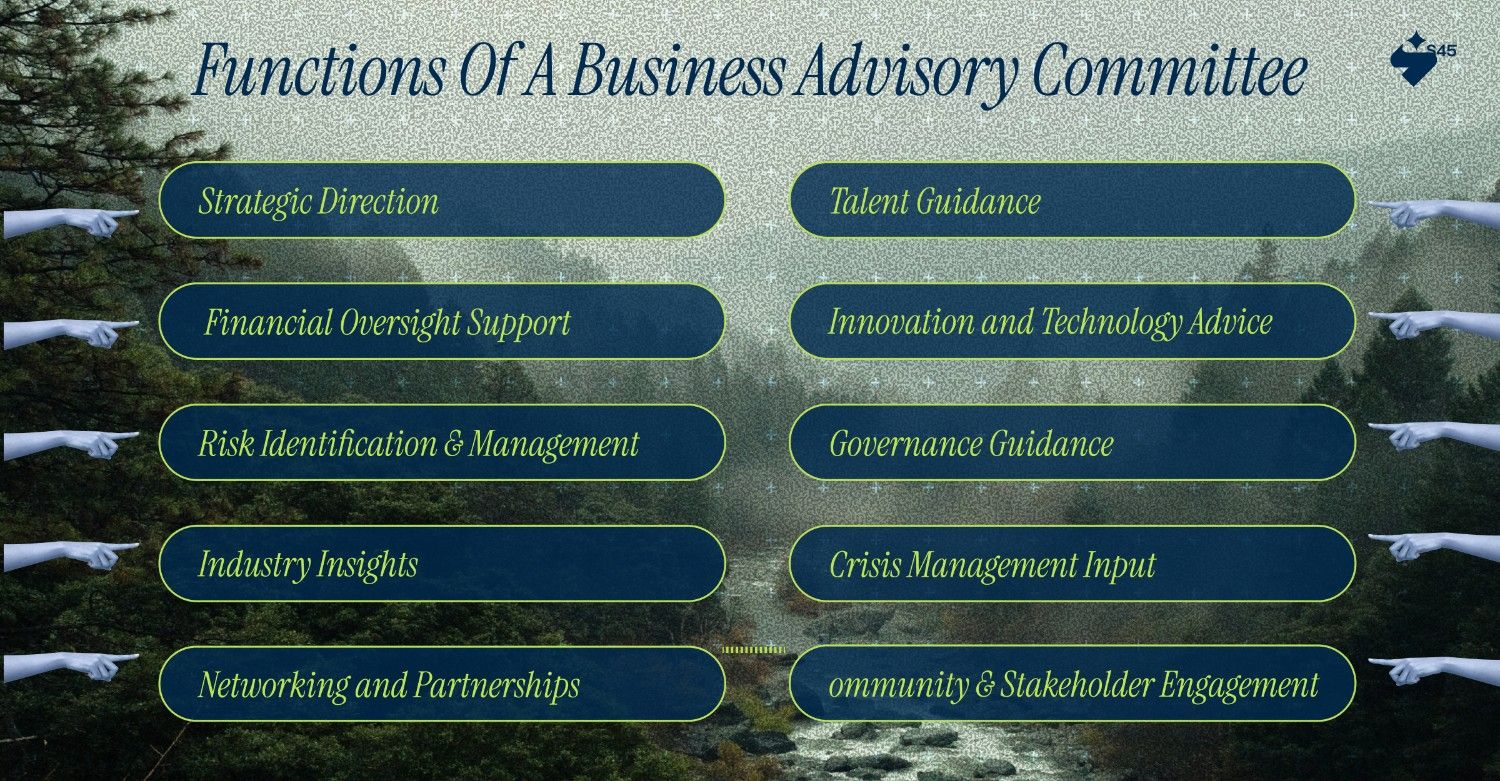
One of the key functions of a business advisory committee is shaping long-term direction and assessing realistic paths to achieve it. They don’t make the decisions but provide external views that prevent tunnel vision.
For instance, they might highlight overlooked opportunities in regional expansion or diversification. By questioning assumptions, they sharpen the company’s positioning in competitive markets.
Among the functions of a business advisory committee, guiding financial discipline is central. They review budgets, suggest capital allocation strategies, and flag risks in overspending. Committees also bring in best practices from other industries.
This guidance ensures businesses sustain profitability while balancing growth investments, avoiding costly missteps that often emerge from unchecked financial optimism.
Advisors spot risks that leadership may underestimate regulatory changes, supply chain issues, or shifting consumer behaviors. They offer structured frameworks for managing these risks, including contingency planning and scenario mapping.
Their external lens allows companies to prepare for shocks with practical solutions rather than reacting late, when options are limited.
Advisory committees contribute deep market knowledge gained from years in the sector. They interpret shifts in consumer preferences, competitor strategies, and global influences. Unlike consultants, their role is to ensure businesses stay informed.
It helps leaders refine positioning, look for new products, or time expansions with confidence backed by relevant insights.
Advisors often bring a valuable professional network. They can introduce businesses to investors, suppliers, distributors, or strategic collaborators. These connections are not casual; they are carefully recommended based on business needs.
Such partnerships accelerate growth, provide financial support, or open new markets, giving companies access that might otherwise take years to build.
One of the practical functions of a business advisory committee is guiding talent strategy. Advisory committees provide direction on hiring strategies, leadership training, and even succession planning.
They may suggest organizational changes to strengthen teams or recommend external professionals for key roles. Their focus is on aligning talent with long-term business strategy, not just immediate vacancies.
Staying relevant requires adopting new tools and practices. Advisors guide companies on emerging technologies, digital adoption, or product innovations.
Their role includes evaluating ROI on tech investments and advising on risks of delay. It ensures leaders don’t chase every trend but adopt solutions that truly support growth and competitiveness.
Committees advise leaders on adopting governance practices without formal oversight. They suggest ways to strengthen transparency, reporting standards, and accountability.
For SMEs, they introduce simple frameworks that prepare them for future scaling or investor scrutiny. By building discipline early, companies avoid governance issues that derail expansion later.
During downturns or sudden disruptions, advisory committees provide calm, external judgment. They draw on prior experiences to suggest actions leaders may not see in stressful times. Whether renegotiating contracts, restructuring operations, or revisiting financial priorities, their input helps businesses stabilize and recover with less damage to reputation or finances.
Many businesses overlook the importance of reputation with customers, regulators, and local communities. Advisory committees ensure companies build credibility by guiding corporate social responsibility, ethical practices, and stakeholder communication.
They help strike a balance between commercial goals and community trust, which supports long-term brand strength and loyalty.
Understanding the diverse functions of a business advisory committee provides leaders with foresight, discipline, and a fresh perspective. Platforms like S45 connect founders with sector-focused advisors, ensuring insights translate into actionable, growth-oriented decisions without disrupting daily management.
This balance of external insight and internal execution naturally brings us to the challenges businesses face in running such committees effectively.
Running an advisory committee is not without its hurdles. While external experts bring perspective, maintaining structure and trust requires effort. Without careful planning, the committee may drift into inefficiency or even create friction with leadership. Understanding the common challenges helps businesses build stronger, more effective committees.
Here are a few core challenges and how they can be addressed:
The root issue is advisors treating meetings as a formality rather than a meaningful contribution. Passive involvement dilutes the committee’s value. Clear agendas, defined roles, and accountability mechanisms ensure every advisor’s expertise is tapped.
Encouraging open dialogue and measuring the impact of advice keeps members engaged and committed to the business’s success.
A recurring problem arises when advisors overstep, blurring the line between guiding and managing. It can strain relationships with leadership. To avoid conflict, businesses must define boundaries early.
A clear charter that distinguishes advisory input from executional authority ensures that committees support, rather than compete with, management teams.
Advisory committees require honorariums, logistics, and time from leadership. For SMEs, it can feel like a heavy expense. The solution is aligning committee size and expertise with actual needs.
Rotating advisors periodically and using virtual formats reduces costs without undermining access to vital expertise or informed decision-making.
The root challenge lies in sharing sensitive business data with external advisors. Without trust, openness is compromised, limiting effectiveness. Companies must implement confidentiality agreements and establish strong governance norms.
By building a culture of mutual respect, businesses protect sensitive information while benefiting from candid, honest feedback from advisors.
Advisors may push ideas based on personal experiences, which can conflict with company priorities. Misalignment creates confusion and wasted effort.
Regular strategy alignment sessions and structured feedback loops help sync committee advice with leadership objectives, ensuring recommendations stay actionable, realistic, and directly tied to business growth ambitions.
Advisory committees are most effective when challenges are recognized and managed early. Addressing these issues transforms potential friction into long-term strength. Now, let’s see how platforms like S45 can support leaders in building committees that actually work.
S45 is a capital structuring platform for growth-stage SMEs with ₹100 Cr+ revenue or ₹10 Cr+ profit. It focuses on helping businesses build sustainable financial systems and connect with experts who can guide scaling decisions. Unlike one-off consultants, S45 provides structured, long-term support customized to the founder's needs.
To make advisory committees effective, S45 ensures SMEs don’t just form them but run them with purpose. Here’s how we assist:
As an added advantage, S45 Club for Founders offers a peer community where SME leaders exchange experiences, learn from successful peers, and access curated insights that complement their advisory committees.
Strong committees can shape a company’s growth story. With S45, SMEs gain the right experts, structure, and discipline to make them effective. Book a free demo today.
The functions of a business advisory committee go beyond surface-level guidance. They include shaping strategic direction, identifying risks, offering financial oversight, and guiding talent decisions. These inputs help SMEs sharpen execution and open new opportunities.
The benefits are clear: access to diverse expertise, stronger credibility, and long-term resilience. At the same time, risks such as added costs, misaligned advice, or confidentiality breaches must be managed with care.
The true value emerges when the functions of a business advisory committee are backed by planning, the right mix of experts, and alignment with business goals. Done well, such a committee can transform decision-making and scale growth with confidence.
As an SME founder, are you struggling to balance expert advice with execution? S45 can help you set up advisory committees that don’t just talk; they accelerate growth and credibility. Connect with our experts today.
Discover more insights on similar topics