
April 9, 202611 min read
Valuation of Alternative Investments: What an IPO-Bound Founder Must Know
By Aman Singh
IPO

Disclaimer: This content is for educational purposes only and should not be considered as financial advice. Every business situation is unique, and we recommend consulting with qualified financial advisors before making important business decisions.
If you are preparing your enterprise for the public markets, you already know where the process gets chaotic. Data rooms built on spreadsheets. Advisors who draft sections independently, without coordination. Disclosures that are technically accurate but institutionally weak. Months spent on filings that should have taken weeks.
Institutional investors, by definition, are not retail participants making bets. They are professionally managed entities running due diligence infrastructure that is frequently more rigorous than anything a mid-market Indian company has faced before. When your DRHP lands in front of a qualified institutional buyer's analyst team, they are not reading for inspiration. They are reading for evidence, traceability, and structural logic.
The gap between a company that is "growing well" and a company that is "institutionally ready" is not a valuation gap. It is a documentation and workflow gap. Getting that wrong costs you the institutional interest you cannot afford to lose.
This blog breaks down what it actually takes to close that gap. From structuring disclosures to building evidence-backed narratives and aligning workflows across stakeholders, the focus is on how companies can move from operational readiness to true institutional readiness, where every number, claim, and document stands up to scrutiny.
Institutional funding refers to capital deployed into a company by large, professionally managed entities that invest on behalf of their own members, clients, or beneficiaries. Institutional investors are companies or organizations that manage and invest funds on behalf of others, pooling money from different entities and investing to generate positive returns.
What distinguishes this category from retail or individual investment is not just scale. It is the decision-making framework behind the capital. Institutional investors use proprietary research, sector analysts, risk models, and governance filters before deploying a rupee. Their involvement sends a market signal. Their absence sends an equally loud one.
For an Indian enterprise on the path to an IPO, institutional funding is not a destination. It is a test of whether your enterprise has been built to institutional standards.
Institutional capital does not behave like opportunistic or retail money; it follows a structured process shaped by timing, validation, and access. Understanding these underlying dynamics helps founders and CFOs prepare more strategically, rather than reacting during the IPO process.
Understanding the types of institutional funding is not an academic exercise. For a founder preparing for a Main Board or SME Exchange listing, these categories directly map to who will own your stock, at what price, with what lock-in obligations, and with what post-listing behavior.
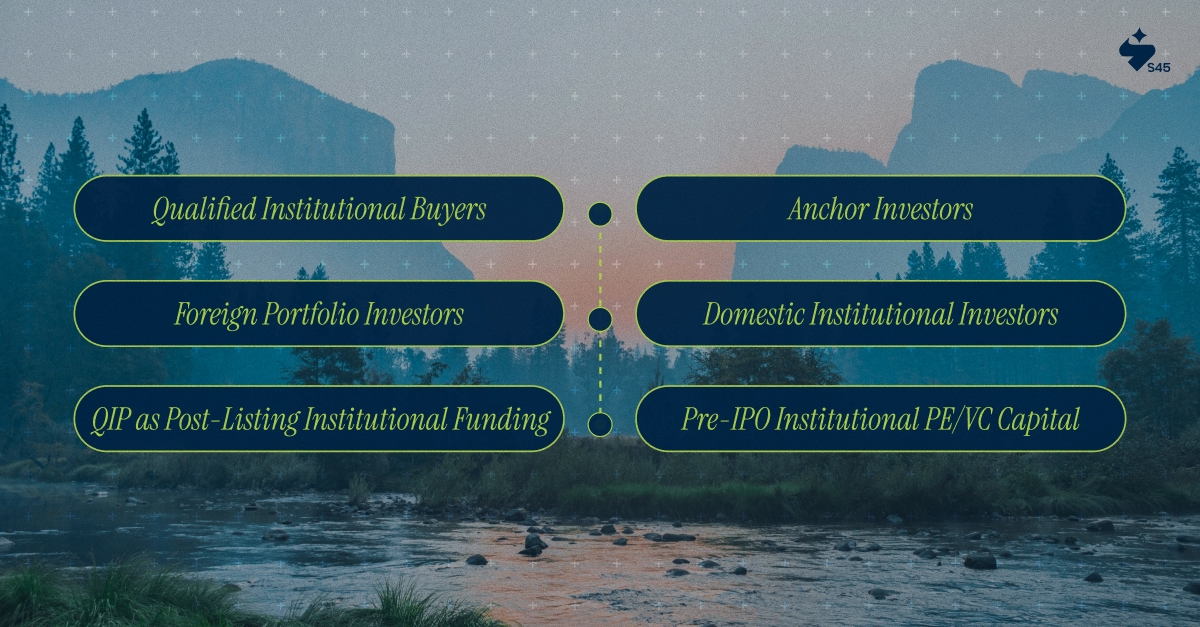
QIBs are the most consequential category of institutional funding in the IPO process. Institutional investors such as mutual funds, pension funds, insurance companies, and banks are collectively classified as Qualified Institutional Buyers in India, and they must be registered with SEBI.
Their participation is not discretionary from a regulatory standpoint. In IPOs, at least 50% of the issue size is reserved for QIBs. This means that for any book-built IPO in India, institutional funding is literally baked into the capital structure by regulation.
Key characteristics:
For the founder, QIB subscription levels are the single most-watched metric during an IPO. An under-subscribed QIB book is not just a capital shortfall. It is a public signal of institutional scepticism.
Anchor investors are a distinct and strategically critical subset of QIBs. They invest one day before the public issue opens, at a fixed price, and their commitment is designed to establish market confidence before retail participation begins.
Securing strong anchor investor participation requires more than a compelling business story. It requires an institutionally credible DRHP, a defensible pricing rationale, and a banker relationship that can get your file in front of the right institutional desks at the right time.
FPIs represent overseas institutional capital entering Indian public markets. They are registered with SEBI and operate within defined regulatory parameters. Statutory agencies in India, such as SEBI, have prescribed norms for registering FIIs and for regulating such investments flowing through them.
FPI participation in an IPO adds cross-border credibility to the offering. For mid-market Indian enterprises, meaningful FPI interest at the DRHP stage is not automatic. It requires sectoral visibility, high-quality governance, and a disclosure standard that reads well for international analysts.
DIIs are institutions registered and operating within India. Types of DIIs in India range from traditional players, such as banks and insurance companies, to modern players, such as mutual funds, venture capital, and private equity firms.
In practice, DII participation in an IPO includes:
DII and FPI flows together constitute the institutional participation that every public market CFO and promoter must track. Their combined behavior defines secondary-market liquidity after listing.
QIP is not a pre-IPO mechanism. It is relevant for companies already listed and seeking to raise additional capital from institutional investors without a full public process. QIP is an SEBI-regulated capital-raising method that allows Indian listed companies to issue shares or convertible securities to QIBs through private placement, introduced to reduce dependence on foreign funding and to simplify access to capital.
For CFOs planning the long arc of a listing strategy, QIP represents the post-IPO institutional funding runway. Designing for QIP eligibility begins at the DRHP stage, not after listing.
Before the public markets come into the picture, institutional funding often arrives in the form of PE and VC investment. These investors are not just capital providers. They are governance architects who shape board composition, financial reporting standards, and promoter accountability structures.
For a company targeting an IPO, the quality of pre-IPO institutional investors on the cap table directly influences how QIBs and anchor investors evaluate the offering. A well-structured PE-backed company that approaches an IPO with audited financials, clean promoter disclosures, and a professionally governed board is fundamentally more investable than an equally profitable company that has never faced institutional scrutiny.
This is where founders consistently underestimate the stakes.
Institutional funding does not flow to companies with good businesses. It flows to companies that can prove they have good businesses, in a format that institutional analysts can verify, model, and defend to their own investment committees.
In the DRHP, institutional investors look for:
This is where execution quality at the DRHP stage directly determines institutional interest at the bidding stage. Weak drafting does not just attract SEBI comments. It keeps institutional desks from taking the file seriously.
S45's AI-driven DRHP drafting model is engineered specifically to address this problem, compressing the time from mandate to an institutionally credible DRHP while maintaining the evidence linkage that institutional investors require.
Founders who treat SEBI's ICDR and LODR frameworks as procedural checkboxes consistently pay for it later. Compliance is not a cost centre in an IPO. It is the foundation on which institutional confidence is built.
When institutional investors evaluate a DRHP, they are partly evaluating the quality of the compliance infrastructure behind it. A disclosure framework that is precise, well-structured, and internally consistent signals that the management team understands what they are committing to as a public company.
Founders who engage compliance late in the process routinely face:
Institutional clarity does not come from adding more disclosures. It comes from building a disclosure architecture that is traceable, consistent, and reflective of how the business actually operates.
Institutional funding does not arrive because your business deserves it. It arrives because your enterprise has been structured, documented, and presented in a way that institutional decision-makers can trust.
For Indian promoters and CFOs in the Rs. 80 to 800 crore revenue range, the path to institutional capital runs directly through execution quality. The DRHP is not a filing. It is the first institutional product your company has ever released to the market. It will be read by analysts who have seen hundreds of DRHPs. It will be judged against the evidence standard that sophisticated capital demands.
The founders who attract strong institutional participation are not always those with the best businesses. They are those who built their IPO process with institutional-grade precision from the start.
If you are evaluating whether your enterprise is genuinely ready for the public markets and the institutional scrutiny that follows, connect with S45 for the IPO Readiness Scan, designed to give you the clarity you need before you commit to months of work.
Discover more insights on similar topics