
March 9, 202610 min read
How Mergers and Acquisitions Reshape Indian Companies: A Capital Markets Perspective
By Aman Singh
Finance Advice

Disclaimer: This content is for educational purposes only and should not be considered as financial advice. Every business situation is unique, and we recommend consulting with qualified financial advisors before making important business decisions.
Financially viable arbitration claims get abandoned in India every year. Not because they lack merit. Because they lack capital. Legal fees, arbitrator charges, and institutional costs accumulate fast, and most enterprises quietly absorb the loss rather than pursue what they are owed.
Third-party funding in arbitration exists to close that gap. A non-party funder covers your dispute costs and takes a share of the award if you win. If you lose, the funder bears the loss. The structure is non-recourse, commercially rational, and judicially accepted in India.
But "accepted" is not the same as "regulated". TPF in India sits in a grey zone: court-legitimized, legislatively unaddressed, and contractually under-defined. That gap is where enterprises are exposed: engaging funders without understanding disclosure obligations, conflict triggers, or confidentiality risks.
To turn a legal claim into a viable financial asset, one must move past the concept and into the structural mechanics of how these deals are built.
Third-party funding (TPF) is a financial arrangement in which an external entity, not a party to the underlying dispute, provides capital to cover the costs of arbitration proceedings in exchange for a share of the monetary award or settlement, if the funded party succeeds.
The transaction typically takes one of three forms:
Funding covers legal fees, arbitrator charges, institutional administration costs, expert witness fees, and, in some cases, adverse cost exposure. The arrangement is generally non-recourse — meaning if the claim fails, the funder bears the loss.
In addition to specialized third-party funders, other parties who invest in legal claims as an asset class include investment banks, hedge funds, insurance companies, family offices, private equity funds, group companies, and pension funds. In India, dedicated litigation finance firms like LitiCap and Legal Pay have emerged alongside international funders like Burford Capital operating in larger cross-border disputes.
The commercial logic is straightforward: funders evaluate claims for merit, recoverability, and return profile. They function like underwriters, assessing risk on a case-by-case basis before committing capital.
Treating a legal claim as a balance sheet asset requires the same rigorous evidence architecture used in institutional capital raises. S45 provides this execution framework, ensuring that the data rooms and documentation used to attract professional funders are structured to withstand both rigorous due diligence and eventual regulatory scrutiny.
India lacks a standalone statute governing third-party funding in arbitration. There is no special law for TPF, so it is mostly controlled by the Contract Act of 1872. What India does have is a body of judicial precedent that has gradually, if cautiously, legitimized the practice.
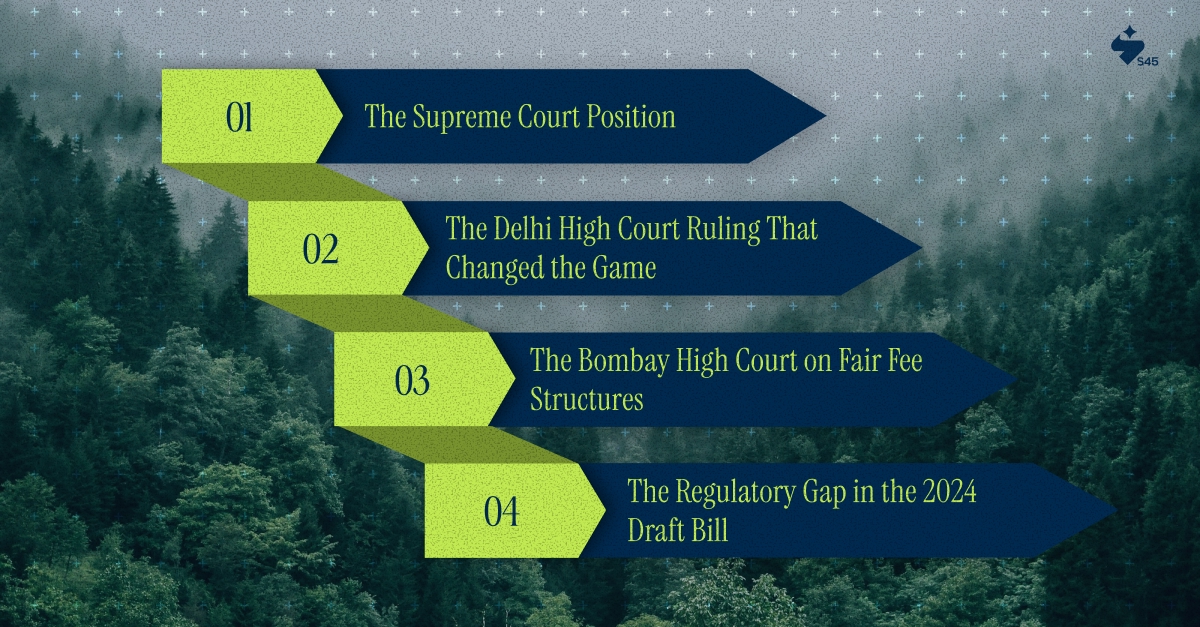
The Hon'ble Supreme Court in Bar Council of India v. A.K. Balaji & Ors. held that a lawyer is forbidden from financing his client's claim, but "there appears to be no restriction on third parties (non-lawyers) funding the litigation and getting repaid after the outcome of the litigation." This remains the foundational judicial position on TPF in India.
In Tomorrow Sales Agency v. SBS Holdings, the Delhi High Court ruled that a third-party funder was not liable to pay an adverse cost award on the basis that it was not a party to the arbitration agreement. The dispute arose from an SIAC arbitration valued at approximately USD 48 million, in which the claimants were funded by a third party. When the claimants lost and could not pay the respondents' costs, the respondents sought to recover those costs directly from the funder. The Court declined.
This decision is significant as it indicates that third-party arbitration funding is not impermissible in India and is a key aspect of the legal ecosystem.
The Bombay High Court, in Harilal Nathalal Talati v. Bhailal Pranlal Shah, reinforced that while TPF was legal, agreements that offered disproportionate returns to funders were invalid as "opposed to public policy." This positions the Indian judiciary as willing to police abusive funding structures, even in the absence of specific legislation.
Despite the growing relevance of TPF in arbitration and its recognition in judicial pronouncements, the Draft Arbitration and Conciliation (Amendment) Bill, 2024, remains conspicuously silent on the subject. This omission is notable because the Vishwanathan Committee expressly recommended including provisions to regulate TPF within the Indian Arbitration Act. The result: enterprises and funders continue to operate on contractual foundations, without codified safeguards.
Understanding that third-party funding is permissible is only the first layer of due diligence. The more consequential questions are operational: What disclosures are required? How do you manage conflicts of interest? What happens to confidentiality?
When TPF is involved, the arbitrator's ability to remain unbiased and independent may be questioned because of the funder's influence or perceived influence. Section 12 of the Arbitration and Conciliation Act, 1996, requires arbitrators to maintain independence and impartiality throughout the arbitration process.
If an arbitrator has a prior relationship with the funder, whether financial, professional, or institutional, and that relationship is not disclosed, the entire proceedings are at risk. A successfully obtained award can be challenged on these grounds.
Funders mostly want to hide their identity from the opposite party and from the Tribunal, to keep the terms of the funding agreement private and secure. If the arbitrator has any connection to the funder, it could create a conflict of interest that delays the arbitration process. Such conflict can also lead to a challenge to the arbitrator's appointment.
In the absence of mandatory disclosure norms in Indian law, this creates a structural dilemma. Voluntary disclosure is both a risk-management tool and, in practice, the only mechanism available to prevent a post-award challenge. Failure to disclose a live conflict is not just an ethical failing; it can undo years of proceedings.
Funding agreements require the funder to have access to case-critical information: legal strategy, evidence, financial exposure, and settlement logic. Issues such as conflicts of interest, disclosure obligations, confidentiality, and undue funder influence on proceedings remain largely unaddressed in Indian law. Enterprises must contractually quarantine the information the funder accesses and specify under what conditions it can be shared.
A funder with no explicit limitation on their role can leverage their position to influence settlement strategy, discourage early resolution, or redirect case priorities toward outcomes that maximize their return, not yours. The funder can use the leverage of withdrawing financial support to dilute the litigant's autonomy, breach confidentiality of the proceedings, and discourage settlement of claims.
These risks are not hypothetical. They are contractual, which means they can be mitigated with precision drafting.
Given the regulatory vacuum, the funding agreement itself becomes the governing document. Enterprises cannot rely on statutory protections that do not yet exist.
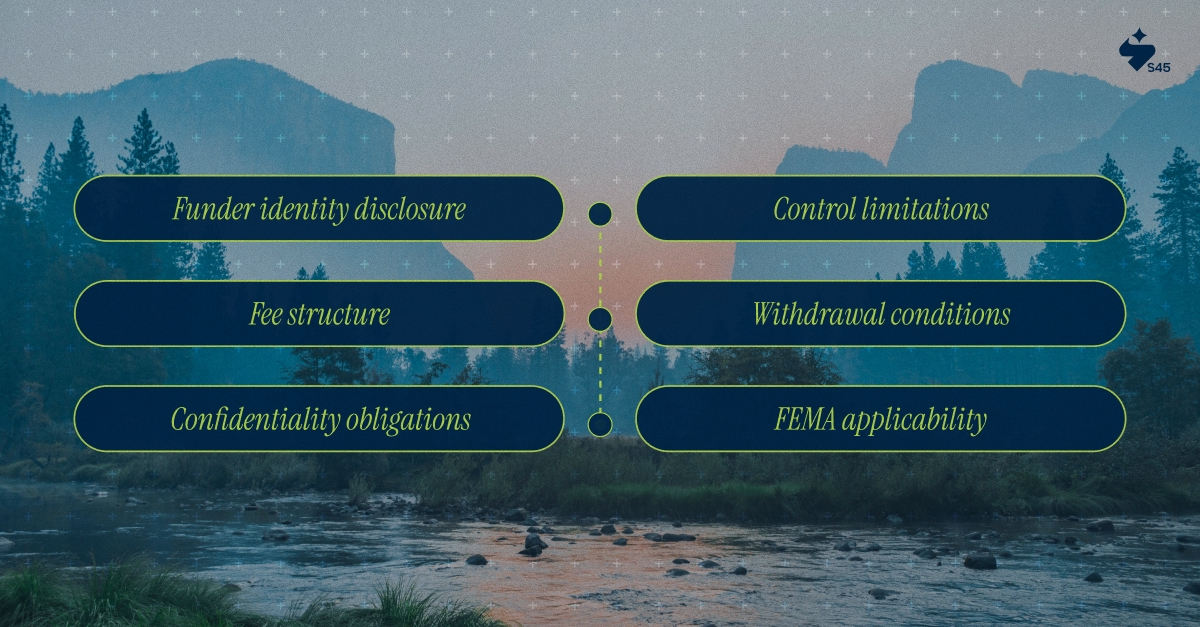
A robust third-party funding agreement in the Indian arbitration context should address:
Getting this wrong does not just affect the funding arrangement. It affects the arbitration itself.
While India's legislative response has been delayed, arbitral institutions are beginning to fill the gap, and enterprises engaged in international arbitration need to understand these institutional rules now.
A positive step has been observed in India with the introduction of the new Draft Mumbai Centre for International Arbitration (MCIA) Rules 2024, which incorporates disclosure provisions for TPF agreements. This is incremental progress, but it signals the direction of travel.
SIAC Arbitration Rules 2025, through Rule 38, impose mandatory disclosure of TPF agreements and funder identity, prohibit post-tribunal constitution funding arrangements that create arbitrator conflicts, and grant tribunals the authority to impose sanctions for non-compliance. For Indian enterprises choosing SIAC as their seat or institution, these rules apply with full force.
In mid-2025, IFSCA permitted changes that enable Third-Party Fund Management in GIFT City, aligning India's financial framework with international dispute-resolution centres where such financing is standard practice. This is a material development for cross-border dispute financing routed through India's international financial center.
Singapore's approach offers the clearest regulatory benchmark. In Singapore, the Civil Law (Amendment) Act 2017 legalized TPF for arbitration, limiting funding to "Qualifying Third-Party Funders" that meet specific financial and ethical criteria. This approach provides a balanced model, ensuring funders' reliability while protecting claimant rights. India's eventual framework, when it arrives, will likely draw heavily from this model.
Not every arbitration claim is a candidate for third-party funding. Funders are not philanthropists; they are capital allocators with return requirements and risk models.
The discipline here mirrors what institutional investors apply in any capital deployment decision: evidence beats narrative, and recoverability matters as much as merit.
Third-party funding in arbitration is a legitimate financial instrument, not a workaround. For Indian enterprises managing high-value commercial disputes, it can unlock capital that turns abandoned claims into pursued ones. But in India's current regulatory environment, the structure you build around the funding matters as much as the funding itself.
Disclosure discipline, conflict management, confidentiality architecture, and FEMA compliance are not formalities. They are the difference between an award that holds and one that gets challenged. The statutory framework will eventually arrive. The enterprises that have already built sound contractual foundations will not need to scramble when it does.
If you are evaluating how a significant arbitration claim intersects with your balance sheet or capital structure, connect with S45 for a structured conversation before the decision gets made by default.
Discover more insights on similar topics