
February 13, 202610 min read
Are Startup Accelerators Worth Joining? The Capital Markets Perspective
By Aman Singh
Growth & Development

Disclaimer: This content is for educational purposes only and should not be considered as financial advice. Every business situation is unique, and we recommend consulting with qualified financial advisors before making important business decisions.
You have built a profitable business. Revenue is real. The promoter team is experienced. The growth story is genuinely compelling. But the moment your investment banker or legal counsel begins preparing for an IPO, something breaks.
Not a strategy. Not vision. Workflow.
The financial data is scattered across departments. Historical disclosures are inconsistent. Related-party transactions have not been documented with institutional precision. The business has been run on founder instinct, which is exactly how it should have been built, but that instinct does not translate directly into a DRHP that SEBI finds clean.
This is the gap. And it is wider than most founders expect.
What bridges it is not just a better CA or a faster legal team. It is a specific kind of professional: someone who has spent years in high-performance consulting, understands how to stress-test a business thesis, and has transitioned into private equity, where every judgment is tied to capital outcomes. These professionals think in both languages: the founder's and the banker's.
This is the most common experience for founders in pre-IPO preparation. The business has been running well. Margins are healthy. The promoter knows every operational detail. But institutional investors and SEBI operate on evidence, not familiarity. S45, an AI-native investment bank built for Indian capital markets, encounters this gap across nearly every mandated company. The businesses that close it fastest are the ones that bring the right strategic talent in early.
Unorganized does not mean unprofessional. It means the internal systems were built to run the business, not to be audited by investors who will hold the stock for years.
Common structural gaps include:
Founders build intuition across years of operating experience. That intuition is valuable and, in many cases, irreplaceable. But intuition cannot write a credible investment thesis. It cannot model a five-year exit scenario with a returns waterfall. It cannot translate operational reality into the structured evidence a SEBI-compliant DRHP demands.
What you need, alongside your instinct, is someone who can take your business story and rebuild it in institutional language without losing the truth of it.
Suggested read: The Investment Banking Future: How AI-Native Execution Is Rewriting India's Capital Markets
The professional who has moved from top-tier consulting into private equity carries a profile that is genuinely rare. They have spent years diagnosing businesses across sectors. They have then moved into environments where every business judgment is backed by capital at risk. That combination produces a skill set that is directly applicable to companies preparing for public markets.
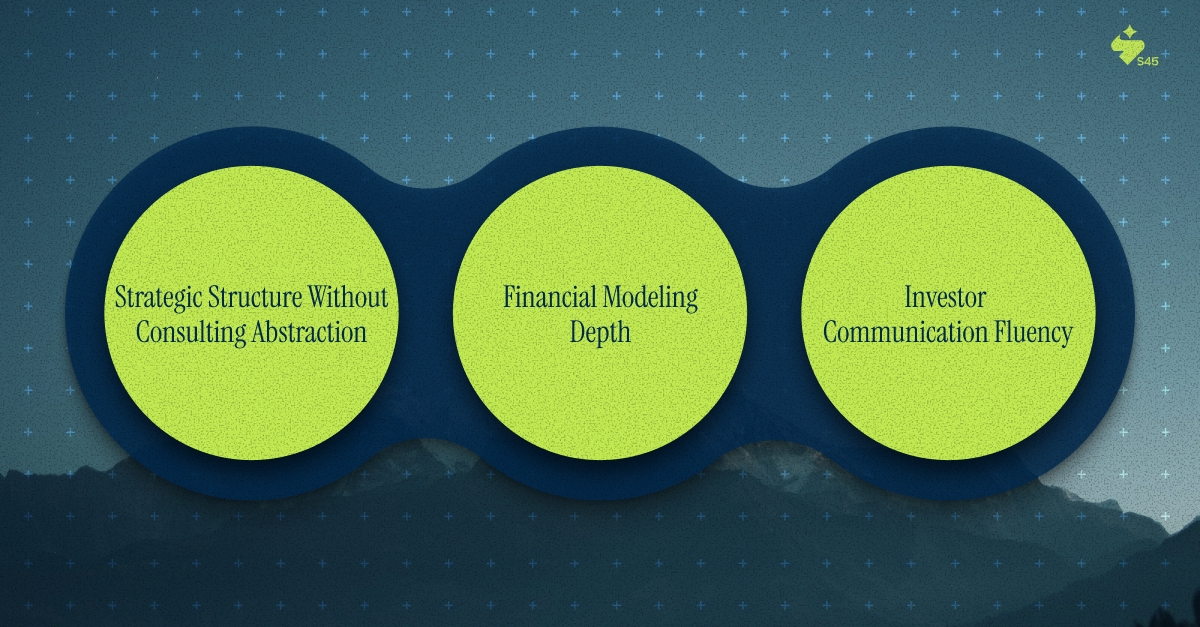
Consultants are trained to build frameworks and deliver recommendations. PE professionals are trained to make decisions with real capital consequences. Someone who has done both can take the operational complexity of your business and structure it in ways that are simultaneously true to how the business works and legible to how institutional investors evaluate it.
For a founder preparing for an IPO, this means:
Management consulting modeling is directional. Private equity modeling is transactional and must hold up under pressure and across-the-board scrutiny throughout the entire hold period for an investor.
A professional who has made this transition can build the financial infrastructure your business needs before the IPO process begins:
Perhaps the most underestimated skill this profile brings is the ability to communicate with institutional investors in their own language. SEBI reviewers, anchor investors, and QIBs do not speak in founder language. They speak in return multiples, entry valuations, exit pathways, and risk-adjusted thesis clarity.
Having someone in your team who genuinely understands both the promoter's perspective and the investor's requirements compresses the translation layer that causes most IPO delays.
Must read: What is Fund Accounting in Investment Banking Basics?
Beyond individual skill sets, there are three structural problems that a consulting-to-PE professional solves in the IPO preparation phase. These problems, if unaddressed, either delay the listing or compromise the pricing.
SEBI's ICDR regulations require every material disclosure to be traceable. Every claim about market size, competitive position, or growth trajectory must be supported by credible, documented evidence. Consulting-trained professionals build this kind of evidence architecture instinctively. In a PE context, they learn that evidence is not a compliance exercise; it is the foundation of investor conviction.
When this profile enters your pre-IPO team, they bring a discipline that most operationally-built businesses have never formalized: the habit of linking every strategic claim to a source, a number, and a methodology.
Promoter-run businesses often have governance that is efficient and functional but built around trust rather than systems. An institutional investor requires systems. Board independence, audit committee oversight, related-party transaction policies, and management accountability structures are not just good governance; they are prerequisites for a clean DRHP.
A consulting-to-PE professional has typically spent time inside PE portfolio companies where governance institutionalization was the first priority post-acquisition. They know which governance gaps trigger SEBI comments and how to fix them before the comment arrives.
Your IPO story needs to hold across every document: the DRHP, the investor presentation, the analyst briefing, and the anchor investor call. The risk of building a business on founder instinct is that the narrative exists only in the promoter's head and has never been formally structured for external audiences.
A consulting-to-PE professional can extract the narrative, stress-test it, identify where it breaks under investor scrutiny, and rebuild it into a coherent thesis that survives the IPO process from DRHP filing through listing.
Not every consulting-to-PE professional fits the same role in your organization. The right placement depends on your business's specific gaps and the timeline you are working toward.
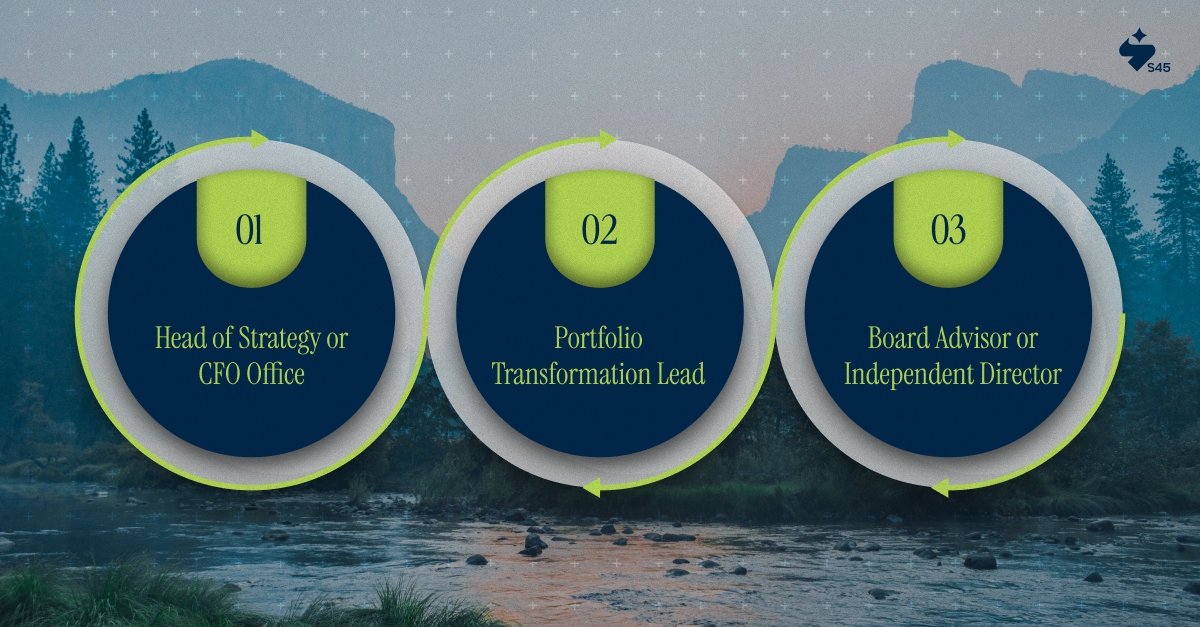
For businesses where the primary gaps are financial modeling, investor communication, and evidence architecture, embedding this profile in the CFO office or appointing a Head of Strategy creates the most direct impact. They work alongside the CFO to restructure financials, build the investor narrative, and coordinate with your investment bank on DRHP preparation.
For businesses with deeper operational gaps, where systems need to be built before the story can be told, this profile works most effectively as a transformation lead. They identify the highest-priority structural gaps, build implementation roadmaps, and hold accountability for the institutional readiness milestones your listing timeline requires.
For businesses that are further along in their preparation, institutional credibility becomes important at the board level. In such cases, bringing in a consulting-to-PE professional as an advisor or independent director helps add depth to governance. This is the kind of maturity institutional investors look for before making anchor commitments.
The consulting-to-PE transition is not uniform. Not every professional who has made this move brings the same capabilities. When evaluating candidates for your pre-IPO team, these signals matter most.
A consulting professional who has advised on strategy but has never worked on a live M&A transaction, commercial due diligence, or PE portfolio value creation is a different hire than one who has. Transaction exposure, even in a supporting role, fundamentally changes how someone thinks about a business as an asset.
Ask specifically about:
Can the candidate build a DCF from scratch? Can they construct a comparable company analysis for your sector? Can they walk you through the assumptions behind a revenue projection and defend them under pressure? These are the technical skills that distinguish a consulting profile that has genuinely repositioned for PE from one that has simply updated its resume. Test for these in your hiring process, not after the offer is made.
India's PE market is sector-driven. A professional with deep expertise in your specific sector, whether that is consumer, financial services, healthcare, technology, or infrastructure, will compress the learning curve and bring an investor perspective directly applicable to how your sector is valued and how your IPO will be priced.
The common mistake founders make is treating pre-IPO talent as a late-stage addition, someone who helps finish the DRHP rather than someone who builds what the DRHP requires.
The optimal window for bringing a consulting-to-PE professional into your business is 18 to 24 months before your intended listing date. At this stage:
Across mandates, the pattern is consistent: companies that begin institutional readiness work early have measurably cleaner DRHPs, faster SEBI review cycles, and stronger anchor investor conviction at pricing. S45's IPO Readiness Scan is specifically designed to surface these gaps before they become timeline problems.
Your business is ready. The question is whether it is institutionally ready.
The consulting-to-private-equity professional is not a consultant who knows about PE. They are someone who has built the discipline to think about businesses as capital assets and to communicate that thinking in the language that bankers, investors, and regulators require.
Bringing this profile into your pre-IPO structure is not an overhead cost. It is an investment in the quality of the outcome: a cleaner DRHP, a faster regulatory process, a more credible pricing story, and an anchor investor pool that is convinced before the roadshow begins.
The gap between founder instinct and banker requirements is real. The right hire closes it systematically and specifically, before the pressure of the IPO process makes it harder to fix.
Connect with S45 for a capital markets readiness assessment before you begin preparing for your IPO. Clarity at the start is the most efficient investment you can make in the outcome.
Discover more insights on similar topics