
February 23, 202611 min read
The Investment Banking Future: How AI-Native Execution Is Rewriting India's Capital Markets
By Abhishek Bhanushali
Finance Advice

Disclaimer: This content is for educational purposes only and should not be considered as financial advice. Every business situation is unique, and we recommend consulting with qualified financial advisors before making important business decisions.
If your enterprise has attempted a merger, acquisition, or business combination in the last three years, you already know where the process fractures. It's not the deal structure. It's not the valuation debate. It's the accounting reconciliation that begins after the transaction closes, when fragmented Excel files, incomplete disclosure trails, and retroactive fair value assessments collide with regulatory timelines.
India's M&A market recorded $69.2 billion in transactions across the first nine months of 2024, reflecting resilience despite global headwinds. Yet institutional preparedness lags deal velocity. Enterprises announce combinations without accounting clarity. Promoters commit to timelines without evidence of infrastructure. CFOs inherit disclosure gaps that should have been addressed during due diligence.
The result: delayed filings, restated financials, and valuation disputes that erode stakeholder confidence before the combined entity ever reports consolidated results.
This isn't a failure of accounting standards. This is a failure of execution design.
The breakdown isn't random. It follows a predictable pattern across Indian enterprises, from fragmented advisor networks to compliance approached as an afterthought. Understanding where execution fails is the first step toward institutional clarity.
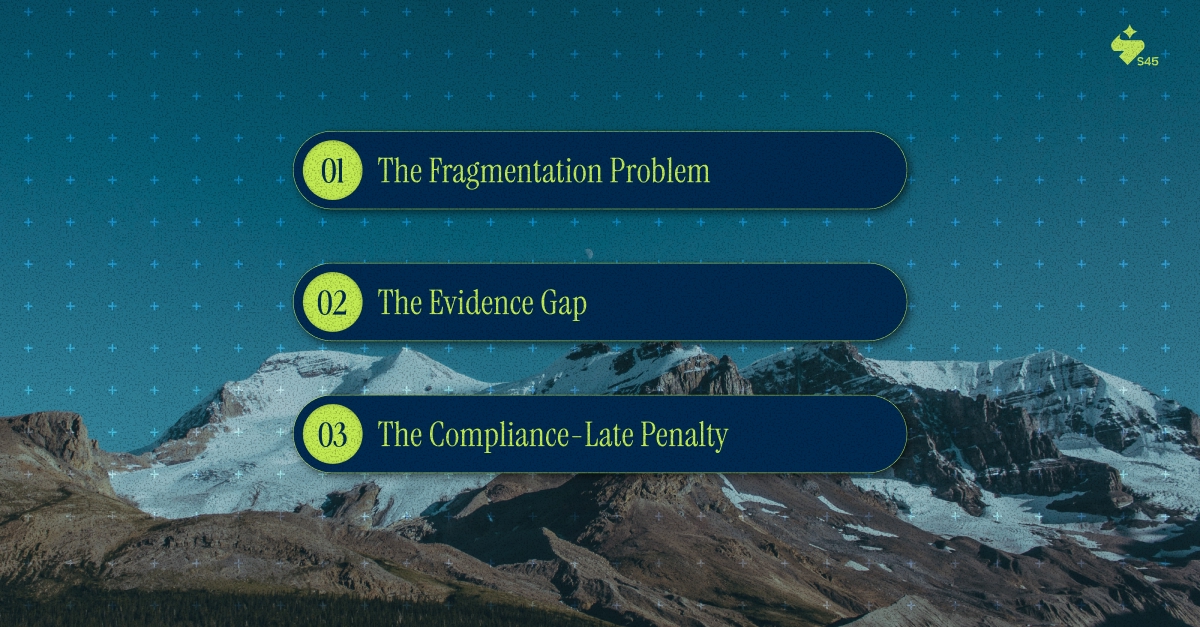
Indian mergers and acquisitions accounting runs across disconnected systems. Legal advisors draft scheme documents. Valuers issue fairness opinions. Tax consultants model post-transaction structures. Auditors reconcile after the fact. No single system owns the accounting outcome end to end.
Ind AS 103 assumes institutional coordination, requiring fair value recognition of assets and liabilities on the acquisition date. Purchase price allocation across tangible assets, intangible assets, contingent liabilities, and goodwill must withstand regulatory and shareholder scrutiny.
Most Indian enterprises lack the infrastructure to execute this in real time. This is where execution infrastructure matters. AI-native investment banks like S45 own M&A accounting outcomes end-to-end, compressing timelines from months to weeks without compromising institutional rigour.
Mergers and acquisitions accounting under Ind AS 103 requires every disclosure to be linked to verifiable evidence. Customer contracts support intangible valuations. Asset registers validate tangible fair values. Historical financials underpin goodwill. Contingent liabilities require legal documentation, not management estimates.
Yet enterprises often rely on opinion-based assessments rather than evidence-based disclosures. Valuers offer ranges rather than defendable numbers. Finance teams cite “industry practice” over transaction-specific data. This gap becomes a time sink, delaying consolidation, diluting valuation credibility, and frustrating boards.
Companies that treat accounting as a post-deal formality always pay more. Restated goodwill figures trigger audit queries. Fair value adjustments discovered months after acquisition require disclosure amendments. Purchase price allocations prepared without a sector context fail regulatory review.
India's regulatory framework, spanning SEBI, CCI, and NCLT, expects accounting precision at the time of deal announcement, not at deal closure. Late compliance compounds risk.
Ind AS 103, converged with IFRS 3, eliminates the discretion that previously allowed Indian enterprises to choose accounting methods based on deal optics rather than economic substance. The standard mandates uniform treatment while introducing complexity that most finance teams are unprepared to execute.
Ind AS 103 requires all business combinations to be accounted for using the acquisition method. This eliminates the pooling-of-interests approach previously available under AS 14, creating uniform treatment across Indian enterprises.
The acquisition method demands that:
For Indian enterprises, this means M&A accounting cannot rely on carrying values or historical cost. Every combination requires a fresh fair value assessment at the transaction date.
Appendix C of Ind AS 103 addresses business combinations under common control, i.e., transactions in which the combining entities are ultimately controlled by the same party before and after the combination. These follow the pooling-of-interests method, in which assets and liabilities retain their carrying values and no goodwill arises.
This distinction matters for Indian conglomerates restructuring their portfolios, as common-control transactions bypass fair-value requirements but require different disclosure protocols.
When the legal acquirer (entity issuing shares) is determined to be the accounting acquiree, Ind AS 103 requires reverse acquisition accounting. This occurs when the legal target's shareholders control the combined entity after the transaction.
Indian enterprises pursuing equity-based acquisitions must assess control dynamics during structuring, as reverse acquisition accounting impacts consolidated financial presentation and EPS calculations.
Execution precision requires a phased approach where accounting clarity informs deal structure from inception. Each phase builds evidence infrastructure that supports the next, eliminating the retroactive reconciliation that plagues traditional M&A workflows.

Accounting clarity begins during deal structuring, not after signing. Integrating accounting outcomes into term sheet negotiations ensures purchase price, consideration structure, and contingent payments align with Ind AS 103 disclosure requirements from the start.
This phase addresses:
Enterprises that defer accounting design to post-closure inherit disclosure gaps that auditors and regulators will reject.
Fair value isn't market price; it's the price at which a market participant would sell in an orderly transaction. For M&A accounting, this requires:
Automated comparables analysis, discount rate selection, and probability modelling compress valuation timelines from weeks to days while maintaining institutional rigour.
Purchase price allocation (PPA) allocates the total consideration to acquired net assets. This isn't an Excel exercise; it's an evidence-linked disclosure that auditors, boards, and regulators will scrutinize.
The sequence:
Linking every line item to source documentation, asset registers, contracts, valuations, and legal opinions creates an audit-ready PPA on acquisition date, not months later.
Consolidated financial statements must incorporate the acquiree's results from the acquisition date forward. This demands:
Enterprises that lack integrated financial systems struggle with consolidation velocity, delaying the release of results and eroding market confidence.
Technology alone doesn't solve accounting complexity. But when AI infrastructure is paired with sector banking judgement, it eliminates the manual reconciliation bottlenecks that extend M&A accounting timelines from weeks to months.
AI infrastructure compresses mergers and acquisitions accounting timelines by automating evidence aggregation, not by reducing analytical rigour. Advanced systems:
This shifts banker time from data assembly to judgement application, validating assumptions, challenging valuations, and defending disclosures.
Traditional M&A accounting follows a linear path: due diligence → valuation → PPA → consolidation, each phase waiting for the previous to complete. AI-enabled platforms allow parallel execution. Valuers access live data feeds. PPA models update as deal terms evolve. Consolidation logic runs against draft structures.
The result: PPA completion within 30–45 days of acquisition date versus the industry standard of 4–6 months.
AI accelerates, but sector banking experience validates. Complex intangibles require a market context. Contingent liabilities demand legal interpretation. Fair value ranges need strategic judgement. The combination of technology and experienced bankers who've defended disclosures before SEBI, negotiated with auditors, and presented to boards ensures technology handles data while humans own outcomes.
Pre-IPO combinations create accounting complexity at the worst possible time, when regulatory scrutiny intensifies, and timeline delays compound reputational risk. The challenge isn't managing M&A accounting in isolation; it's executing under capital markets visibility.
Indian enterprises often consolidate portfolios or acquire complementary businesses in the 18–24 months preceding IPO. This creates accounting complexity precisely when regulatory scrutiny intensifies.
SEBI expects three years of audited financials reflecting a stable business composition. Recent M&A activity triggers:
Enterprises approaching IPO cannot afford M&A accounting delays. Treating pre-IPO combinations as capital markets events and building disclosures for inclusion in the offering document from transaction inception eliminates last-minute reconciliation chaos.
When M&A occurs during IPO preparation, the Draft Red Herring Prospectus must disclose:
AI-driven DRHP drafting systems automatically integrate M&A disclosures, link accounting notes to source transactions, and update them dynamically as PPA finalizes.
Promoters approaching business combinations face conflicting pressures. Boards demand deal closure velocity. Auditors require accounting precision. Regulators expect disclosure completeness. The market watches for integration execution.
Accounting delays signal operational weakness. Restated financials erode credibility. Goodwill write-downs suggest overpayment. Yet rushing through mergers and acquisitions accounting without institutional rigour guarantees regulatory friction.
The solution isn't choosing between speed and accuracy; it's building execution infrastructure that delivers both. Treating accounting as transaction design rather than post-closure reconciliation eliminates the trade-off.
For founders, this means:
M&A accounting becomes institutional infrastructure rather than an administrative burden.
S45 operates as an AI-native investment bank that owns M&A accounting outcomes from transaction structuring through consolidated reporting. The firm treats Ind AS 103 compliance as craftsmanship, not friction, building evidence infrastructure during due diligence rather than retroactively assembling disclosures after deal closure.

S45’s proprietary AI systems map purchase consideration across identifiable assets and liabilities in real time, linking every allocation to source documentation. Customer contracts inform intangible valuations. Asset registers drive tangible fair values. Financial models support goodwill. Contingent liabilities reference legal opinions, not assumptions. This is not automation for speed, but institutional precision at scale.
Traditional M&A accounting relies on valuers delivering reports weeks after the acquisition date. S45 embeds valuation logic directly into transaction workflows, allowing fair values to evolve as deal terms finalize. Sector bankers add market context while AI systems ensure cross-asset consistency.The result is fair value disclosure built for regulatory defence, not internal convenience.
Before a combination or IPO, enterprises require accounting readiness. S45’s scan evaluates historical M&A treatment, pending transaction complexity, goodwill impairment risk, and fair value execution capability.The outcome is institutional clarity on M&A accounting readiness, not generic advice.
For IPO-bound enterprises with M&A history, S45 owns the disclosure chain—restated financials, DRHP disclosures, SEBI query responses, investor materials, and post-listing integration monitoring.M&A accounting is treated as a capital markets execution requirement, ensuring accounting precision accelerates, rather than delays, IPO timelines.
Accounting for mergers and acquisitions under Ind AS 103 separates institutions from operators. Indian enterprises approaching capital markets cannot afford the accounting delays, restatements, or disclosure gaps that traditional M&A workflows create.
The distance between the deal announcement and the accounting closure signals either institutional clarity or operational chaos. For enterprises using M&A for IPO preparation, growth, or portfolio optimisation, that gap directly impacts execution velocity and stakeholder confidence.
Infrastructure matters. AI-driven fair value assessment, evidence-linked purchase price allocation, and sector-specific banking judgement that withstand regulatory scrutiny can compress M&A accounting timelines from months to weeks without compromising the rigour SEBI, auditors, and boards expect.
Before committing months and your reputation to your next transaction, assess whether your enterprise is built to execute it. S45 helps Indian enterprises close that gap with institutional-grade M&A and IPO execution.
Discover more insights on similar topics