
February 23, 202611 min read
The Investment Banking Future: How AI-Native Execution Is Rewriting India's Capital Markets
By Abhishek Bhanushali
Finance Advice

Disclaimer: This content is for educational purposes only and should not be considered as financial advice. Every business situation is unique, and we recommend consulting with qualified financial advisors before making important business decisions.
Cross-border mergers and acquisitions often look settled long before they begin to unravel. Boards approve the strategy. Advisors validate the target. Term sheets circulate. On the surface, the deal feels inevitable.
Then execution begins.
Regulatory filings stretch timelines. RBI conditions surface late. FEMA compliance exposes structural gaps. What was planned as a six-month transaction is drifting toward eighteen months, eroding momentum and deal certainty. The failure isn’t strategic; it’s procedural. Indian enterprises rarely lose cross-border deals because the rationale is weak; they lose them because execution was designed too late.
In India’s regulatory environment, approval is not a formality. It is the transaction.
In this blog, we break down the specific FEMA rules, valuation math, and RBI hurdles that determine if your deal actually closes. We move beyond high-level strategy to show you how to build a deal that is approved by regulators on the first attempt.
India’s recent surge in cross-border mergers and acquisitions has masked a deeper problem. While outbound and inbound ambitions continue to grow, execution failures remain stubbornly consistent.
Pricing rules invalidate negotiated share swaps. Rule 25A valuations fail evidentiary scrutiny. Deemed RBI approvals collapse under documentation gaps. Liability transfers trigger ECB non-compliance. Promoters discover binding constraints during filing, when redesign is costly and time is already lost.
This is the execution gap. Institutions that treat regulation as deal architecture rather than post-facto compliance identify these constraints early. AI-native investment banks like S45 approach cross-border mergers and acquisitions by testing regulatory viability, valuation evidence, and approval sequencing before documentation begins, preventing structural failures that surface too late in traditional workflows.
Cross-border mergers and acquisitions are execution-led transactions disguised as strategy-led ones. Enterprises that succeed embed FEMA, RBI, valuation, and approval sequencing into deal architecture from day one. Those who don't learn, too late, that in India, execution discipline determines outcomes long before closing.
Indian cross-border M&A operates within a layered regulatory framework in which jurisdiction, approval authorities, and compliance timelines are fragmented across institutions. This isn't academic; it determines whether deals close.
The FEMA (Cross Border Merger) Regulations, 2018 set the compliance framework for cross-border M&A. Section 234 of the Companies Act requires RBI approval, but FEMA enables deemed approval when structural conditions are met.
The distinction is operational. Explicit RBI approval extends timelines. Deemed approval compresses execution but demands stricter compliance, including:
Most enterprises discover these constraints during the filing process. S45 embeds them into the deal architecture from the mandate stage.
Cross-border mergers also require NCLT sanction under Sections 230–232, covering shareholder consent, creditor approval, and regulatory clearances. NCLT focuses on valuation fairness, disclosure quality, and procedural compliance.
Parallel reviews may be conducted by CCI and SEBI. When approached sequentially, these approvals compound timelines; Indian deal closures now average 220 days.
The challenge is coordination, not regulation. Parallel regulatory structuring compresses timelines; sequential execution distorts deal economics.
Recent amendments have reduced friction while raising execution complexity. September 2024 MCA changes mandate RBI approval for mergers between foreign holding companies and Indian subsidiaries, while removing NCLT clearance for certain structures.
August 2024 amendments to FEMA (Non-Debt Instruments) Rules streamlined FDI norms for cross-border share swaps. These shifts simplify execution only for enterprises that design compliance into transactions from the outset.
Cross-border mergers and acquisitions live or die on valuation methodology. Not market multiples. Not negotiated enterprise values. Regulatory-compliant valuation under Rule 25A.
Indian and foreign entities must obtain independent valuations from registered valuers using prescribed methods. These reports support NCLT applications and underpin share exchange ratios, consideration structures, and fairness opinions for shareholders and creditors.
The framework rejects strategic narratives and unsupported DCFs. Valuations must trace to audited financials, disclosed business plans, and verifiable market data. When evidence standards aren’t met, NCLT demands reevaluations or rejects schemes, delays that compress execution windows and erode deal certainty.
Pricing rules are not negotiable.
These requirements determine transaction feasibility. S45 embeds them early, analyzing financials, applying prescribed methodologies, stress-testing pricing, and producing filing-ready documentation. Valuation workflows compress from months to weeks, introducing institutional discipline before execution risk appears.
Cross-border mergers and acquisitions introduce structural risk when liabilities are transferred between foreign and Indian entities. FEMA regulations dictate how these liabilities must align with Indian foreign exchange norms.
In inbound mergers, overseas borrowings of the foreign entity must conform to the ECB, trade credit, or other approved frameworks within two years of NCLT sanction. Non-conforming liabilities trigger immediate cash flow pressure, often requiring prepayment or restructuring before implementation.
Outbound mergers face parallel constraints. Indian shareholders acquiring foreign securities must comply with overseas investment rules, including:
Promoters of domestic structures often encounter these limits only during regulatory review.
The two-year window is not flexible; it is a compliance deadline that creates execution risk when liabilities exceed thresholds. Enterprises that assess liabilities early structure around conformity. Those that defer analysis face unplanned capital restructuring post-merger.
S45 addresses liability conformity during structuring. Its AI systems map borrowings to regulatory limits, flag non-conforming exposures, and model restructuring options before definitive agreements are signed.
Sectoral and jurisdictional rules define whether a cross-border transaction is even executable. These constraints operate before valuation, structuring, or negotiation, and ignoring them results in a deadlock.
Cross-border transactions expose Indian enterprises to currency volatility between the signing and completion stages. Consideration structures involving foreign currency, share swap ratios based on exchange rates at valuation dates, and repatriation requirements create financial risks that extend beyond the strategic merger rationale.
FEMA Regulations permit resultant companies to maintain foreign currency accounts for transactions incidental to cross-border mergers for 2 years from the date of NCLT sanction. This enables currency management but doesn't eliminate exchange rate exposure on consideration payments, working capital requirements, or liability settlements.
Enterprises structuring cross-border mergers and acquisitions without currency risk mitigation face situations in which exchange rate movements between signing and closing fundamentally alter deal economics. Natural hedges through operational cash flows, financial hedging instruments, or modifications to the consideration structure can manage this risk if addressed during transaction structuring rather than post-facto.
Indian tax regulations create structural disadvantages for outbound mergers. Unlike domestic mergers, which permit the carry-forward of accumulated losses and unabsorbed depreciation to the resultant companies, outbound transactions lack equivalent tax benefits. This asymmetry makes outbound cross-border mergers and acquisitions economically inferior to inbound structures.
Indian shareholders acquiring foreign company securities in outbound mergers must comply with the Liberalized Remittance Scheme limits if they're individuals. This caps per-person annual remittances, creating practical barriers for promoter groups with concentrated shareholdings.
Tax treaty provisions, transfer pricing implications, and withholding tax on cross-border payments layer additional complexity. Enterprises that model tax consequences during deal structuring optimize structures to minimize tax leakage. Those addressing tax planning post-transaction face costs eroding deal returns.
Cross-border mergers and acquisitions don’t conclude with regulatory approval; they transition into execution. This phase determines whether compliance translates into sustained business value or post-merger friction.
Traditional advisory models sequence cross-border M&A requirements: strategy first, structuring second, compliance third. This approach maximises execution risk and explains why 40% of deals fail to close within projected timelines.
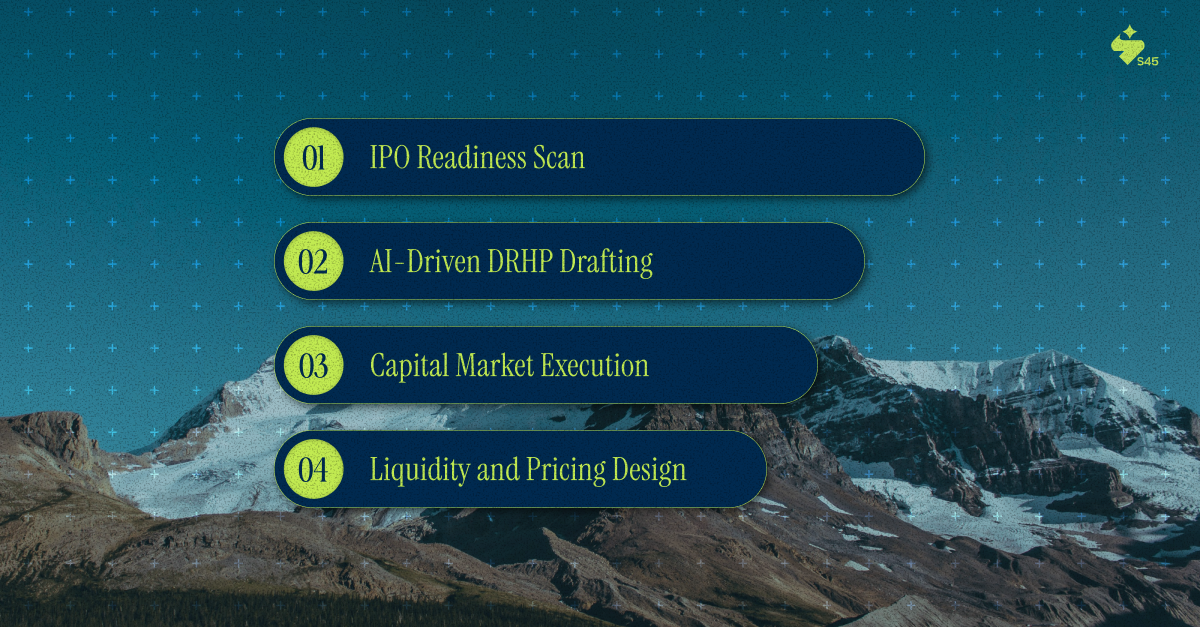
S45 inverts the workflow. Regulatory viability defines transaction structure from the mandate stage. Our platform's capabilities integrate seamlessly into cross-border execution:
This isn't advisory work. It's outcome ownership across the complete cross-border M&A lifecycle, from regulatory viability assessment through NCLT sanction to post-merger compliance execution.
Cross-border mergers and acquisitions offer strategic optionality for Indian enterprises pursuing global integration. But strategy alone doesn’t ensure execution. Despite India’s M&A surge in 2024, regulatory compliance, approval timelines, and liability management still determine whether value is created or capital is consumed.
Enterprises that succeed treat regulation as structure, not bureaucracy. FEMA compliance is validated early. RBI conditions are embedded into the deal design. NCLT sanctioning is coordinated alongside parallel approvals. Execution is institutional, not improvized.
Those approaching cross-border M&A opportunistically encounter failures that capital and reputation can’t absorb. India’s regulatory architecture doesn’t accommodate improvisation.
For enterprises ready to execute with discipline, S45’s AI-driven regulatory assessment compresses timelines, eliminates compliance risk, validates structural viability before board commitment, and coordinates approvals before documentation begins.
Book an IPO Readiness Scan with S45 to confirm whether your enterprise is structurally prepared for cross-border integration, before regulation defines your outcome.
Discover more insights on similar topics