April 1, 202612 min read
Traditional vs Alternative Investments: What You Need to Know Before Going Public
By Aman Singh
Investopedia

Important Disclaimer: This content is for educational and informational purposes only and does not constitute financial, investment, tax, or legal advice.
Your MSME is profitable, revenue is steady, and your team is growing. By most standards, you've made it. But something’s bothering you: What if the market shifts? If your industry consolidates? If you sell tomorrow, what's next?
This is the founder's paradox. One disruption, one competitor, one supply chain issue, and years of wealth could vanish. Meanwhile, your competitors are evolving. The successful founders, those scaling or exiting, are investing like founders. They're accessing capital through alternative channels and building personal wealth while scaling operations.
But the truth is, alternative investments have changed. And now, they’re within reach for ambitious MSME founders like you.
In this blog, we will help you find the best alternative investment options in India for 2025.
Let’s get straight to it: the traditional investment playbook for founders is outdated. Here’s the old routine:
But that strategy no longer works. Here’s why:
Alternative investments solve all of this. But what most founders don’t realize is that the alternative investment landscape has shifted dramatically in recent years. What once required ₹5 crore now works with just ₹50 lakh. Let me show you exactly what's available.’
Also Read: Categories of Alternative Investment Funds Explained
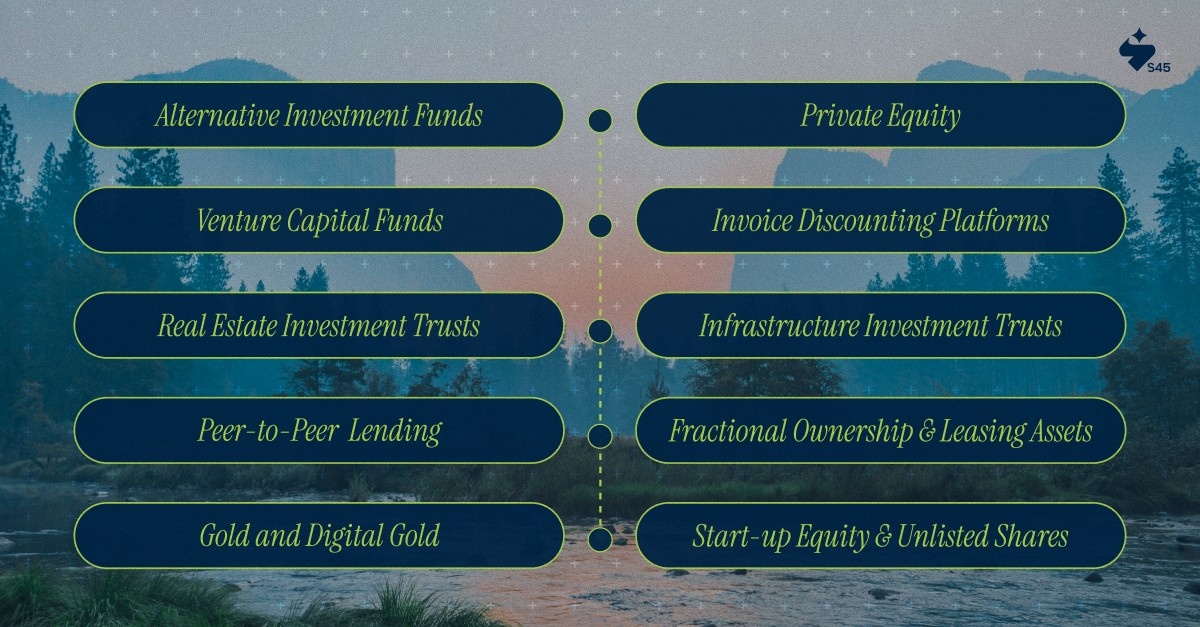
The alternative investment ecosystem in India has exploded, and most founders don't realize how many accessible options exist beyond traditional stocks and fixed deposits.
Here are some of the best alternative investment options for you:
AIFs allow high-net-worth individuals and institutions to invest in private equity, venture capital, real estate, private credit, and hedge funds. India has over 1,600 SEBI-approved AIFs in 2025, with top performers such as Finideas Growth Fund or Knightstone Matterhorn Fund.
Pain point addressed: MSME founders can consider Category I AIFs for SME- and impact-driven ventures, providing both diversification and exposure to high-growth businesses.
Private equity investments fund growth-stage or turnaround companies and are ideal for experienced founders seeking higher but risk-adjusted returns. With India’s PE market having nearly 20% share of the total investment of Asia-Pacific, participation through AIFs or co-investment deals is rising.
Pain point addressed: Helps founders learn valuation dynamics and investor expectations, useful for securing future funding.
Venture capital AIFs invest in startups and innovative small enterprises. In 2025, early-stage VC funds like 360 One High Growth Fund are outperforming public benchmarks.
Pain point addressed: VC exposure allows MSME founders to back future disruptors in their supply chains or industries while learning how institutional funds operate.
Platforms like KredX and TradeCred let investors buy unpaid invoices at a discount, helping businesses unlock working capital while earning annualized returns up to 16%.
Pain point addressed: MSMEs struggling with delayed B2B payments can become investors themselves, turning cash-flow knowledge into predictable passive income.
REITs make commercial real estate accessible through fractional units. They provide liquidity and long-term stability without managing property directly.
Pain point addressed: In 2025, REITs remain a hedge against inflation and a diversification tool for founders heavily invested in their own operations.
InvITs are similar to REITs but focused on roads, power, and telecom assets, offering moderate risk and steady income. As government and private projects expand, InvITs have become appealing to founders seeking regulated yet growth-linked exposure.
Pain point addressed: Government-backed stability provides predictable yield streams aligned with India’s expanding infrastructure agenda, ideal for steady diversification.
Platforms like Faircent and LenDenClub connect investors directly with borrowers seeking business or personal loans. However, diversified portfolios are crucial to manage default risk.
Pain point addressed: Founders can deploy surplus funds to earn steady returns while gaining insight into borrower dynamics, mirroring their own credit-seeking experiences.
Through Grip Invest and similar platforms, investors co-own or lease income-generating assets like logistics vehicles, machinery, or equipment.
Pain point addressed: Provides MSMEs with affordable exposure to industrial or tech assets without capital-heavy ownership.
Even in 2025’s digital landscape, gold remains a safe-haven asset, showing steady appreciation (~10% CAGR). Platforms like Augmont and MMTC-PAMP enable micro-investments with instant liquidity.
Pain point addressed: Ideal for Indian founders balancing family wealth preservation and portfolio diversification.
Through curated private platforms like Altdrx and Precize, investors can access pre-IPO and unlisted equity opportunities.
Pain point addressed: For strategic MSME founders, this channel opens doors to industry partnerships or future alignment, creating both financial and business leverage.
Smart founders are building blended portfolios: invoice discounting for cash flow and learning, venture debt for sector exposure, Category I AIFs for sustainable growth, and founder syndicates for control and upside. At s45, we work with founders, integrating this into their strategy so that within 3 to 5 years, you could build a legitimate alternative portfolio.
But there’s another layer to this, one that goes beyond returns and speaks to the long game founders are now playing.
Also Read: How to Evaluate Alternative Investments Effectively
Here’s a tough question: What kind of founder do you want to be? If legacy matters, and for most ambitious MSME founders, it does, you can’t just chase returns. You need to build wealth through vehicles that reflect the change you want to create.
That’s where sustainability-focused alternatives come in.
ESG-aligned AIFs are India’s fastest-growing investment segment, backing:
This isn’t philanthropy. It’s smart capital allocation.
At s45, we work with founders building this into their strategy from day one. So the question becomes: are you ready to act on this opportunity?
This is where your founder's instinct takes over. You've built one business. You can build multiple streams of wealth through alternatives, and they're more accessible than you think.
At s45, we work directly with MSME founders navigating this transition. We help you:
We're not here to pitch financial products. We're here to help you think like an alternative investor while remaining grounded in operational reality.
The question isn't whether alternatives are for you. It's whether you're ready to take control of your wealth-building journey.
Reach out to learn how we can help you build your alternative investment strategy, connect you with other founder-investors, and access opportunities that used to be reserved for High Networth Individuals (HNIs).
Discover more insights on similar topics