
February 3, 202611 min read
What is Fund Accounting in Investment Banking Basics?
By Aman Singh
Investopedia

Key Insights
Disclaimer: This content is for educational purposes only and should not be considered as financial advice. Every business situation is unique, and we recommend consulting with qualified financial advisors before making important business decisions.
If your enterprise is engaging with private equity investors, you already know where the process fractures. Legal teams churn documents your finance team didn't prepare. The CIM promises trajectories that your actuals cannot defend. Four months in, you're still answering questions the term sheet suggested would take six weeks.
This is damage control, not due diligence.
What is due diligence in private equity is the forensic examination of whether your enterprise can substantiate every claim under institutional scrutiny. It is not information gathering. It is an evidence tribunal where your business model, financial integrity, and operational discipline are either validated or marked for valuation adjustment.
Indian mid-market firms treat this as disclosure, even though it is a readiness assessment. They respond to requests without the required evidence. By the time they understand the difference, negotiating leverage is gone.
The institutional logic is straightforward: if an enterprise cannot withstand private equity fund investment due diligence standards, it will not survive SEBI’s ICDR scrutiny. If financial disclosures fail to meet institutional investors’ commercial due diligence expectations, the DRHP will accumulate comment letters. The disciplines are the same; only the interrogators change.
This is where execution architecture becomes decisive. S45 operates as an AI-native investment bank that treats private equity due diligence not as a fundraising checkpoint but as the foundation for capital-market readiness. The firm combines sector bankers who have defended valuations across multiple transaction cycles with proprietary AI systems that enforce evidence linkage across financial statements, management assertions, and regulatory disclosures.
This is execution ownership, where due diligence discipline functions as the operating system for Main Board and SME Exchange preparation, not a parallel workstream.
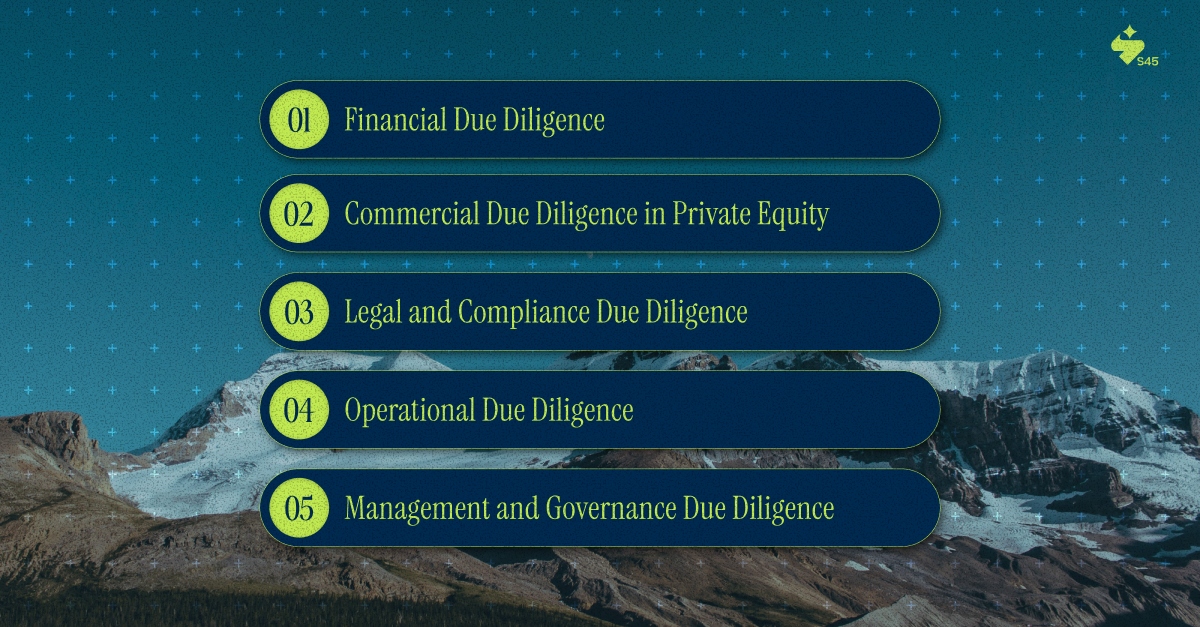
Private equity due diligence operates across five institutional domains, each demanding a distinct evidence architecture rather than narrative justification.
Financial due diligence in private equity tests whether reported EBITDA reflects operational reality or accounting optimism. Indian enterprises routinely discover during this phase that:
The institutional corrective is not a better explanation. It is an evidence-linked financial architecture in which every number traces to source documentation, every adjustment reconciles with policy, and every forecast connects to demonstrated execution capability.
S45’s AI-driven financial due diligence infrastructure analyzes three-to-five-year historical performance not to surface errors, but to establish predictive patterns. Quality of earnings becomes the basis for valuation defence, not a post-facto exercise outsourced to auditors.
Commercial due diligence assesses whether the claimed market positioning can withstand competitive scrutiny. Private equity investors conducting commercial due diligence assessments examine:
Indian mid-market enterprises frequently present growth narratives supported by favourable industry tailwinds, yet fail to demonstrate a defensible competitive advantage. Institutional standards demand evidence, customer retention metrics, pricing premium documentation, and operational efficiency benchmarks that separate aspiration from execution.
Legal due diligence assesses whether the corporate structure can survive institutional ownership. India’s regulatory environment, including the Companies Act, FEMA, and sectoral licensing frameworks, creates compliance obligations that many mid-market firms manage reactively rather than systematically.
Due diligence typically reveals:
S45’s compliance framework treats SEBI ICDR and LODR requirements not as constraints, but as institutional disciplines that strengthen equity credibility. Enterprises preparing for private equity fundraising often discover that capital market compliance becomes a strategic advantage rather than a regulatory burden.
Operational due diligence evaluates whether management systems can scale to institutional expectations. Investors assess:
The institutional question is not whether operations function today, but whether they can sustain 3× revenue growth without margin erosion or quality failure. Indian enterprises often lack the documented processes, system controls, and performance metrics required for institutional scalability modelling.
Private equity due diligence includes a forensic assessment of management capability, board effectiveness, and governance maturity. Investors scrutinize:
Promoter-led Indian enterprises routinely underestimate the depth of governance scrutiny applied by institutional investors. Transitioning from entrepreneurial control to institutional partnership requires governance discipline that many mid-market firms have yet to institutionalize.
A comprehensive private equity due diligence checklist for Indian enterprises must address regulatory and commercial realities specific to this market:
The private equity fund due diligence checklist becomes more extensive when investors evaluate platform companies for buy-and-build strategies, requiring assessments of add-on acquisition capabilities and an evaluation of the integration playbook.
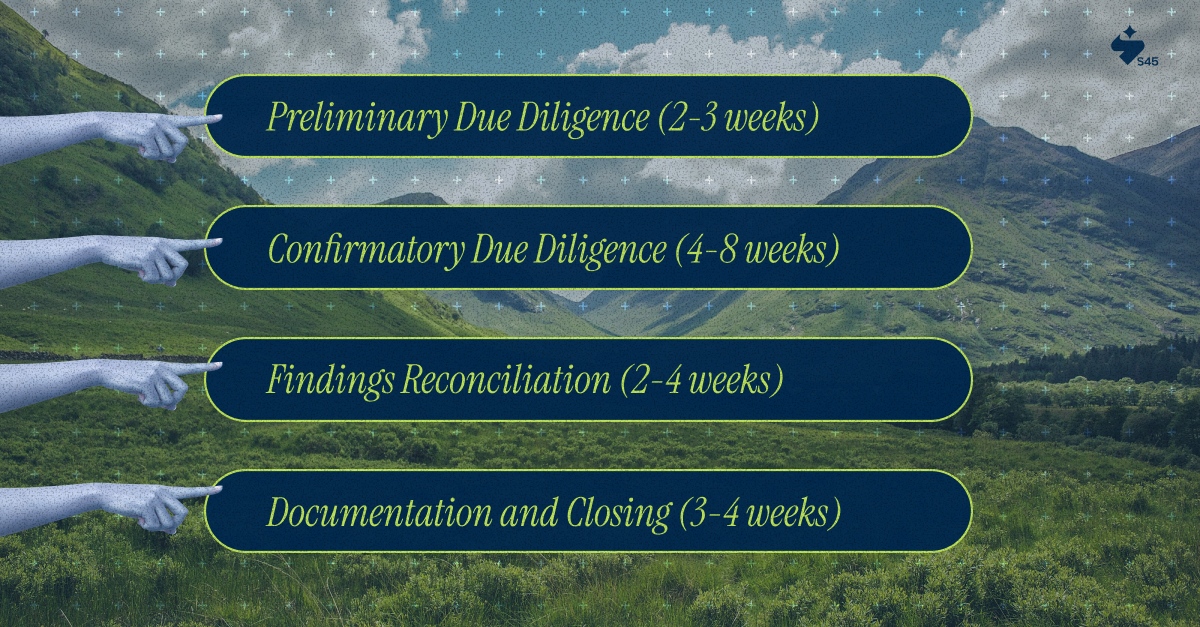
Understanding the private equity due diligence process requires recognising that timelines compress or extend based on evidence readiness, not investor patience:
Phase 1: Preliminary Due Diligence (2-3 weeks)
Initial information review, management presentations, and the establishment of a preliminary valuation framework. Investors evaluate whether to proceed to confirmatory due diligence.
Phase 2: Confirmatory Due Diligence (4-8 weeks)
Detailed financial, legal, operational, and commercial analysis. External advisors conduct quality-of-earnings studies, legal reviews, and commercial assessments. Data room access becomes the operational battleground.
Phase 3: Findings Reconciliation (2-4 weeks)
Issue resolution, valuation adjustments, and transaction structure refinement based on due diligence findings. The institutional capability to respond rapidly to issues determines whether timelines hold.
Phase 4: Documentation and Closing (3-4 weeks)
Investment agreements, shareholder arrangements, and regulatory approvals finalized.
Indian mid-market enterprises that lack institutional readiness extend Phase 2 timelines to 12-16 weeks, creating valuation pressure, deal fatigue, and, at times, transaction abandonment.
Private equity due diligence services from institutional-grade advisors serve specific functions that internal teams cannot replicate:
The execution advantage comes from integrating these services into unified capital markets preparation rather than hiring separate advisors for fundraising, listing preparation, and regulatory compliance. Sector bankers who coordinate institutional-grade due diligence as the foundation for DRHP drafting, valuation defence, and post-listing liquidity design compress timelines and eliminate coordination friction.

Private equity diligence failures in the Indian mid-market follow predictable patterns:
The institutional solution is not better preparation during fundraising. It is continuous capital-market readiness, where evidence architecture, financial controls, and governance structures operate to institutional standards before engaging investors.
AI's role in private equity fund investment due diligence is specific and operational:
When paired with sector banking expertise, AI infrastructure enforces institutional discipline at scale, ensuring that every financial disclosure links to evidence, every regulatory requirement maps to documentation, and every management assertion connects to demonstrated capability.
For Indian enterprises targeting Main Board or SME Exchange listings, the private equity due diligence process becomes a dress rehearsal for SEBI scrutiny. The disciplines converge:
Enterprises that complete private equity fundraising rounds with institutional-grade investors discover that subsequent IPO preparation timelines compress significantly. The evidence architecture, disclosure discipline, and governance frameworks developed during due diligence translate directly into capital market readiness.
S45's execution model leverages this convergence. Rather than treating private equity fundraising and public market listings as sequential milestones requiring separate preparation, the firm architects institutional readiness systems that serve both paths.
The strategic question for Indian mid-market enterprises is not whether to prepare for private equity due diligence, but when to build institutional evidence architectures that eliminate due diligence as a friction point.
Enterprises that architect evidence systems before engaging investors compress fundraising timelines, retain negotiating leverage, and demonstrate operational maturity that commands valuation premiums. Those that treat due diligence as reactive disclosure extend transaction cycles, accept valuation adjustments, and sometimes discover that institutional capital was not actually available on acceptable terms.
The Indian market is shifting. Rising institutional investor participation, tightening regulatory standards, and increasing founder awareness that equity capital requires institutional partnership mean that private equity diligence discipline becomes table stakes, not a competitive advantage.
For enterprises targeting revenue of ₹80–800+ crore, preparing for institutional capital through Main Board listings, SME Exchange debuts, or private equity partnerships, the question is no longer whether to meet institutional standards, but how. The question is whether to build that capability internally through fragmented advisors and extended timelines, or to engage execution partners who own outcomes across evidence architecture, capital raising, and post-transaction value creation.
Before engaging private equity investors or initiating an IPO, assess whether your enterprise meets institutional standards or aspires to them.
An IPO Readiness Scan examines financial statement quality, regulatory compliance architecture, and governance frameworks against capital market requirements. This institutional assessment determines whether you are 6 or 18 months from transaction readiness and identifies the specific evidence gaps that separate ambition from execution.
For enterprises committed to capital markets, an AI-driven due diligence infrastructure, paired with sector-specific banking expertise, helps close the gap between current practice and institutional standards. The platform enforces evidence discipline across financial, legal, and operational domains.
The choice is whether to discover your due diligence gaps during investor scrutiny when timeline pressure and valuation dynamics favour the capital provider, or to architect institutional readiness on your terms before engaging the market.
Visit S45 for institutional capital market preparation built for Indian enterprises.
Discover more insights on similar topics