
April 10, 20269 min read
Crowdfunding vs. Angel Investors: What Indian Founders Must Know Before Choosing a Capital Path
By Aman Singh
Angel Investing

Let’s say you want to expand your business. That means more working capital, more machinery, and more risk. Your CA mentions investors, angels, venture capitalists, private equity firms, and suddenly, the questions pile up. What’s the difference between them? Which one fits your business stage? And will taking external funding mean losing control of what you’ve built?
If that sounds familiar, you’re not alone. India’s funding ecosystem is thriving, yet most resources cater to tech startups chasing billion-dollar valuations. For traditional MSMEs, guidance often feels out of reach.
This guide breaks it down simply. You’ll understand how angel investors, venture capital, and private equity actually work, what they mean for your ownership and decision-making, and how they shape your growth trajectory.
Disclaimer: This content is for educational purposes only and should not be considered as financial advice. Every business situation is unique, and we recommend consulting with qualified financial advisors before making important business decisions.

Before choosing an investor, it’s worth asking: why do established, profitable MSMEs need outside capital at all? The answer lies in growth limitations, modernisation demands, and competitive pressure.
The real question isn’t if you need capital, it’s which type fits your growth journey without compromising control. Understanding the differences between angel investors, venture capital, and private equity is key.
That’s also where S45’s model stands out: combining capital with operational expertise to help MSMEs grow sustainably while protecting their core values.
Next, let’s explore each funding source, starting with the earliest stage, angel investors.
Angel investing is often the first and most founder-friendly form of external capital.
Angel funding is a strong first step, but as your capital needs grow, venture capital becomes the logical next stage. Let’s look at how VCs work and when they’re right for you.
When your MSME moves from validation to real growth, venture capital becomes relevant. VCs bring large institutional funds, structured processes, and high growth expectations, very different from individual angel investors.
However, if your market is smaller, your business generates steady cash flows, or you prioritise control over speed, VC may not be ideal. In those cases, or when you’ve reached a more mature stage, private equity becomes the next step. Let’s explore how PE funding works.
Private equity (PE) is the most substantial and sophisticated form of capital for established MSMEs. While angel investors and VCs focus on early and growth stages, PE targets mature, profitable businesses ready for transformation or large strategic moves.
Understanding angel investing, venture capital, and private equity gives MSME founders the tools to make informed decisions. Next, let’s compare these funding sources across key dimensions to help you choose the right fit.
The differences between angel investors, venture capital, and private equity extend across multiple dimensions that directly impact your business operations, control, and growth trajectory.
Parameter | Angel Investors | Venture Capital (VC) | Private Equity (PE) |
Investment Stage | Pre-revenue to early revenue; concept validation stage | Early revenue to growth stage; proven business model | Mature, profitable businesses; established market position |
Typical Investment Size (₹) | 10 lakhs - 2 crores | 2 crores - 50+ crores | 50 crores - 1,000+ crores |
Revenue Range Targeted | ₹0 - 5 crores | ₹3 crores - 50 crores | ₹25 crores - 500+ crores |
Equity Stake | 10-20% | 15-30% per round | 26-100% (majority common) |
Control Dynamics | Minimal; advisory role | Board seat; significant influence on strategy | Majority control or strong minority with veto rights |
Decision-Making Speed | 4-8 weeks | 3-6 months | 6-12 months |
Source of Capital | Personal wealth of individual | Pooled institutional capital (fund model) | Large institutional funds |
Risk Tolerance | Very high; accept 7/10 failures | High; expect 3-5 winners per fund | Moderate; established businesses reduce risk |
Expected Returns | 10-30x in successful exits | 5-10x return on investment | 2.5-5x return; 20-25% IRR |
Investment Horizon | 5-8 years; patient capital | 7-10 years | 3-5 years |
Governance Requirements | Minimal reporting; informal updates | Monthly metrics, quarterly board meetings | Comprehensive reporting; formal governance |
Management Involvement | Mentorship-based; periodic guidance | Active board participation; strategic oversight | Hands-on operational involvement; may change management |
Due Diligence Intensity | Light; trust-based | Moderate to intensive; 1-2 months | Extremely comprehensive; 3-6 months |
Documentation Complexity | Simple term sheets; lighter agreements | Standard VC documents; moderate complexity | Extensive legal documentation; high complexity |
Follow-On Capital Capacity | Limited; personal wealth constraints | Substantial reserves for multiple rounds | Significant; can support large growth initiatives |
Exit Expectations | Flexible; piggyback on later rounds | IPO, strategic acquisition, secondary sale | Strategic sale, IPO, secondary buyout |
Growth Pressure | Moderate; supportive of sustainable growth | High; aggressive scaling expected | Moderate to high; value creation focused |
Industry Focus | Varies by individual expertise | Often sector-specific funds | Diversified or sector-focused |
Geographic Focus | Often local/regional networks | Pan-India; metro-centric | Pan-India; can be international |
Profitability Requirement | Not required; future potential matters | Not required initially; path to profitability needed | Required; consistent EBITDA generation |
Leverage/Debt Use | None; pure equity | Minimal; occasionally venture debt | Significant, 50-70% debt common |
Best Suited For | First-time founders Concept-stage MSMEs; businesses needing validation capital | Proven MSMEs ready to scale aggressively; capital-intensive growth | Mature MSMEs seeking transformation; founders wanting liquidity; consolidation plays |
While all three provide capital, the additional value varies significantly. For MSME founders, the "beyond capital" aspect is often as important as the funding itself. S45 understands this, blending capital with operational expertise to help founders build scalable systems, implement best practices, and tackle growth challenges. But how would you know which investment is best for you?
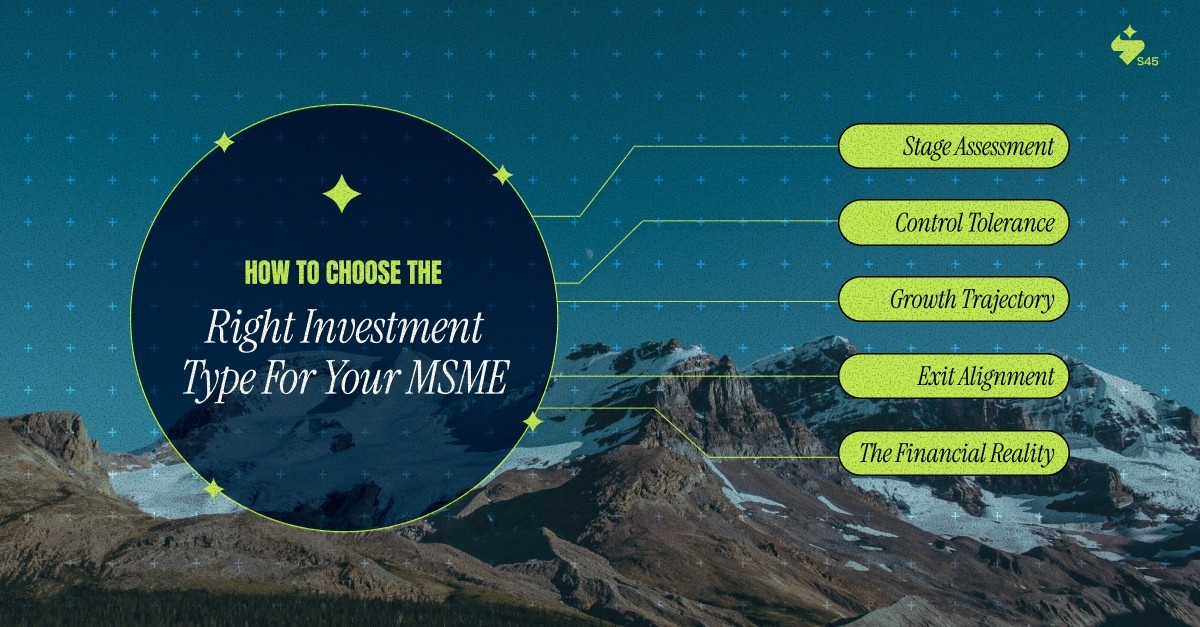
Choosing the right investment isn't about which is "best"—it’s about which aligns with your current stage and future goals. Here's a practical framework to help you decide.
Be honest about your business stage:
Think about giving up control:
If you’re uncomfortable losing control, angels or debt financing might suit you better.
Traditional MSMEs typically grow at 35-50% annually. This builds long-term value but doesn’t fit VC’s 3–5x annual growth target.
Consider your 7–10 year vision:
Be clear about your exit goals to avoid misaligned expectations.
Understand the financial terms:
Consult legal and financial experts before committing to any terms. You may end up with more equity and better economics through angels, even with slightly higher dilution.
Traditional funding models, angel, VC, PE, fit certain business types. Tech startups move from angels to VCs, while large corporates engage PE for transformations. But what about profitable, growing MSMEs in traditional sectors that don’t fit these categories?
This is where S45 adds value. Instead of forcing conventional businesses into venture models or demanding PE-style control, we focus on tailored growth strategies for MSMEs.
Connect with S45 to discuss how tailored capital and strategic support can accelerate your growth while maintaining your core values.
Discover more insights on similar topics