
April 1, 202612 min read
Traditional vs Alternative Investments: What You Need to Know Before Going Public
By Aman Singh
Investopedia

Both bonus shares and stock splits increase the number of shares a company’s shareholders hold, but they do so for different reasons and with distinct outcomes. While bonus shares reward existing investors by converting reserves into additional equity, stock splits make shares more affordable by dividing existing shares into smaller units.
Understanding the difference between bonus shares and stock splits is essential for investors to assess how each impacts share value, ownership, and market perception. This blog breaks down their key differences, benefits, and what they mean for your investment decisions.
When a company issues bonus shares, it's essentially converting its accumulated reserves into share capital, handing out additional shares to existing shareholders at no extra cost.
The face value of your shares stays the same. If it was ₹10 before, it stays ₹10 after. What changes is the number of shares in circulation and, as a result, the market price per share. The total value of your investment doesn't shift, just the price and quantity of the shares you own.
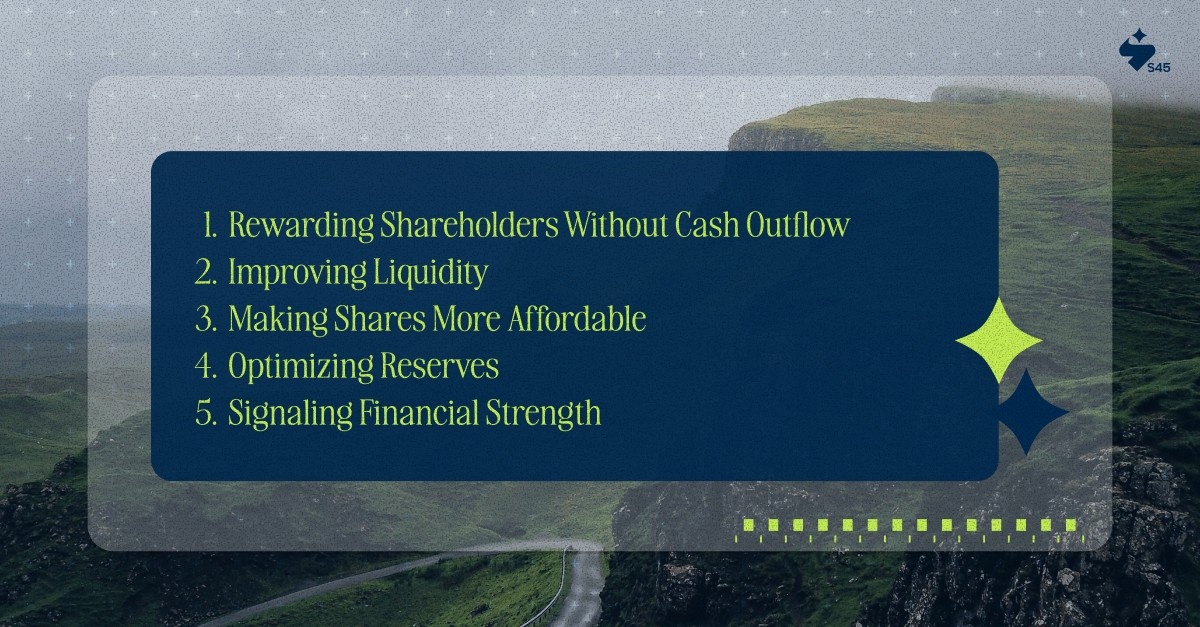
Bonus issues offer MSME founders more than just a way to reward shareholders. Here's why they’re a strategic choice:
At S45, we’ve seen manufacturing MSMEs use bonus issues to accomplish multiple goals—rewarding early investors, improving liquidity before an IPO, and signaling financial maturity, all while preserving cash. The key is timing and having enough reserves.
A stock split increases the number of shares by proportionally reducing the face value. Unlike bonus issues, there’s no transfer of reserves to share capital; it's simply a mathematical redivision of existing equity.
For example, Bajaj Finserv executed a 5:1 split in 2022 when the price crossed ₹15,000. As a result, retail participation surged, trading volumes increased by 340%, and shares became more accessible.

Stock splits aren’t just about the numbers; they serve a strategic purpose for MSMEs:
For MSMEs, the question isn’t "Should we split?" but "Does it align with our capital strategy?" If retail accessibility is a priority, especially with plans for an IPO, the answer is often yes. If you prefer an institutional-only shareholder base, a split may not be necessary.
At S45, we help founders think about capital decisions as strategic moves that shape the future of their businesses.
Now that we understand each action independently, let's compare them across the dimensions that actually matter to business owners:
Bonus shares and stock splits are both corporate actions that involve increasing the number of outstanding shares. However, they serve different purposes and impact shareholders differently. Here are the key differences between the two:
Aspect | Bonus Shares | Stock Split |
Definition | Additional shares given to existing shareholders at no extra cost, based on the number of shares they already own. Issued from retained earnings. | A company divides its existing shares into multiple new shares. The overall value of the investment remains unchanged, as the share price adjusts accordingly. |
Impact on Shareholders' Ownership | Ownership percentage remains the same. Shareholders receive additional shares, but the total value of their holdings doesn't change. | Ownership percentage remains the same. Shareholders receive more shares, but the price per share is adjusted to keep the total value the same. |
Market Capitalization | No impact on market capitalization. The total value of the company remains the same. | Market capitalization remains the same, but the share price is adjusted accordingly. |
Purpose | Typically, it is issued to reward shareholders and make the stock more affordable for small investors. | Generally done to lower the trading price of the stock to make it more accessible to a broader range of investors. |
Accounting Treatment | Issued by capitalizing the company's reserves, meaning they are distributed from retained earnings. | Does not involve any distribution of reserves; it's simply an increase in the number of shares, with a reduced share price. |
Dividend Impact | Shareholders will receive dividends on the bonus shares, but the overall dividend payout remains unchanged. | The dividend per share may be reduced due to the increased number of shares. |
Face Value | Remains unchanged | Reduces proportionally |
Share Capital | Increases (reserves move to share capital) | Remain unchanged (only the number of shares multiplies) |
Reserves | Decrease (transferred to share capital) | No change |
Whether you opt for a bonus issue or a stock split, four key elements remain unchanged:
The Takeaway for Founders: These actions don’t create wealth; they restructure existing wealth. If your business fundamentals are strong, these tools can optimize your capital structure for strategic reasons like fundraising, liquidity, or succession. If not, no corporate action will fix that.
Both bonus issues and stock splits can impact financial metrics. Here’s how:
The Practical Implication: Expect changes in your financial ratios following corporate actions. Advance communication with analysts, investors, and lenders is crucial to ensure they adjust their models and don’t misinterpret these changes as performance issues.
At S45, we guide founders through these ratio impacts before taking any action, because while the technical side is straightforward, strategic communication is where most founders need help.
You understand what bonus shares and stock splits are, now, let's discuss when they make strategic sense for your business stage and objectives.

When it comes to scaling your MSME, strategic decisions around capital structure can make all the difference. Let’s break down the key principles founders need to consider to make these decisions work in their favor:
By considering the timing, staying compliant with regulations, and ensuring clear communication, you can harness the power of these tools to benefit your business in the long run.
Understanding corporate actions intellectually is different from executing them strategically within your broader growth context. At S45, we go beyond just understanding corporate actions; we help you execute them strategically within your growth plan. We partner with founders to design a capital structure aligned with their vision.
Our expertise focuses on the "how," "when," and "why." While the mechanics of corporate actions are straightforward, strategic judgment is what truly matters: timing, impact on investors, signaling to lenders, and positioning for IPO.
How we support MSMEs:
Join the S45 Founder Community and connect with 200+ MSME founders, share insights, and solve growth challenges together.
Discover more insights on similar topics