April 1, 202612 min read
Traditional vs Alternative Investments: What You Need to Know Before Going Public
By Aman Singh
Investopedia

Disclaimer: This content is for educational purposes only and should not be considered as financial advice. Every business situation is unique, and we recommend consulting with qualified financial advisors before making important business decisions.
If you're an MSME founder who has built a profitable business over the past decade, you've likely hit a familiar wall. Bank loans come with rigid terms and mounting interest. Private equity investors want board seats and exit timelines that don't align with your vision. Family capital has its limits.
You're caught between the ambition to scale and the reality that traditional funding options either cost too much or demand too much control. The problem isn't your business model. It's that you haven't explored the one funding avenue designed to give you growth capital without surrendering your legacy: India's capital markets.
Here's what most MSME founders don't realize. Over 690 companies have already been listed on SME exchanges, raising thousands of crores while retaining majority control. The capital markets aren't just for Tata and Reliance anymore. SEBI has spent the last three years building infrastructure specifically for businesses like yours.
This guide walks you through exactly how capital markets work in India and which market type suits your growth stage.
The capital market is India's largest business matchmaking platform. It connects companies that need growth capital with investors hunting for returns. Unlike your relationship manager at the bank, this marketplace operates on transparency, valuation, and market forces rather than collateral and personal guarantees.
Here are the advantages of capital markets:
S45 works with MSME founders to evaluate whether capital markets align with your current business stage and growth ambitions. We help you understand the trade-offs between debt, private equity, and public markets before you commit to any path.
Now that you understand what capital markets offer, let's break down the two entry points available to MSME founders like you.
Types of Capital Markets: Primary vs Secondary
Most MSME founders get confused here. They hear "stock market" and think it's one giant trading floor. Actually, you're looking at two distinct markets that serve completely different purposes in your fundraising journey. Understanding this difference determines how you raise capital and when you can access liquidity.
This is where you actually raise fresh capital for your business. When you decide to go public, you're entering the primary market. Think of it as your one-time fundraising event where new shares get created and sold directly to investors.
Your Options in the Primary Market:
MSMEs raised ₹3,095 crore through SME IPOs in 2024, showing massive investor appetite. The money you raise here goes straight into your company's bank account. You use it for expansion, working capital, debt repayment, or whatever your business needs. Investors get ownership stakes in return.
Once your shares are listed, they start trading on exchanges like NSE and BSE. This is the secondary market. You've already raised your capital. Now investors trade your shares among themselves. You don't get any money from these transactions, but this market solves a critical problem.
Why the Secondary Market Matters for MSMEs:
Here's what makes this powerful. Unlike private equity, where investors lock in for five to seven years, public market investors can sell anytime. That flexibility attracts more capital to your primary fundraising. Banks also view listed companies more favorably when extending credit lines.
With this foundation clear, let's look at who actually makes these markets function.
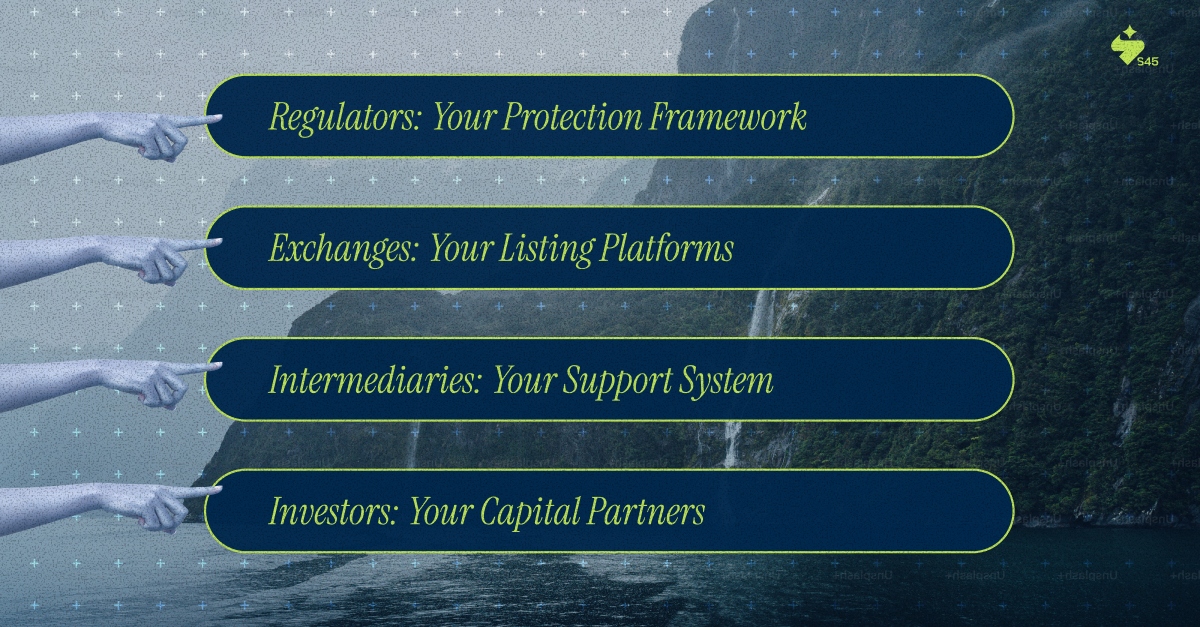
Going public isn't a solo journey. You'll work with regulators, exchanges, intermediaries, and investors throughout the process. Each player has a specific role in getting your MSME listed and keeping it compliant.
SEBI (Securities and Exchange Board of India) acts as the watchdog for India's capital markets. They set the rules, approve your listing documents, and monitor trading activities. But here's what's changed recently. SEBI launched a comprehensive review of listing norms in 2024, specifically to make public listings easier for MSMEs.
They've introduced the Saarthi app for investor education in multiple languages. Disclosure requirements have been simplified. The approval process that once took 12 months now averages 6 months. SEBI wants more quality MSMEs in public markets because it deepens capital availability across the economy.
NSE Emerge and BSE SME are your two main listing destinations. NSE Emerge typically attracts tech and service companies. BSE SME has a stronger presence among manufacturing and traditional businesses.
Both have lowered entry barriers significantly over the past three years. Your chances of a successful listing improve dramatically on these specialized platforms.
You'll need a merchant banker to manage your IPO process from start to finish. They prepare documents, coordinate with SEBI, conduct due diligence, and handle book building. Brokers connect retail investors to your offering. Investment banks sometimes co-manage larger SME IPOs alongside merchant bankers.
Many state governments now offer subsidies up to ₹5 lakh to cover listing expenses. Factor this into your budget planning.
India has over 100 million active retail investors seeking growth stories. Quality MSME IPOs regularly see 87x oversubscription.
Institutional investors like mutual funds and insurance companies add stability. High net worth individuals (HNIs) and family offices often become strategic partners beyond just capital. They bring networks, expertise, and long-term patient capital that pure financial investors don't provide.
S45 connects MSME founders with the right intermediaries based on your industry, size, and growth stage. We've built relationships with merchant bankers, legal advisors, and exchanges over the years. That saves you months of research and helps you avoid intermediaries who overpromise and underdeliver.
This ecosystem might seem complex at first glance. But once you know who does what, the path becomes clearer. Each player has specific expertise that plugs into different stages of your listing journey. Next, let's explore which financial instruments actually make sense for your business stage.
Not every MSME needs an IPO. Sometimes bonds make more sense. Other times, preference shares give you the capital without losing voting control. The capital market offers a menu of instruments, each designed for different business stages and funding needs. Choosing wrong costs you either too much dilution or an unsustainable debt burden.
Here's how to match instruments to your business maturity and growth requirements.
Your priority at this stage is growth capital without crushing debt obligations. Banks see you as risky. Capital markets offer alternatives that don't demand monthly EMIs or property mortgages.
Your Best Options:
You've proven your business model. Now you need serious expansion capital. Debt instruments become viable because you have steady cash flows to service interest payments.
Smart Funding Choices:
At this scale, you can access sophisticated instruments that optimize your capital structure and manage operational risks better.
Advanced Instruments:
Green and ESG-focused instruments are no longer nice to have. They're becoming competitive advantages that attract premium valuations.
Sustainability Focused Options:
The right instrument evolves as your business grows. As India's capital markets evolve, S45 stands ready to guide MSME founders through this transformation—combining capital access with strategic expertise to build enduring legacies.
Capital markets in India are practical funding tools for MSMEs ready to scale without sacrificing control or drowning in debt. The decision comes down to three questions. Does your business generate consistent revenues above ₹10 crore annually? Can you commit to transparent quarterly reporting and public scrutiny? Do you need growth capital exceeding ₹5 crore that banks won't provide on reasonable terms?
If you answered yes to all three, capital markets deserve serious evaluation. But here's the reality: most MSME founders don't know where to start. Which merchant banker actually understands your industry? How do you structure governance before spending lakhs on listing? What's the realistic timeline from decision to listing day?
This is exactly where S45’s strategic guidance makes the difference between a smooth listing and a costly false start.
We offer:
Connect with us to evaluate whether capital markets align with your growth strategy and legacy-building vision.
Discover more insights on similar topics