
April 1, 202612 min read
Traditional vs Alternative Investments: What You Need to Know Before Going Public
By Aman Singh
Investopedia

At a glance
Disclaimer: The information provided in this article is for general educational purposes only and should not be considered financial or career advice.
Most growth-stage founders approach IPOs with a single question: "How much equity should we sell?" That's the wrong question. The real question is: "Which mix of capital market instruments positions us for the strongest listing and sustainable post-IPO growth?"
Your capital structure, the blend of equity, debt, convertible securities, and strategic instruments, determines everything. Valuation multiples. Investor appetite. Post-listing liquidity. Long-term flexibility.
Yet most first-time issuers structure their IPOs using only fresh equity issuance. They leave millions on the table and create unnecessarily dilutive capital tables.
Capital market instruments are not abstract financial products. They are strategic tools that, when deployed correctly, transform promising companies into institutional-grade public entities.
This guide breaks down each instrument category with founder-specific applications for you.
Capital market instruments are financial securities issued and traded for long-term capital formation, typically one year or longer. For retail investors, these are portfolio diversification tools. For founders, they are capital structure building blocks that determine how you fund growth, manage dilution, and attract the right institutional investors.
Your pre-IPO capital structure signals everything about your business to QIBs (Qualified Institutional Buyers) and anchor investors:
The Indian IPO market raised ₹1.75 lakh crore in 2025 across the Main Board and SME segments. Companies that entered with optimized capital structures (mixing equity, debt, and strategic instruments) consistently demonstrated stronger anchor book coverage and better listing performance.
S45 benchmarks your capital structure against institutional standards, flags dilution and covenant risks early. It closes disclosure gaps, taking you from eligibility check to DRHP-ready faster through structured evidence mapping and AI-assisted drafting.
Capital markets operate through two interconnected segments that founders must navigate sequentially: the primary market (where you raise capital) and the secondary market (where your investors trade post-listing).
The primary market is where new securities are issued directly to investors. This is your IPO moment, when your company sells fresh shares or existing promoter shares (Offer for Sale) to institutional and retail investors.
Key primary market mechanisms for growth-stage companies:
The primary market is where your pricing, capital structure, and demand thesis get stress-tested. Strong IPO executions combine clean eligibility screening, evidence-linked DRHPs, and institutional-grade disclosure standards that meet SEBI's rigorous review process.
Once listed, your securities trade on secondary markets, NSE and BSE, where investors buy and sell among themselves without fresh capital flowing to your company.
Why this matters to founders:
The Securities and Exchange Board of India (SEBI) governs all capital market activity through the ICDR (Issue of Capital and Disclosure Requirements) Regulations 2018.
However, SEBI observations can delay your IPO by 45–90 days. S45’s AI-led readiness process identifies disclosure and control gaps early, strengthening compliance and accelerating readiness through evidence-linked documentation and gap analysis.
Now that you understand where these instruments operate, let's examine each instrument category in detail.
Capital market instruments fall into five categories, each serving distinct strategic purposes in your IPO journey.
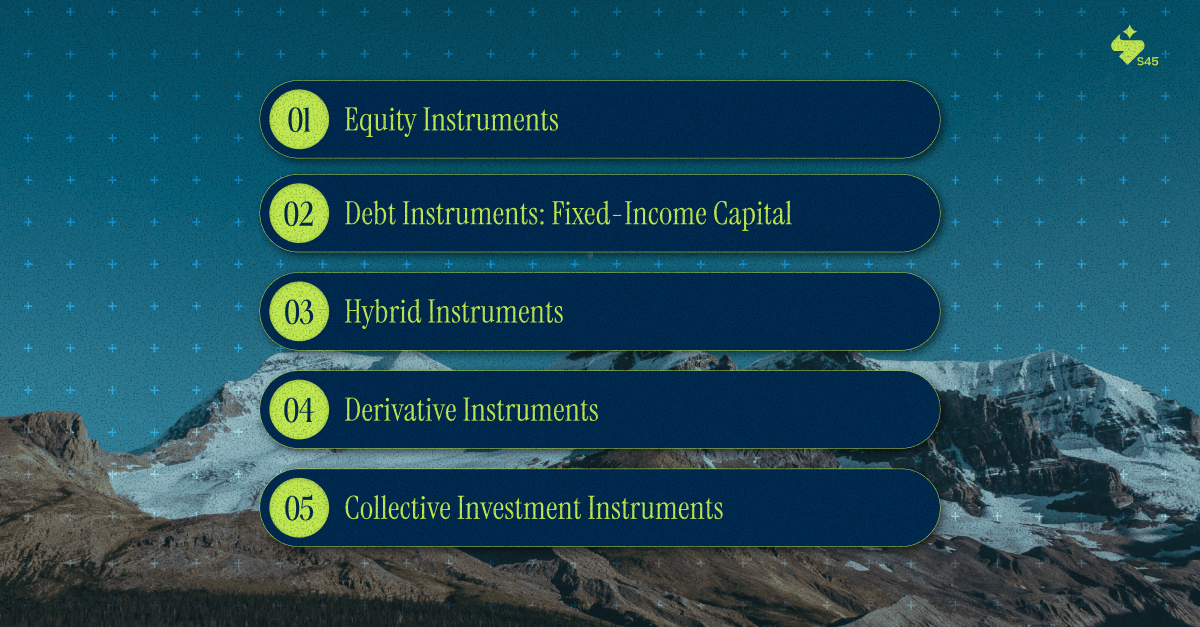
Equity represents ownership stakes in your company. When you issue equity, you sell a percentage of future profits, voting control, and liquidation proceeds in exchange for non-repayable capital.
They are ordinary shares with full voting rights, dividend eligibility (if declared), and residual claim on assets.
When to use for IPO:
Most Main Board IPOs combine both. Example: A ₹500 Cr IPO might have ₹350 Cr fresh issue plus ₹150 Cr OFS.
They are equity with fixed dividend rates, priority over common equity in liquidation, but typically no voting rights unless dividends are unpaid for two consecutive years.
Types:
When to Issue: Pre-IPO vs IPO Equity Decisions
Timing | Instrument | Purpose | Typical Cost |
Pre-IPO (12-18 months before listing) | Private Equity / Preferential Allotment | Bridge funding for growth, financial cleanup, and demonstrate momentum. | 15-25% IRR expectation |
IPO | Fresh Equity Issue | Major growth capital, institutionalize the company, create public currency | 12-18% (based on public market valuation) |
Post-IPO (6-12 months after listing) | QIP / Rights Issue | Expansion capital, M&A funding, leverage strong stock performance | 8-15% (discount to market price) |
Pre-IPO equity rounds at 30-50% higher valuations than your last funding round signal momentum to IPO investors. Post-IPO, a rising stock price makes QIPs the cheapest equity capital available.
Debt instruments represent loans to your company in the form of tradable securities. You receive capital upfront, pay periodic interest (coupon), and repay principal at maturity. Unlike equity, debt doesn't dilute ownership but creates repayment obligations and covenants.
They are long-term debt securities (3-10 years) issued by companies to institutional investors, typically in ₹10 lakh denominations.
Key features:
When to use for IPO:
Debt makes sense if:
They are similar to bonds but often issued by smaller companies or for shorter durations (1-5 years).
When to use for IPO:
Growth-stage companies raising ₹50-200 Cr often use secured debentures for:
Always prioritize secured debt or equity over expensive unsecured bonds.
They are debt issued by central (G-Secs) or state governments (SDLs—State Development Loans). Risk-free investments for institutions.
Why founders should care:
Government securities set the risk-free rate that anchors all other capital costs. As of Q4 2024, 10-year G-Secs yield approximately 7%. Corporate bonds trade at spreads above this (AAA at roughly +150 bps, BBB at +400 bps).
Your cost of debt and equity is directly tied to government bond yields. When G-Sec yields fall, capital becomes cheaper, creating favorable IPO windows.
Hybrid instruments combine equity and debt features, offering flexibility in capital structure design.
They are debt securities that convert into equity shares after a predetermined period or trigger event (such as an IPO).
Why use for IPO:
Convertible debentures work best when your pre-IPO valuation is defensible, but you expect 40-60% uplift at IPO. Structured correctly, they minimize dilution while attracting patient capital.
Rights issues work when your stock is trading strongly, and you need quick capital for M&A or expansion. Warrant sweeteners make pre-IPO debt cheaper (reduce coupon by 1-2%).
Hybrid instruments excel in three scenarios:
Over-engineered capital structures confuse IPO investors. Best practice: No more than two instrument types in your DRHP. Simplicity attracts capital.
Derivatives are financial contracts whose value derives from underlying assets (stocks, commodities, currencies, interest rates). For IPO-bound companies, derivatives serve as hedging tools, not capital-raising instruments.
Futures: Contracts to buy or sell an asset at a predetermined price on a future date. Companies use commodity futures (steel, oil) or currency futures (USD/INR) to lock in input costs or export revenues.
Options: Rights (not obligations) to buy (call option) or sell (put option) an asset at a strike price. Used for:
Companies with visible hedging strategies often trade at premium multiples in volatility-prone sectors (chemicals, metals, textiles) because they demonstrate operational maturity.
However, post-IPO investor relations should include risk management disclosures and quarterly hedging updates to institutional investors, building confidence in financial discipline and management capability.
Collective investment vehicles pool money from multiple investors and deploy across diversified portfolios. For founders, these represent key institutional investor categories in your IPO.
They are SEBI-registered funds that collect money from retail and institutional investors and invest in stocks, bonds, or mixed portfolios.
Why this matters for IPO:
Mutual funds dominate the QIB category (75-80% of QIB allocations in most IPOs per NSE data). Attracting domestic mutual funds—HDFC MF, ICICI Prudential, SBI MF, Aditya Birla MF—is critical for oversubscription.
They are passively managed funds that track indices (Nifty 50, Nifty Midcap, sector indices). ETFs must buy your stock if you enter their benchmark index.
Post-IPO opportunity:
Getting included in Nifty indices drives passive inflows. Nifty Midcap 150 inclusion alone can trigger substantial automatic ETF buying based on index weights.
Maintain market cap above index thresholds, ensure minimum 10% free float per NSE requirements, trade with adequate daily turnover for 6 months post-listing.
Companies executing disciplined IR frameworks consistently demonstrate higher institutional holding percentages versus peers by 12 months post-listing.
Also Read: Pre-IPO Investing in India: A Complete Guide for Smart Investors
Choosing capital market instruments is not about "what sounds good" but about strategic sequencing aligned with your growth stage, cash flow profile, and listing timeline. Follow the tips below:

Smart instrument selection protects ownership, improves valuation, and sets the foundation for long-term public market success.
Also Read: How Capital Markets Turn Ambition into Sustainable Growth
Capital market instruments are complex and often misunderstood by first-time issuers. IPO success depends on choosing the right instruments, timing them correctly, and structuring them with precision. Institutional discipline and execution quality separate strong listings from failed attempts.
S45 operates as an AI native investment bank, partnering with Narnolia, a Category I Merchant Banker, to execute IPOs across the Main Board and SME platforms.
Our services cover the full IPO lifecycle:
S45 treats IPOs as capital engineering exercises, not transactions. Every instrument, disclosure, and interaction follows a disciplined, regulation-driven process built for long-term market credibility.
Ready to structure your capital for a successful IPO. Start with S45 and bring execution discipline to your listing journey.
Discover more insights on similar topics