
February 23, 202612 min read
How to Get Funding Help for Startups: Beyond VC Rounds to Public Markets
By Abhishek Bhanushali
Startup Funding

Disclaimer: This content is for educational purposes only and should not be considered as financial advice. Every business situation is unique, and we recommend consulting with qualified financial advisors before making crucial business decisions.
If you have raised institutional capital in India (whether from domestic VCs, cross-border funds, or strategic investors), you already know where cross-funding manifests. It appears in board discussions about follow-on rounds. It surfaces when your Series B lead wants to bring in their growth fund. It becomes operational friction when SEBI's ICDR disclosures demand granular detail on every funding source, timeline, and ownership structure.
Cross-funding is not a funding innovation. It is a structural reality in venture capital and growth equity, one that Indian enterprises preparing for IPOs must document with institutional precision, not manage retrospectively. AI-native investment banks now compress this documentation timeline from months to weeks, but only when paired with a sector banker's judgement that understands SEBI's interpretive requirements.
The chaos emerges when promoters treat historical funding as "done deals" rather than evidence trails that SEBI scrutinizes line by line.
Cross-funding operates across three distinct structures in global capital markets:
Cross-fund investment occurs when a venture capital firm manages multiple funds and deploys capital from more than one fund into the same portfolio company. A VC with Fund I (vintage 2018) and Fund II (vintage 2021) invests from both vehicles into your Series B. This creates layered ownership, staggered valuations, and documentation requirements that Indian promoters must unwind before drafting the DRHP.
Crossover funding represents institutional investors, typically mutual funds, hedge funds, or asset managers investing in private companies before their IPO. These investors bridge the private-public gap, often participating in late-stage rounds six to twelve months pre-listing. In Indian markets, crossover rounds have compressed from 180+ days to under 100 days between funding and filing, intensifying the documentation burden.
Cross-border funding involves raising capital from investors domiciled in multiple jurisdictions. For Indian enterprises, this means FPI structures, NRI investments, and offshore holding companies all requiring RBI compliance, FEMA adherence, and SEBI-compatible disclosure frameworks.
Firms like S45 encounter these structures daily in IPO readiness assessments, where cross-border complexity often becomes the primary documentation bottleneck for promoters targeting Main Board listings.
Indian promoters preparing for Main Board or SME Exchange listings face cross-funding complexity across three operational phases, requiring institutional-grade precision.
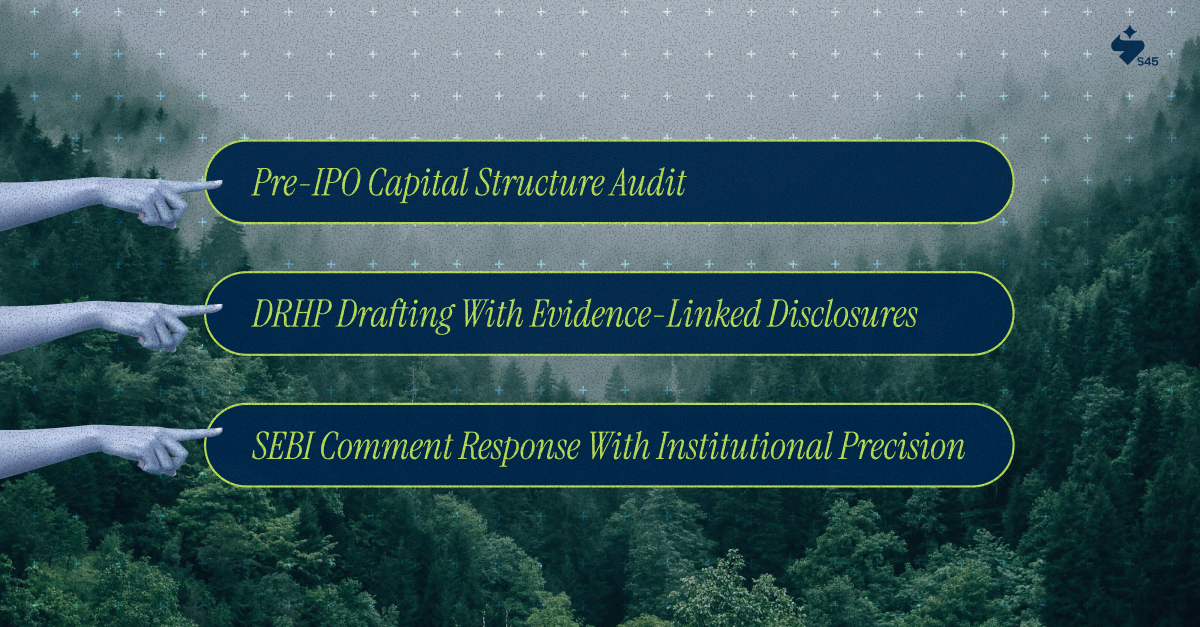
Every funding source must map against SEBI ICDR requirements. Cross-fund investments require disclosure of each fund's vintage, corpus, LP structure, and investment thesis. Crossover rounds require evidence of fair market valuation, an independent appraisal, and minutes of board approval. Cross-border capital necessitates FEMA compliance certificates, RBI approvals, and beneficiary ownership trails. AI-native platforms can compress this audit from weeks to days by automating evidence assembly whilst maintaining banker-grade accuracy.
Every DRHP section must link cross-funding transactions to source documentation. Promoter shareholding tables trace backward through each funding round. Related party disclosures map relationships across funds managed by the same firm. The material contracts section itemizes investor rights, anti-dilution provisions, and exit clauses embedded in cross-fund or crossover structures.
When SEBI queries cross-funding structures (and SEBI always queries complex cap tables), responses require evidence-backed answers: shareholder agreements, board resolutions, valuation certificates, and RBI approvals. No narrative explanations. No promotional language. Only documentation that closes regulatory scrutiny.
Indian IPOs fail operationally when promoters underestimate the precision required in cross-funding documentation. The chaos manifests predictably:
Promoters maintain investor data in spreadsheets, legal counsel holds shareholder agreements, and CFOs manage compliance in separate folders. Cross-fund investments span multiple documents across years. Crossover rounds introduce investor rights that conflict with listing requirements. Cross-border structures generate tax certificates stored in email threads.
Each cross-fund deployment carries its own valuation methodology. Crossover rounds price at discounts to projected IPO valuations. Cross-border investors negotiate currency-adjusted returns. When SEBI demands coherent valuation progression in the DRHP, promoters discover their funding history lacks institutional coherence.
Companies with clean cross-funding documentation receive SEBI observations in 30-45 days. Enterprises with fragmented records may require 90-120 days, as regulators issue multiple rounds of comments to clarify shareholder structures, related-party transactions, and ownership structures.
This is not market risk. This is a workflow failure that can be prevented through institutional-grade documentation, from initial funding through SEBI filing.
SEBI ICDR Regulations demand traceable evidence for every cross-funding structure. Indian promoters often struggle to explain complex cap tables clearly. They must document them with source-level precision.

Every cross-fund investment requires disclosure of material terms: anti-dilution rights, board representation, information rights, and exit preferences. SEBI evaluates whether these rights conflict with public market requirements. Companies must either amend their pre-IPO agreements or disclose their continuing obligations post-listing.
When the same VC firm invests through multiple funds, SEBI treats each fund as a separate related party requiring individual disclosure. Transactions between portfolio companies backed by the same investor trigger additional scrutiny. Modern AI systems automatically identify these relationships, ensuring no related-party disclosure gaps that could extend SEBI approval cycles.
FPI investments require RBI approval documentation. NRI funding needs FEMA compliance certificates. Offshore holding structures demand beneficiary ownership disclosure. Each document must link to the corresponding DRHP section with date-stamped evidence.
This is not the best practice. This is an institutional requirement and the difference between 45-day DRHP approval and 120-day regulatory loops.
Great IPOs treat cross-funding complexity as structure, not constraint. S45 positions SEBI's ICDR and LODR regulations as the framework that transforms fragmented funding history into institutional disclosure.
SEBI mandates minimum holding periods for pre-IPO shareholders. Cross-fund investments made at different times require separate holding period calculations. Crossover investors participating within 12 months of filing face enhanced disclosure obligations. S45's IPO execution workflow tracks every deadline against SEBI timelines, ensuring zero compliance gaps.
Promoter shareholders face mandatory lock-in post-listing. Cross-fund investments held through multiple entities require consolidated lock-in calculations. Crossover investors negotiate reduced lock-ins based on investment timing. Institutional-grade DRHP preparation maps these structures with precision that survives stock exchange scrutiny.
Cross-funding structures create ongoing LODR obligations. Related party transactions continue to require quarterly disclosure. Material investor agreements trigger event-based announcements. Companies that treat listing as the finish line discover that cross-funding complexity extends into public market operations.
AI-native platforms compress cross-funding documentation from months to weeks, not by eliminating rigour, but by automating evidence assembly.

AI cannot determine whether a cross-fund investment triggers related party disclosure without understanding SEBI's interpretive guidance. Algorithms cannot assess whether crossover investor rights conflict with listing requirements without institutional market experience.
Effective IPO execution pairs proprietary AI with seasoned sector bankers who have defended cross-funding structures in SEBI comment responses, negotiated investor right amendments pre-listing, and structured crossover rounds that validated IPO readiness without compressing due diligence timelines.
The platform accelerates documentation. Banker judgment ensures the documentation survives regulatory scrutiny.
For mid-market enterprises targeting SME Exchange listings, cross-funding creates distinct operational considerations. SEBI's revised ICDR regulations (effective March 2025) tightened eligibility norms: companies with outstanding convertible securities face listing restrictions, minimum EBITDA thresholds apply, and promoter ownership changes trigger waiting periods.
Cross-fund investments through convertible instruments must be converted before the SME IPO filing. Crossover rounds must demonstrate institutional validation and must not exceed the ₹25 crore post-issue paid-up capital threshold. Cross-border funding needs simplified disclosure given SME investors' limited appetite for complex ownership structures.
Institutional IPO execution integrates these constraints into capital structure planning, ensuring cross-funding enhances listing readiness rather than creating regulatory friction.
Crossover investors enter pre-IPO rounds expecting liquidity at listing. Cross-fund structures may include exit timelines tied to public market performance. These expectations create post-IPO liquidity pressure that promoters must design for, not discover.
Institutional liquidity design maps cross-funding exit scenarios against listing-day supply-and-demand dynamics. If crossover investors hold 15% pre-IPO equity and expect 6-month exits, the listing-day orderbook must absorb that selling pressure without destabilising price discovery.
This is capital markets craftsmanship (treating cross-funding not as isolated financing events, but as integrated components of listing execution).
Promoters raising cross-fund or crossover capital face legitimate pressure: boards demand growth capital, institutional investors offer validation, and market windows compress decision timelines.
The institutional reality remains unchanged: every funding structure you accept today becomes a documentation obligation tomorrow. Crossover rounds that validate market appetite also introduce investor exit expectations. Cross-fund investments that provide patient capital also create layered disclosure complexity.
Empathy is understanding the pressure. The discipline is in adhering to demanding documentation standards that withstand SEBI scrutiny (before you commit to the funding structure, not after regulatory comments arrive).
Cross-funding structures (whether cross-fund investments, crossover rounds, or cross-border capital) are inevitable components of India's institutional growth capital landscape. The operational challenge for IPO-bound promoters is not whether to engage with these funding models, but whether to document them with the institutional precision SEBI demands.
Companies that treat cross-funding as a discrete financing event encounter complexity during DRHP preparation. Enterprises that institutionalize documentation from first funding onward compress IPO timelines, reduce regulatory friction, and enter public markets with a cap table that withstands scrutiny.
The difference between 45-day SEBI approval and 120-day comment loops is not market timing or sector dynamics. It is a documentation discipline applied before regulatory pressure arrives.
Cross-funding is a structural reality. How you document it determines whether it accelerates or derails your IPO execution.
S45 pairs AI-native DRHP systems with sector banker judgement to transform cross-funding complexity into institutional-grade documentation. Schedule an IPO Readiness Scan to evaluate your capital structure against SEBI requirements before you commit to additional funding rounds.
Discover more insights on similar topics