
February 12, 20269 min read
What is Cross-Funding? Understanding Global Options
By Aman Singh
Startup Funding

Disclaimer: This content is for educational purposes only and should not be considered as financial advice. Every business situation is unique, and we recommend consulting with qualified financial advisors before making important business decisions.
The Indian IPO market recorded 62 public listings in Q1 2025, raising approximately $2.8 billion and accounting for 22% of global IPO activity. Behind these numbers lies an institutional truth that growth-stage enterprises learn the hard way: IPO delays are rarely market-driven. They are workflow failures.
Founders who cross ₹100 crore in revenue realise that funding help is no longer about pitching or closing rounds. It is about translating operational success into public-market readiness. About turning management narratives into SEBI-compliant disclosures. About defending growth with evidence that survives regulatory scrutiny, not boardroom optimism.
This is where traditional funding breaks. Between the mandate and DRHP, enterprises find that their financials were built for private reporting, not public disclosure. Related-party transactions resurface as SEBI observations. Cap tables designed for speed need forensic reconstruction. PE pricing logic fails to hold in public-market valuation frameworks.
Most IPO timelines break here. Not from lack of ambition, but from confusing advisor coordination with institutional execution. Adding consultants instead of building integrated infrastructure where compliance is craftsmanship and evidence is currency.
The companies that reach listing day are not the best storytellers. They are the ones who replaced fragmented workflows with institutional discipline before SEBI saw the first draft.
In 2016, the Government of India established the Fund of Funds for Startups with a corpus of ₹10,000 crore to catalyse venture capital investments through SEBI-registered Alternative Investment Funds. The Startup India Seed Fund Scheme provides up to ₹20 lakh in grants for proof of concept and prototype development. These are valuable instruments for companies in their first 24 months of incorporation.
But if you're reading this as a CFO of a ₹200 crore enterprise with institutional investors on your cap table, government seed funding isn't relevant. Neither is another advisory engagement that promises "IPO readiness" without defining what that means in SEBI's language.
The funding help you need isn't capital; it's institutional clarity.
This means:
You don't need consultants who build decks. You need execution partners who own outcomes.
Traditional IPO preparation in India operates through a fragmented advisor ecosystem: one firm for financial due diligence, another for legal drafting, a third for valuation, and merchant bankers who coordinate but don't execute. Each advisor works in silos. Each produces documents that must be manually reconciled. Each assumes someone else verified the underlying data.
This is the "chaos gap": the structural inefficiency that turns a 90-day DRHP process into a 6-month ordeal.
The chaos manifests predictably:
Founders lose months reconciling conflicting advisor inputs before SEBI even reviews substance. By the time the DRHP is filed, market conditions have shifted, investor appetite has changed, and the entire pricing thesis needs to be recalibrated.
The chaos gap isn't solved by hiring more advisors. It's solved by replacing fragmented workflows with institutional execution infrastructure. This is the problem S45 was built to solve: an AI-native investment bank that pairs seasoned sector bankers with proprietary systems to compress IPO timelines from 6 months to 30-45 days while maintaining institutional rigour.
The model eliminates coordination layers by consolidating readiness, drafting, compliance, and execution into a single workflow, where evidence architecture and regulatory precision occur simultaneously.
SEBI doesn't accept narratives. It demands evidence. Every claim in your DRHP - revenue growth, market position, competitive advantages - must be traceable to source documents. Every number must show its math. Every disclosure must withstand forensic examination.
Traditional DRHP drafting relies on manual document review and subjective interpretation. Bankers read management presentations, ask clarifying questions, and draft disclosures based on their understanding of the business. This process is slow, error-prone, and vulnerable to omissions.
AI changes the evidence architecture fundamentally. Natural language processing can parse thousands of pages of board minutes, financial statements, legal agreements, and operational reports to extract disclosure-relevant facts. Machine learning identifies related-party transactions, contingent liabilities, and risk factors that human review might miss. Every claim in the DRHP is hyperlinked to its source document.
Also read: The Essential Credit Funding Guide for Indian SMEs: Scores, Risks & Smarter Decisions
The SEBI (Issue of Capital and Disclosure Requirements) Regulations, 2018, and the SEBI (Listing Obligations and Disclosure Requirements) Regulations, 2015, are not obstacles. They are the architecture that enables public market trust.
Great IPOs treat regulation as structural design, not red tape.
ICDR shapes the offer structure:
LODR defines post-listening discipline:
Compliance determines how capital is raised and how credibility is sustained.
Founders who ask, “What does SEBI require?” usually discover gaps too late.
This leads to:
Reactive compliance always costs more, in time and credibility.
Founders who ask, “How do we build institutional infrastructure?” move faster. They:
This mindset shift, from friction to craftsmanship, separates successful listings from withdrawn DRHPs.
AI-native systems can operationalize regulatory rigor. Instead of reviewing compliance after drafting, the system:
Compliance isn’t layered on top.
It’s built into the foundation.
AI doesn't replace investment bankers. It eliminates the manual labor that prevents them from applying judgment where it matters.
Traditional DRHP drafting involves:
This process takes 4-6 months and produces documents that still contain gaps. Not because bankers lack expertise, but because manual workflows don't scale to the volume and complexity of modern enterprises.
AI compresses this timeline to 30-45 days by:
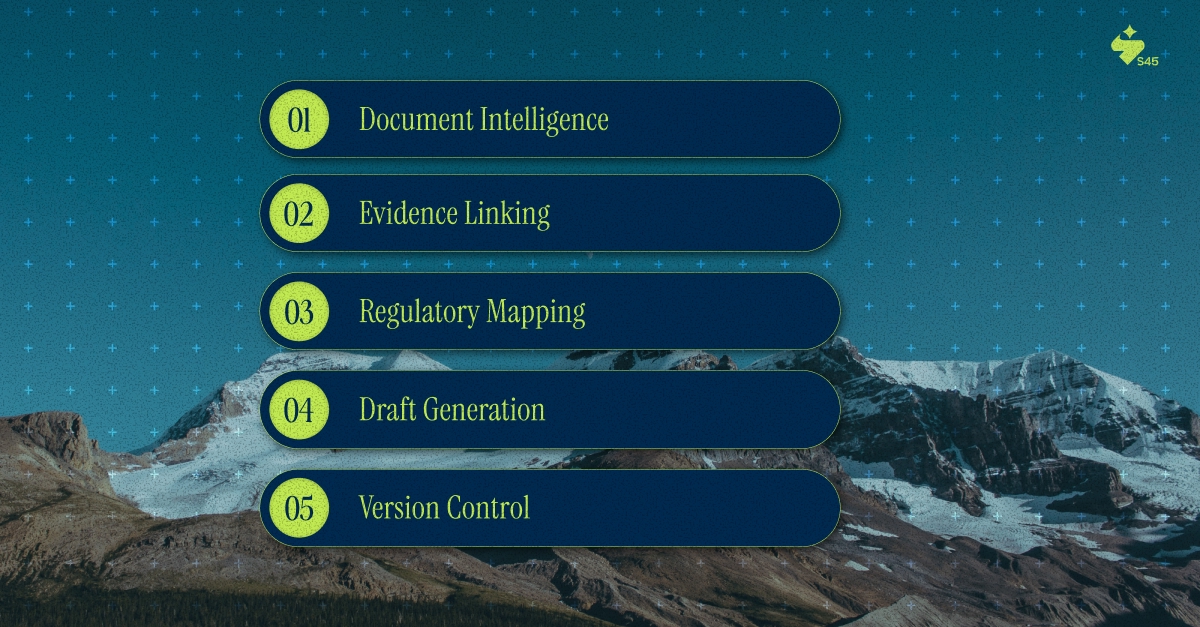
But AI cannot:
This is why platforms like S45 pair AI infrastructure with sector bankers who have sat across SEBI comments, defended pricing logic, and cleaned up founder-led chaos without ego. The AI handles execution precision. The bankers handle institutional judgment.
Enterprises that try to use AI without banker oversight produce compliant but uncompetitive documents. Enterprises that rely solely on traditional bankers without AI infrastructure produce slow, expensive outcomes. Both approaches fail.
When growth-stage enterprises ask for "funding help," they're actually asking: "Can we access public markets without destroying everything we've built?"
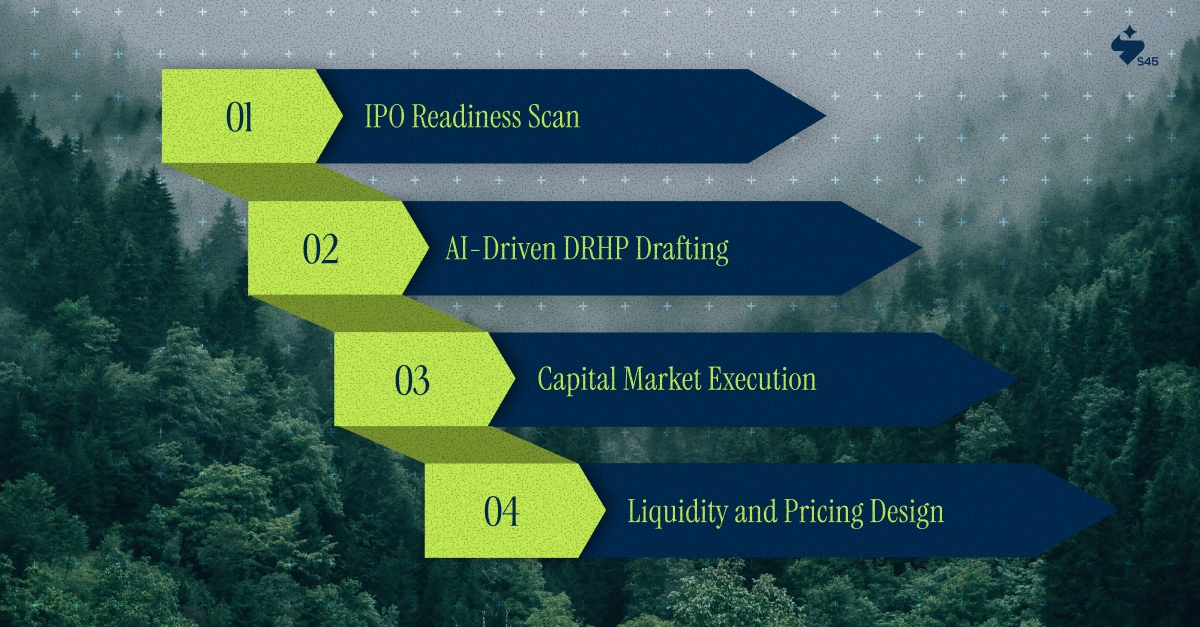
The answer lies in a structured pathway that treats IPO preparation as institution-building, not a fundraising event:
Not a consulting report. A diagnostic that identifies operational, financial, and governance gaps before committing to the IPO process. This examines cap table cleanliness, financial system robustness, documentation of related-party transactions, board composition, and regulatory compliance posture. The output isn't a to-do list. It's a decision framework: are you ready now, or do you need six months of institutional infrastructure before engaging investment bankers?
Once readiness is confirmed, AI systems can generate the first draft of a DRHP in 30-45 days. Every section (company overview, risk factors, financial performance, use of proceeds) contains evidence-linked disclosures. Sector bankers review, refine, and ensure the document defends the valuation thesis while meeting SEBI standards. The result is a DRHP that survives regulatory scrutiny without requiring fundamental rewrites.
Execution matters on both the Main Board and SME Exchange listings. For Main Board IPOs, the focus is on enterprises with institutional-grade financials and governance. For SME listings, execution extends to designing liquidity frameworks and pricing strategies that prevent post-listing collapse. Too many SME IPOs list at inflated valuations, crash within weeks, and destroy founder credibility. Institutional execution treats SME listings as seriously as the Main Board because reputation is on the line either way.
Especially critical for SME listings, where thin trading volumes and market maker arrangements determine whether a stock becomes tradable or trapped. Proper execution designs offer structures that balance founder liquidity needs with investor confidence. This includes advising on anchor allocation, retail reservation, and price band positioning. Post-listing, liquidity metrics must be monitored to ensure the stock doesn't become dead capital.
This isn't a services menu. It's an integrated execution pathway in which each stage builds institutional credibility for the next. Platforms like S45 implement this model by owning outcomes from readiness through listing, treating each phase as a connected infrastructure rather than a series of disconnected advisory engagements.
Also read: Is Your Business Facing a Funding Gap? Here’s What Every SME Should Know
Preparing for an IPO is a psychological "moment of reckoning" that rarely appears in pitch decks. It is the transition from a company built on Founder Instinct to an enterprise sustained by Institutional Infrastructure.
The shift from private to public is not a loss of authority; it is an evolution of leadership. Successful promoters recognize that the very traits that built the company must now be "institutionalized" to protect it.
The hesitation founders feel is not irrational; it is a response to the structural realities of the public market. We address these fears through structure, not reassurance:
IPO preparation is often mischaracterized as a surrender of control. In reality, it is a migration from personal influence to institutional scale.
Institutional execution is not for the faint of heart. It requires a fundamental mindset shift:
Bottom Line: If you treat an IPO as a "fundraising event," the process will feel like a constraint. If you treat it as Institution-Building, that same discipline becomes your greatest competitive advantage.
Not every enterprise needs IPO execution support. Some should remain private. Others need operational maturity before engaging capital markets.
Institutional funding help makes sense when:
Enterprises aren't ready if:
An IPO Readiness Scan exists to answer this question honestly. Better to hear "not yet" in month one than withdraw a DRHP in month eight after spending ₹2 crore on advisors.
The funding help growth-stage enterprises need at ₹100 crore revenue isn’t more capital or pitches. It is an institutional execution infrastructure that compresses IPO timelines without compromising regulatory rigour.
India’s capital markets are rewarding preparedness. Venture-backed firms raised $4.9 billion through IPOs in 2025, marking a shift from cash-burning growth to financial discipline. The winners treat compliance as craftsmanship, evidence as currency, and AI as infrastructure, not innovation theatre.
The gap between mandate and DRHP filing breaks more IPO timelines than the market does. Fragmented advisors, manual workflows, and weak evidence trails turn 90-day processes into six-month ordeals. Companies that reach listing day aren’t the best storytellers. They are the ones who replaced coordination with integrated execution before SEBI reviewed the first draft.
Institutional funding help means owning outcomes: readiness, DRHP drafting, compliance infrastructure, pricing strategy, and post-listing liquidity design. It treats IPO preparation as institution-building rather than fundraising.
Public markets aren’t getting easier. But execution is accelerating for enterprises that replace advisor chaos with AI-native systems paired with sector-specific banking expertise.
Before committing months and reputation to the IPO process, get an IPO Readiness Scan from S45. Institutional clarity begins with knowing whether you're prepared now or what infrastructure needs to be built first.
Discover more insights on similar topics