
6 Sources of Debt Financing for Entrepreneurs

6 Sources of Debt Financing for Entrepreneurs

By Abhishek Bhanushali
January 15, 2026
10 min read
Debt & Equity Financing

Key Takeaways

  • Indian entrepreneurs can access six types of institutional debt sources, from traditional banks to venture debt funds, each serving different stages of IPO readiness.
  • Main Board candidates typically maintain debt-to-equity ratios of 1:1 to 1.5:1 to demonstrate financial discipline while preserving valuation multiples.
  • Government-backed schemes like SIDBI offer interest rates of 8-11%, strengthening IPO disclosures while reducing capital costs.
  • Time your debt strategically. Structure term loans 18 months before IPO, bridge financing 6 months out, and optimize working capital in the final quarter before listing.
  • S45's evidence-linked approach helps mid-market companies align debt facilities with SEBI disclosure requirements and institutional investor expectations.

Disclaimer: This content is for educational purposes only and should not be considered as financial advice. Every business situation is unique, and we recommend consulting with qualified financial advisors before making important business decisions.

You’ve built a ₹50 crore business with strong margins and diversified customers, yet scaling to ₹200 crore without dilution feels risky and unclear.

The problem isn’t access to capital, it’s choosing debt that won’t trigger SEBI red flags or complicate IPO disclosures.

This guide explains 15+ institutional debt options that align with IPO timelines, helping you raise capital without weakening your public-market readiness.

What is Debt Financing and Why is it Popular in Indian Businesses?

Debt financing means borrowing capital that you repay over a fixed period with interest. Unlike equity, it does not dilute ownership or board control. You retain decision-making authority while using external capital to fund growth, working capital, or asset expansion.

The lender earns predictable returns through interest and scheduled repayments. You retain strategic control.

Why Indian Businesses Prefer Debt Financing

Indian promoters increasingly choose debt over equity for four practical reasons:

  1. Control and ownership remain intact: Promoter families prefer debt because it avoids dilution. You scale the business without giving up voting rights, board seats, or long-term control.
  2. Tax efficiency lowers the real cost of capital: Interest paid on business loans is tax-deductible under Section 24 and Section 36(1)(iii) of the Income Tax Act, reducing effective borrowing costs.
  3. Easier access to institutional credit: India’s lending ecosystem has matured post-2015. Banks, NBFCs, and government-backed schemes like MUDRA and Stand-Up India have expanded credit access for mid-market and growth-stage companies.
  4. Strong signal for IPO readiness: Structured debt from regulated institutions signals discipline. It shows that third-party lenders have vetted your cash flows, governance, and repayment ability.

However, not all debt supports an IPO journey.

Some facilities include restrictive covenants, promoter guarantees, or cross-default clauses that create red flags during SEBI reviews. Others complicate disclosures under ICDR regulations or weaken your governance narrative.

That’s why timing and structure matter.

S45 helps founders design debt structures aligned with IPO milestones. We evaluate how each loan impacts disclosures, related-party reporting, and promoter obligations, ensuring your capital stack strengthens, not delays, your public listing.

Also Read: Debt vs Equity Financing: A Complete Guide for Indian MSME Founders

Now, let’s explore specific debt sources available and when to use each one.

6 Sources of Debt Financing for Entrepreneurs in India

Indian entrepreneurs have access to multiple institutional debt channels. Each source offers distinct advantages in terms of interest rates, approval speed, and IPO compatibility. The key is matching the right source to your capital need and listing timeline.
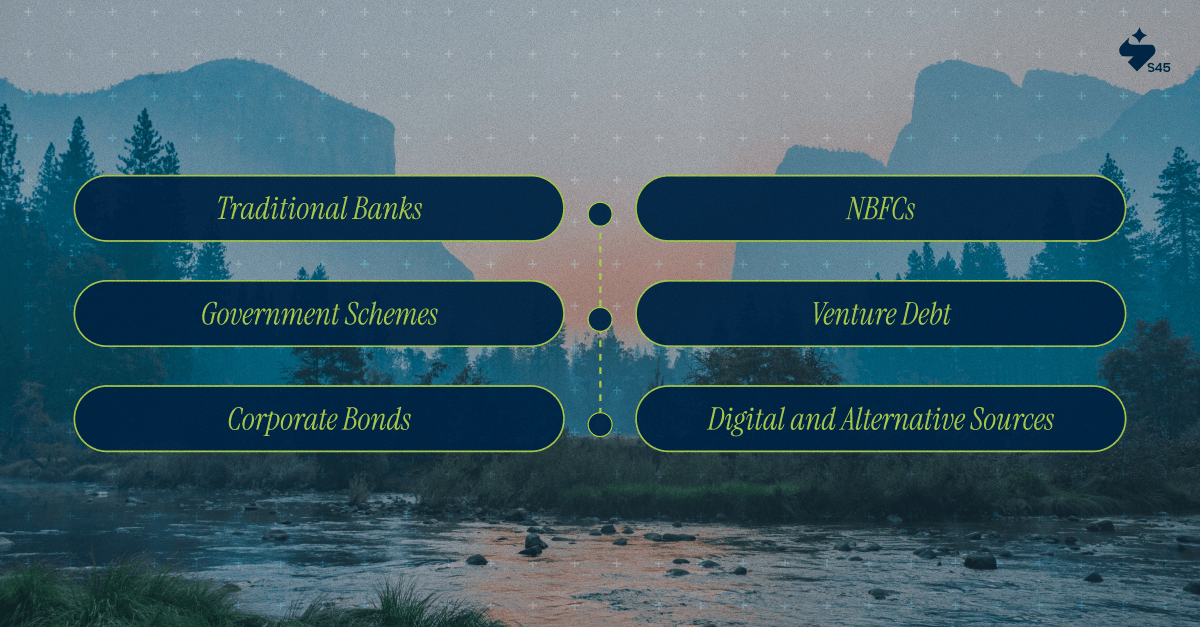
6 Sources of Debt Financing for Entrepreneurs in India

1. Traditional Banks

Scheduled commercial banks offer the lowest rates, longest tenures, and strongest regulatory credibility. They also impose strict documentation requirements and credit evaluation processes.

  • Term Loans finance long-term assets with 5-10 year tenures at 9-12% interest. Loan amounts scale from ₹5 crore to ₹100+ crore based on collateral value. Banks require security worth 1.25x to 1.5x the loan amount.
  • From an IPO perspective, term loans from State Bank of India, HDFC Bank, or ICICI Bank create clean audit trails. Institutional investors view this lending as third-party validation of your business model.
  • Working Capital Loans cover operational needs at 10-13% annually. These include cash credit limits, overdrafts, and letter of credit arrangements. Banks evaluate your Current Ratio and Operating Cycle metrics closely. Strong working capital management signals operational efficiency.

S45 structures banking relationships 18-24 months pre-IPO to establish debt servicing history. Our DRHP drafting ensures every security interest and covenant appears correctly in disclosure schedules.

2. NBFCs

NBFCs approve faster than banks, taking 7-15 days versus 30-45 days. They handle smaller ticket sizes with more flexible documentation. But interest rates run 200-400 basis points higher.

  • Secured business loans from Bajaj Finance, Tata Capital, or L&T Finance range from ₹25 lakh to ₹10 crore at 12-18% interest. Tenures run 3-5 years. Collateral requirements are more flexible than those of banks.
  • Equipment financing helps acquire machinery or technology infrastructure. NBFCs finance 70-90% of asset value at 13-17% rates. This works well for manufacturers needing rapid capacity expansion.
  • Invoice discounting converts receivables into immediate cash. NBFCs advance 70-85% of invoice value at 14-20% annualized rates. This improves working capital cycles but requires disclosing customer relationships.

Use NBFCs strategically for time-sensitive opportunities where bank approval timelines would cause you to miss growth windows. Disclose these higher-cost facilities transparently in your DRHP. Institutional investors will ask why you chose NBFCs over banks.

3. Government Schemes

Government schemes and DFIs offer the most favorable terms. Lower interest, longer tenures, and softer collateral requirements. They also signal institutional credibility because government backing implies rigorous evaluation.

  • SIDBI loans target MSMEs at 8-11% interest with 7-10 year tenures. SIDBI offers specialized products for technology upgradation, energy efficiency, and growth capital. For IPO candidates, SIDBI lending demonstrates government recognition of your sector's importance.
  • CGTMSE provides collateral-free credit guarantees up to ₹5 crore. This helps companies without substantial tangible assets access bank credit. Lenders waive collateral requirements because CGTMSE absorbs default risk.
  • Export credit through EXIM Bank carries concessional rates of 7-10% due to export promotion priorities. Pre-shipment and post-shipment finance support companies with significant export revenue.
  • Green financing schemes incentivize renewable energy and climate-friendly projects. These facilities offer 50-100 basis point rate discounts compared to standard loans.

Government-backed debt strengthens your ESG narrative and policy alignment story. Include these prominently in your DRHP's sustainability sections.

4. Venture Debt

Venture debt serves high-growth companies between funding rounds. It's subordinated debt carrying 14-18% interest plus warrants. Ticket sizes range from ₹5-50 crore with 2-4 year tenures.

  • Funds like Trifecta Capital, Alteria Capital, or InnoVen Capital target companies with existing venture capital backing. They underwrite based on equity investor confidence and revenue growth momentum rather than traditional collateral.
  • For IPO candidates, venture debt works in two scenarios. First, you need capital for specific initiatives without immediate dilution. Second, you're 12-18 months from IPO and want bridge financing that repays from listing proceeds.

Venture debt funds understand public market timelines. They often structure facilities to repay or convert before listing. But disclose warrant terms carefully. If warrants grant equity participation at below-market prices, explain the timing and rationale clearly.

5. Corporate Bonds

Once you cross ₹500 crore revenue or achieve a strong credit rating, you access bond markets directly. This diversifies funding sources and often reduces borrowing costs.

  • Non-convertible debentures are pure debt instruments issued through private placement at 9-13% interest, depending on credit rating. Tenures extend 3-10 years. NCDs require a rating from CRISIL, ICRA, or CARE.
  • Commercial paper provides ultra-short-term funding for 7-270 days. Only companies with strong credit ratings have access to CP markets. Ticket sizes start at ₹5 crore.

Corporate bond history demonstrates capital market sophistication. If you've serviced NCDs for 18-24 months pre-IPO, institutional investors interpret this as rehearsal for public equity markets.

6. Digital and Alternative Sources

Digital platforms like Lendingkart or Capital Float offer 24-48 hour approvals for ₹1-50 lakh at 18-30% interest. They underwrite using GST returns, bank statements, and digital payment patterns.

Speed is the advantage. But high interest rates make these suitable only for short-term needs or quick payback opportunities.

Supply chain financing leverages buyer-supplier relationships. Platforms like TReDS let you discount invoices at 10-15% annually when large corporate buyers guarantee payment.

Use alternative sources tactically for timing mismatches. But build core debt relationships with scheduled banks or DFIs. Institutional investors view heavy reliance on digital lenders as a signal of limited bank access.

Also Read: Debt vs Equity Financing: Which Is Best for Your Business?

The IPO Readiness Timeline: When to Borrow

Debt timing isn't just about when you need capital. It's about sequencing facilities to build credible track records and avoid covenant conflicts during listing.

Below is how experienced founders sequence borrowing as they move toward a public listing.

18 Months Before IPO: Structure Long-Term Debt

This phase is for building visible, durable value.

Why this window matters

  • SEBI requires three years of restated financials in the DRHP
  • Debt taken 15–18 months before listing shows a clean repayment track record
  • Investors see stable leverage and predictable cash flows

What to do

  • Use term loans for asset purchases, capacity expansion, or infrastructure upgrades.
  • Choose scheduled banks or DFIs for institutional credibility.
  • Ensure loan agreements allow dividends and corporate actions.
  • Avoid restrictive covenants that limit restructuring or capital raising.

Outcome

  • Strong operating leverage
  • Verifiable debt discipline
  • Clean disclosure during IPO review

6 Months Before IPO: Use Bridge Financing Carefully

This phase supports valuation acceleration, not structural expansion.

Why this window matters

  • Your DRHP is under preparation
  • Investors start evaluating execution momentum
  • You need flexibility without long-term balance sheet impact

What to use

  • Short-tenure bridge facilities for:
    • Market expansion
    • Senior talent hiring
    • Revenue acceleration initiatives

Key safeguards

  • Structure repayment from IPO proceeds or pre-agreed equity conversion
  • Avoid open-ended or callable debt
  • Prevent dependency on IPO success for basic solvency

Outcome: Stronger growth narrative without long-term balance sheet risk

3 Months Before IPO: Working Capital Only

This is the execution and compliance phase.

Why restraint matters

  • Management focus shifts to roadshows, regulators, and disclosures
  • New debt triggers additional diligence and documentation
  • Any disruption here can delay listing timelines

What to do

  • Rely only on working capital lines
  • Renegotiate interest rates using improved credit standing
  • Extend maturities to avoid expiries during blackout periods

Best practices

  • Maintain 60–90 days of operating expense coverage
  • Avoid new term loans or bridge facilities
  • Preserve liquidity to absorb regulatory or market delays

Every debt decision before an IPO should answer one question: Does this strengthen my listing story or complicate it?

Well-timed debt builds institutional confidence. Poorly timed debt creates avoidable friction. This is where a strategic partner can help you.

Also Read: Financing a Long-Term Asset with Short-Term Debt

How S45 Accelerates Your Debt-Financed IPO Readiness

Most merchant bankers focus on the listing event. True IPO readiness starts 18–24 months earlier, when capital structure and financial discipline are set.

S45 works differently. We pair sector bankers with proprietary AI that tracks how every debt decision flows into your DRHP. Each facility is modeled for its 24-month impact on promoter contribution, leverage, and interest coverage.

For debt-financed growth specifically, S45 helps you answer three critical investor questions:

  • Why debt over equity? We build valuation bridges showing how debt preserved ownership while funding growth that lifted enterprise value beyond capital costs.
  • Can you service debt through cycles? We stress-test your debt load against downturn scenarios and document those tests in your Risk Factors section with clear mitigation strategies.
  • How does debt align with post-listing plans? We map your debt maturity profile against anticipated post-listing capital needs, showing you're not listing to immediately repay debt.

Ready to structure debt facilities for IPO success? S45's IPO Readiness Scan evaluates your current debt profile and creates a 12-24 month roadmap linking every borrowing decision to DRHP requirements. Connect with us to begin your journey with partners who've closed 30+ Main Board and SME Exchange listings.

Frequently Asked Questions

Stay Connected with S45

Get startup insights and connect with our community