
April 9, 202612 min read
Revenue-Based Financing in India: When and How to Use It?
By Abhishek Bhanushali
Debt & Equity Financing

Disclaimer: This content is for educational purposes only and should not be considered as financial advice. Every business situation is unique, and we recommend consulting with qualified financial advisors before making crucial business decisions.
The distinction between private debt and private equity often determines whether SEBI clears an IPO in 60 days or 180. It shapes how institutional investors interpret capital structure—operational discipline or crisis financing—and whether DRHP disclosures build credibility or invite scrutiny.
Many Indian enterprises treat capital structure as settled history. A PE round raised years ago. Private credit taken for expansion. Terms negotiated, documents compliant, balance sheet stable. But SEBI ICDR regulations require disclosure and justification of every term, covenant, and governance right. During DRHP drafting, founders realise the choice between private debt and private equity was never about cost. It was about institutional defensibility.
This complexity surfaces late, when anti-dilution clauses must align with IPO pricing, debt covenants with post-listing growth plans, and preference terms with investor expectations. By then, restructuring is costly, slow, and often impossible without triggering adverse consequences.
Capital structure decisions made today determine disclosure quality tomorrow. This is the principle behind institutional IPO preparation, where firms like S45 reverse-engineer every financing decision through DRHP requirements before drafting begins. The distinction between private debt and private equity is structural. Both are forms of private capital occupying fundamentally different positions in capital structure, positions that dictate disclosure obligations, pricing flexibility, and institutional credibility during IPO preparation.
Private equity represents ownership. Investors take equity stakes targeting a 20–30% IRR, with exits via sale, merger, or IPO. They demand board representation, veto rights, and anti-dilution protections (demands that create governance complexity surfacing during DRHP drafting).
Private credit (also called private debt) represents lending. Non-bank lenders provide debt financing at 12–24% IRR depending on risk. Credit investors do not own equity or control governance, but they impose covenants, including debt-service coverage ratios, capital-expenditure restrictions, and change-of-control triggers.
Both structures work. Both break when applied without understanding public market implications.
Private equity sits at the bottom of the capital structure. Equity holders are last in line for liquidation, seeking control and upside. For IPOs, this includes tag-along rights, drag-along clauses, and pricing protections (all of which require DRHP disclosure and explanation to public investors).
Private credit sits higher as senior secured debt or mezzanine financing. Credit investors are repaid before equity in distress, accepting lower returns but imposing operational covenants. For IPOs, all covenants, security interests, and debt maturities must be disclosed, and institutional investors will price in refinancing risk and covenant-breach potential.
The question is not whether private debt vs private equity is better. The question is: does your capital structure support institutional clarity or create disclosure friction?
The numbers tell a growth story, but not a readiness story. India's private credit market has exploded from $500–600 million annually in 2012 to $10 billion in deal value in 2024. Current AUM stands at $25–30 billion with $9 billion deployed in H1 2025 alone.
Real estate accounted for 28.3% of total deal volume in 2024. The capital is available. The question is whether enterprises understand the implications of an IPO.
The rise of private credit has created well-capitalised, rapidly growing, covenant-heavy enterprises. These companies scale without equity dilution, which appears attractive until IPO preparation begins and covenant disclosures start. This is where firms like S45 audit capital structures not for legal compliance, but for institutional clarity: can covenants be explained without triggering refinancing concerns, or do they create institutional red flags?
Common private credit covenants include debt service coverage ratios of 1.25x–1.5x, restrictions on additional borrowing, change-of-control clauses, capital expenditure limitations, and mandatory prepayment triggers. None is problematic in isolation. All create disclosure obligations. And when institutional investors review your DRHP, they price in covenant breach risk, refinancing uncertainty, and operational constraint.
The question founders rarely ask: if we raise private credit at 14% with a 1.25x DSCR covenant, and our IPO pricing assumes 25% revenue growth requiring capex breaching covenant, have we created a credibility problem before SEBI reviews substance?
Private equity investors are long-term holders. Returns depend on exit valuations, aligning interests with the founder's success (until exit timing conflicts with the founder's timeline).
Private credit investors are fixed-return holders. Returns depend on interest coverage and principal repayment, which means they prioritize cash-flow stability over growth narratives. This creates tension: IPO investors want growth; credit investors want predictability.
The IPO-grade enterprise must balance both. Not avoiding private credit or equity, but structuring capital so growth narratives and covenant obligations are institutionally compatible.
Understanding the structural differences between private debt and private equity is half the preparation. The other half is disclosure craftsmanship, where legal compliance becomes institutional confidence. Most founders treat SEBI ICDR regulations as checklists. The regulations are clear. The craftsmanship is in how you disclose.
Every private equity term sheet becomes a material contract requiring disclosure. Every private debt facility becomes a borrowing disclosure. Every preference share issuance becomes a capital structure explanation. The regulations require transparent disclosure. Institutional investors care about what that disclosure reveals.
The chaos gap in Indian IPOs is not missing disclosures (it is unclear disclosures). SEBI will not reject your DRHP on the basis of a complex capital structure. SEBI will issue observations if your disclosures do not clearly explain:
These are not legal questions. These are institutional clarity questions. The difference between a DRHP that clears SEBI review smoothly and one that accumulates observations is often disclosure craftsmanship: did you explain capital structure decisions with institutional precision, or did you rely on legal boilerplate that raises more questions than it answers?
S45's approach pairs AI-driven systems with banker judgment to treat SEBI compliance as structure, not a checkbox. Every disclosure must answer the institutional investor question before it is asked. Every risk factor must demonstrate founder awareness, not legal defensiveness. Every capital structure explanation must show institutional maturity.
Beyond regulations and institutional logic lies the founder reality. Founders lose sleep over board dynamics, covenant negotiations, and the fear that past capital decisions now limit IPO flexibility.
Traditional investment banks treat capital structure as a historical fact. For founders, capital structure is legacy (reflecting every growth decision, every liquidity crunch, every term where necessity overrode implications).
Resolution comes through institutional discipline. Capital structure complexity can be addressed through evidence and transparency. Some terms can be renegotiated. Some covenants can be refinanced. Some complexity requires clear disclosure and communication.
The goal is an institutionally defensible capital structure.
Capital structure obligations do not end at listing; they intensify. Most founders assume IPO execution ends at listing. Institutional reality: IPO execution begins at listing.
Private debt obligations do not disappear. Covenants remain. Debt service continues. If your facility matures 18 months post-IPO with a 1.25x DSCR covenant, institutional investors price in refinancing risk from day one. If covenant breach triggers mandatory prepayment and cash flow shows Q3 pressure (you have created a liquidity narrative).
Private equity investors may have tag-along rights or lock-in expiry, which can affect post-listing supply. If 30% unlocks 12 months post-IPO, and markets tighten (you have created price pressure for all shareholders).
Post-listing obligations must be treated as IPO planning inputs. This means modelling debt maturity schedules, covenant triggers, lock-in expiry, cash flow requirements vs DSCR constraints, and refinancing windows.
This is institutional scenario planning that identifies pressure points before book-building, so pricing reflects obligations, not optimism.
The positioning matters as much as the execution. Understanding that private debt vs. private equity is not a financing choice but a disclosure engineering decision reflects the fundamental shift Indian enterprises must make when preparing for capital markets.
Growth advisory helps MSMEs scale operations or optimize unit economics. Public markets preparation audits whether capital structures create institutional clarity or disclosure friction. The difference is not semantic. It determines whether DRHP drafting takes 45 days or 6 months.
The traditional investment banking model assumes founders come with clean capital structures ready for DRHP drafting. The institutional reality is that most Indian enterprises have complex, covenant-heavy, governance-layered capital structures requiring institutional translation before SEBI filing.
This is not consulting. This is execution.
Most founders make capital structure decisions in isolation. Private equity in year one for growth capital. Private credit in year three for working capital. Preference shares in year five for bridge financing. Each decision is tactically sound. Collectively, they create DRHP complexity that surfaces years later.
The institutional approach inverts this logic. Capital structure decisions must be evaluated not only for immediate financing needs but also for future disclosure implications. This does not mean avoiding complexity. It means structuring complexity with institutional foresight.
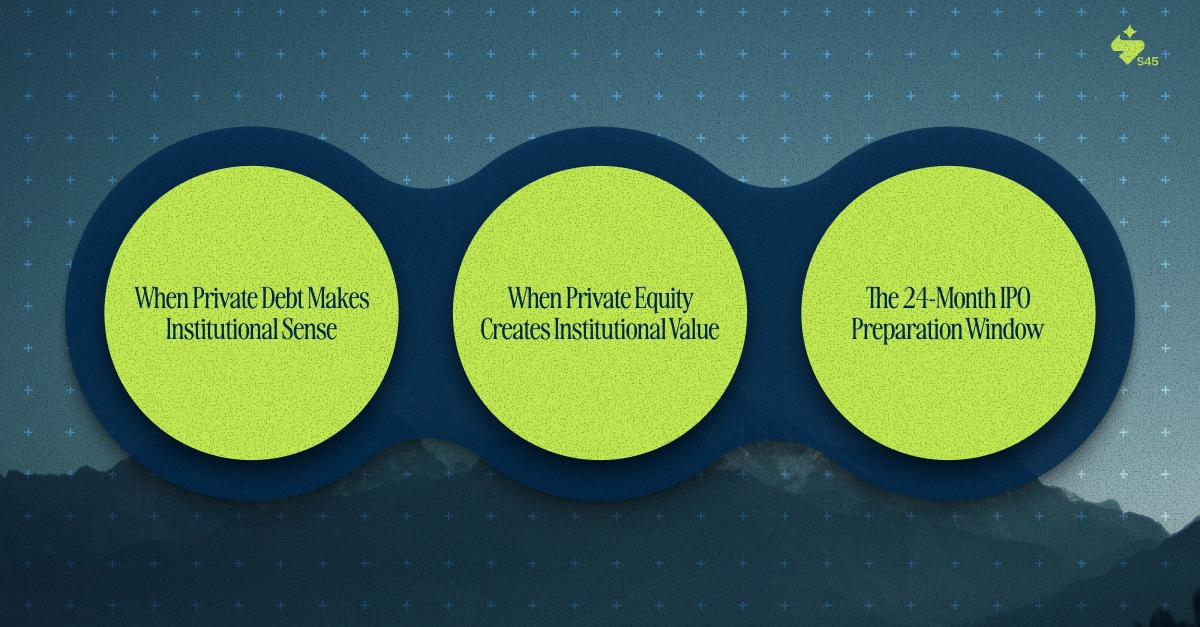
Private debt works for IPO-bound enterprises when covenant structures align with post-listing operations. Senior secured debt with asset backing creates clean disclosure. Revenue-based financing with transparent triggers creates predictable narratives. Term loans with straightforward amortisation schedules create manageable refinancing timelines.
Private debt fails when covenants conflict with growth trajectories. DSCR requirements that restrict capex during expansion phases. Change-of-control clauses triggered by promoter stake dilution during the IPO. Mandatory prepayment terms linked to EBITDA thresholds that public market volatility can breach.
The difference is not the debt quantum. It is covenant craftsmanship. Well-structured private debt becomes institutional evidence of financial discipline. Poorly structured private debt becomes a disclosure liability, requiring extensive explanations of risk factors.
Private equity works when governance structures reflect public company norms. Board observers instead of board seats. Information rights instead of approval rights. Anti-dilution protections with IPO carve-outs. Tag-along rights with exemptions for public offerings.
Private equity fails when term sheets ignore public market realities. Liquidation preferences that complicate EPS calculations. Ratchet anti-dilution that forces pre-IPO repricing. Drag-along rights that conflict with SEBI minimum promoter holding requirements. Redemption obligations that create post-listing cash flow pressure.
Sophisticated private equity investors structure terms with public-market exits in mind. Unsophisticated investors negotiate maximum protections, creating DRHP disclosure complexity that reduces IPO attractiveness and delays timelines.
Capital structure readiness begins 24 months before DRHP filing, not 6 months. This window allows:
Covenant renegotiation with existing lenders before lock-in periods restricts changes. Private equity term amendments when investors still have liquidity incentives to cooperate. Preference share conversions timed to simplify capital structure before SEBI scrutiny. Debt refinancing is structured to avoid maturity clustering in the 18 months post-listing.
Enterprises that begin IPO preparation 6 months before filing discover that capital structure is frozen. Legal documentation is binding. Investors have negotiating leverage. Covenant waivers require consent that may not come. The result: either extended timelines during restructuring, or DRHP filings with disclosure complexity that institutional investors penalize through pricing.
IPO readiness is not a phase. It is a lens through which every capital decision must be evaluated, starting the moment ₹100 Cr revenue is crossed, and public markets become viable.
Private debt vs private equity stops being academic the moment SEBI ICDR disclosures begin. Capital structure decisions resurface as DRHP complexity, covenant obligations, and governance explanations that either strengthen institutional confidence or trigger observation loops. Every private equity anti-dilution clause, every private debt covenant, every preference share term becomes public evidence.
Capital raising and IPO preparation are interconnected, not sequential. Private credit offers non-dilutive capital, but covenant restrictions become post-listing narratives. Private equity provides strategic value, but governance rights become disclosure complexity. Neither is wrong. Both require institutional foresight.
What separates IPO-ready enterprises from IPO-delayed enterprises is disclosure craftsmanship and institutional clarity. SEBI issues observations when disclosures lack precision. Institutional investors price in refinancing risk when covenants conflict with growth projections.
The question is whether your capital structure can withstand DRHP scrutiny without triggering restructuring delays, observation cycles, or pricing friction. That answer determines whether your IPO timeline is quarters or years.
Before capital structure becomes a source of disclosure friction, get institutional clarity. S45 provides IPO readiness audits that reverse-engineer capital structures through SEBI requirements, identifying covenant conflicts, governance complexity, and refinancing pressure points before DRHP drafting begins.
Discover more insights on similar topics