
Understanding Dry Powder in Private Equity

Understanding Dry Powder in Private Equity

By Aman Singh
November 3, 2025
10 min read
Venture Capital

You've built a profitable MSME with healthy margins and a growing customer base, and you're ready to scale. You’ve heard there’s a flood of private equity (PE) capital available, trillions waiting to be deployed. But when you go looking for growth funding, it feels like searching for water in an ocean: it’s everywhere, but you can’t reach it.

This isn’t your imagination. It’s a fundamental disconnect. India holds over $20 billion in private equity "dry powder", funds waiting for the right opportunities. At the same time, MSMEs face a massive credit gap of ₹20-25 lakh crore. These two numbers should meet, yet they don’t. PE firms pursue large-ticket deals while MSMEs can’t access even basic growth capital.

In this blog, we will discuss dry powder in PE and help you position and align with how institutional investors think.

At a glance

  • Record capital levels: Global PE dry powder reaches $2.5 trillion in 2025, with India holding over $20 billion waiting to be deployed
  • The paradox: Despite abundant capital, India's MSME credit gap remains ₹20-25 lakh crore; access is the real challenge
  • 2025 advantage: Deployment pressure on PE firms creates favorable conditions for quality MSMEs, especially in manufacturing, healthcare, and financial services
  • Critical insight: Excess dry powder can work against you if you're unprepared—pressure to deploy doesn't equal smart partnerships
  • Your action plan: Focus on the five pillars of investment readiness: financial health, operational excellence, market positioning, growth narrative, and founder preparedness
  • Bottom line: It's a founder's market in 2025, but only if you're strategically positioned to capitalize on it

Disclaimer: This content is for educational purposes only and should not be considered as financial advice. Every business situation is unique, and we recommend consulting with qualified financial advisors before making important business decisions.

What is Dry Powder in Private Equity?

Dry powder is capital committed by investors (Limited Partners) to private equity (PE) funds, but is still waiting to be invested. It’s accumulating pressure and management fees, ticking away with a deadline. For PE firms, it’s time-sensitive capital.

In 2025, global PE dry powder hit a record $2.5 trillion, roughly the size of India’s entire GDP. India saw $43 billion in PE-VC investments in 2024-25, securing its place as Asia-Pacific's second-largest destination for private capital, behind China.

So why should this matter to you as an MSME founder? Not all dry powder is the same.

The Three Types of Dry Powder That Matter to MSMEs

The Three Types of Dry Powder That Matter to MSMEs

Understanding the differences can help you figure out which capital sources align with your growth stage. Here are the three types of dry powder:

  • Growth Capital: It is for profitable businesses looking to expand—whether it's scaling operations, entering new markets, or developing new products. You won’t be selling out, just taking on a partner to accelerate what’s working. This typically means minority stakes (15-40%) where you stay in control.
  • Buyout Capital: It comes into play when you're considering succession, liquidity, or leadership transitions. This often involves a majority stake and significant involvement from your PE partner. If you’re eyeing an exit or bringing in pro management, this is your category.
  • Distressed Asset Capital: It targets businesses in turnaround mode, solid companies facing temporary struggles. If you’re not in restructuring, this doesn’t apply to you, but understanding this category rounds out the full spectrum of PE strategies.

For most MSME founders, growth capital is where you should focus, and 2025’s market dynamics create a prime opportunity to secure it. However, timing your fundraising strategy is crucial, and understanding the broader market context can give you the edge.

Why 2025 Is a Pivotal Year for Indian MSMEs Seeking Capital

Private equity (PE) firms are under pressure. Nearly 24% of dry powder is now over four years old, what's known as "stale capital." Limited Partners are questioning why this money hasn't been deployed. Are there no good opportunities? Is the fund manager failing to execute?

This pressure creates a unique opportunity for well-positioned MSMEs. PE firms need quality deals, and India's MSME ecosystem offers exactly what they want: profitable, scalable businesses in high-growth sectors with strong fundamentals.

Key growth sectors in 2024-25:

  • Financial services: ₹9.7 billion in PE investments (up 25%)
  • Healthcare: 80% surge in PE investments
  • Manufacturing: Continued benefits from Make in India initiatives

If you’re in one of these sectors, you’re already aligned with where capital is flowing.

At S45, we've seen a shift in 2025. PE firms, once focused solely on large deals, are now exploring mid-market opportunities in India's MSME ecosystem, especially in manufacturing and services.

The deployment pressure is in your favour, but only if you’re ready to engage strategically. Here's the counterintuitive reality most founders miss.

When Too Much Capital Becomes a Problem

Excess dry powder can actually backfire if you're not careful about how you engage with it. When PE firms face pressure to deploy capital, several issues arise that can create long-term problems for founders who don’t spot the warning signs:

  • Valuation inflation: In 2021, an abundance of capital led many Indian startups to accept inflated valuations, which made future fundraising rounds nearly impossible. If your Series A values you at 50x revenue, what happens at Series B? Many 2021 startups learned the hard way with down rounds and extended runways.
  • Rushed timelines and lack of due diligence: If a PE firm is pushing to close quickly, ask why. Quality investors take time to understand your business. Rushed capital often comes with rushed expectations.
  • Unrealistic growth targets: If the deal requires you to 5x revenue in three years to justify the entry valuation, question whether that growth is sustainable or if you're being set up to sacrifice long-term health for short-term numbers.

When evaluating PE partners, ask:

  • What operational value do they bring beyond capital?
  • Who can I speak with about their experience?
  • How do they act when portfolio companies face challenges?
  • What’s their typical holding period and exit strategy?
  • How involved will they be in day-to-day operations?

At S45, we focus on alignment: Are you solving the same problem? Do you share the same vision of success? The best PE partnerships don’t just provide capital, they help expand your capabilities and build long-term value, not just the quickest exit.
How Can You Position Yourself for PE Investments?

How Can You Position Yourself for PE Investments

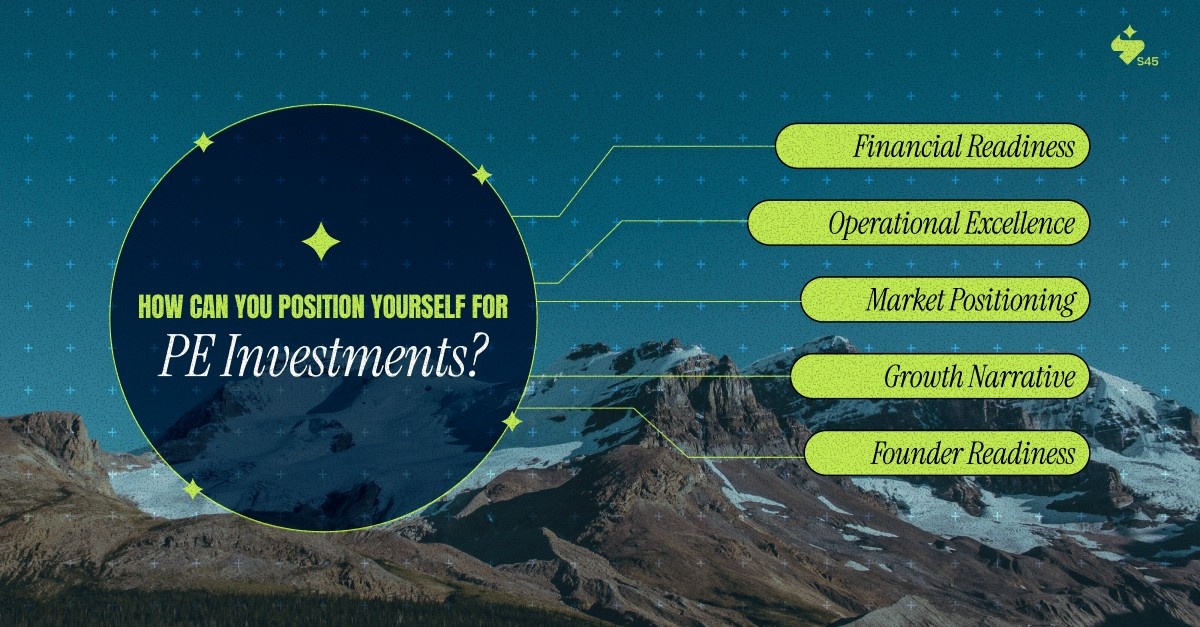
The capital is there. The opportunity is real. But how do you stand out when PE firms are evaluating hundreds of businesses, investing in only a few? Here’s the 5-Pillar Framework for getting investment-ready.

Pillar 1: Financial Readiness

PE investors live in spreadsheets. Your financials must be clean, consistent, and compelling.

  • Audited statements: Start with three years of audited financials. Not “managed by a friend”, trusted audits.
  • EBITDA margins: Show steady profitability or a clear path to it.
  • Working capital: Is cash flow healthy? Are receivables growing too fast? Efficient inventory turnover is a must.
  • Debt-equity ratio: Use leverage wisely. Too much debt creates risk; too little suggests missed opportunities.

Pillar 2: Operational Excellence

Capital scales what’s already there. If your operations can’t handle 3-5x growth, it’s time to fix them.

  • Core processes: Can your business run without you? Build depth in your management team.
  • Tech adoption: PE expects ERP systems, CRM platforms, and data-driven decisions. If you’re still on Excel and WhatsApp, it’s a red flag.
  • Certifications: ISO or industry-specific standards show you’re thinking beyond just being an entrepreneur.

Pillar 3: Market Positioning

Why should a PE investor bet on you? Your answer needs to be immediate and convincing.

  • Competitive moat: What makes you defensible? Is it proprietary tech, exclusive deals, or network effects?
  • Scalable model: Can you grow revenue without growing costs at the same rate?
  • Customer concentration: If your top 3 customers account for 70% of your revenue, you’re too dependent. Diversify.

Pillar 4: Growth Narrative

Money follows stories. Your narrative must be specific, realistic, and market-aligned.

  • 3-5 year vision: Where is the business headed? How will it look at scale?
  • Capital plan: Be specific about how you’ll use the investment—e.g., “₹10 crore to add two manufacturing lines in Pune, expanding capacity 40%.”
  • Milestones and metrics: What does success look like in Year 1 and Year 3?
  • Sector alignment: Are you positioned to benefit from trends like policy shifts, demographics, or tech changes?

Pillar 5: Founder Readiness

This is often the toughest pillar because it requires real self-assessment. Are you ready for a PE partnership?

  • Partnership or exit? Clarify your vision—do you want a partner, or are you looking to exit?
  • Dilution and control: Selling a 30% stake means sharing 30% of the future value and losing 30% of your control. Are you okay with that?
  • Board governance: PE investors will place reps on your board. If that feels like interference, you’re not ready for PE.
  • Legacy vision: What’s your long-term legacy? Are you building something more than just financial value?

At S45, we work with MSME founders across all five pillars, from financial structuring to crafting compelling growth stories. Our expertise ensures you’re not just fundable but positioned for the right kind of partnership that accelerates growth without compromising your business’s soul or your vision. 

However, to set yourself up for long-term success, it’s crucial to avoid these common pitfalls during the post-investment phase.

Common Pitfalls You Should Avoid

Securing investment is just the start; what happens after the capital hits your account is where the real work and value creation unfold.  Here are the common pitfalls you should avoid:

  1. Accepting Capital Without Strategic Fit: Just because someone offers you money doesn’t mean you should take it. Evaluate whether the investor aligns with your vision, values, and growth timeline. A mismatch here can lead to friction later.
  2. Overvaluing at Entry: A high valuation might feel great now, but it can become a burden later, especially when raising subsequent rounds or preparing for an exit. Be realistic about your company’s value and focus on a strong partnership, not just the entry price.
  3. Neglecting Founder Team Alignment: If co-founders aren’t unified on accepting PE investment, those differences will only grow under pressure. Ensure your founder team is aligned on the decision to bring in external capital before moving forward.
  4. Underestimating Post-Investment Time Commitments: PE partnerships require significant time from the founders, quarterly board meetings, strategic planning, and investor updates. Don’t expect to stay purely operational; recalibrate your expectations to make space for these critical activities.
  5. Focusing Solely on Capital, Ignoring Expertise: PE firms bring more than just capital; they offer networks, operational expertise, and strategic guidance. Founders who engage with these resources can create far more value than those who treat PE as merely a source of funds.

Avoiding these pitfalls ensures a smoother, more successful post-investment journey, leading to sustainable growth and long-term value creation.

Partner with S45: Capital + Expertise for Sustainable Growth

At S45, we know sustainable growth requires more than just capital; it needs the right strategic partnership, at the right time, with the right terms. 

We offer:

  • Strategic capital connections: Align with partners whose investment strategies match your growth stage.
  • Pre-investment readiness: Increase your chances of successfully closing rounds with the right support.
  • Ongoing guidance: We support you throughout the scaling process, not just at financing moments.

Our goal isn’t just exits, it’s building legacies. We partner with founders who want to create businesses that last, provide meaningful employment, and contribute to India’s manufacturing and services sectors.

Whether you're seeking growth capital for the first time or preparing for your next round, S45 offers the expertise and network to navigate India’s evolving PE landscape.

Let’s work together to build not just a scalable business, but a lasting legacy that benefits founders, employees, customers, and investors alike.

Frequently Asked Questions

Stay Connected with S45

Get startup insights and connect with our community