
The early-stage venture capital (VC) scene in India is entering an exciting new phase in 2025. Recent data reveals that Indian startups raised nearly $5.7 billion in the first half of 2025, with early-stage investments, particularly in seed and pre-seed rounds, seeing remarkable momentum.
What’s driving this? A wave of confidence from investors who want to be part of the next big story. Over $9 billion in new startup-focused funds were launched within the first nine months of the year, already outpacing previous annual totals. This surge signals a powerful shift toward nurturing ideas from the ground up.
For entrepreneurs eager to join India’s fast-evolving startup ecosystem, understanding how early-stage VC investing works is the first real step toward finding the right partners and building something that lasts.
At a glance
- Early-stage VC investing focuses on startups in pre-seed, seed, or Series A stages, providing capital in exchange for equity.
- Investors offer more than money: they bring strategic advice, industry connections, and mentorship.
- Top 5 VC firms in India (2025): Accel India, Blume Ventures, Matrix Partners (Z47), Kalaari Capital, and Stellaris Venture Partners. These firms back diverse sectors, including tech, SaaS, fintech, and deep tech.
- Key factors to evaluate investors: Assess portfolio fit, sector expertise, value beyond capital, and alignment on growth goals.
- Fundraising steps: Define your vision, prepare your business (clean records, strong team), create a compelling pitch deck, and network strategically.
- S45 offers more than just funding; they provide tailored, hands-on support to scale your MSME.
Disclaimer: This content is for educational purposes only and should not be considered as financial advice. Every business situation is unique, and we recommend consulting with qualified financial advisors before making important business decisions.
What Is Early Stage VC Investment?
Early-stage VC investment typically occurs in pre-seed, seed, or Series A funding rounds. For startups, this is when the real work begins: refining the product, building out a team, ramping up marketing efforts, and starting to acquire customers.
Here’s how it works:
- Investors provide capital in exchange for equity, basically, a stake in the company.
- The funding enables the startup to transition from prototype to product, expanding its reach and building the necessary infrastructure.
- Beyond just money, VCs bring strategic advice, industry connections, and mentorship to the table, helping founders navigate tricky challenges.
- Terms might include convertible notes or SAFEs (Simple Agreements for Future Equity), offering some flexibility in valuation and equity conversion as the startup grows.
- VCs are thorough in their due diligence, assessing factors like the team’s experience, business potential, market opportunity, and scalability.
- In some cases, VCs may take an active role, such as joining the board to guide decision-making.
Early-stage VC is a game-changer for startups, particularly those that don’t have access to traditional funding methods like bank loans or personal savings. But how can you find one?

Top 5 Early Stage VC Investors in India (2025)

Finding the right early-stage investor can make all the difference between struggling to scale and accelerating your growth. Here are the top 10 VC firms actively investing in early-stage startups and MSMEs in India, each with its unique focus and strengths.
1. Accel India
Accel India is one of the most active and respected early-stage investors in the country. With a reputation for being founder-friendly and offering hands-on operational support, they’ve backed some of India’s biggest success stories, helping them scale from early stages to market leaders.
- Year Founded: 2008
- Investment Focus: E-commerce, SaaS, fintech, consumer tech, B2B marketplaces
- Investment Stage: Seed to Series C
- Typical Ticket Size: $1-10 million
- Fund Size: $650 million (Fund VIII launched in 2024)
- Notable Investments: Flipkart, Swiggy, Freshworks, BookMyShow, Cure.fit, Urban Company
- Best For: Tech-enabled businesses with a strong product-market fit, ready for rapid scaling.
2. Blume Ventures
Blume Ventures is known for its founder-first approach and willingness to back unconventional ideas. Often the first institutional investor, they focus on very early-stage companies and are passionate about supporting first-time founders with innovative visions.
- Year Founded: 2010
- Investment Focus: Consumer tech, SaaS, fintech, agritech, B2B services
- Investment Stage: Pre-seed to Series A
- Typical Ticket Size: $500K - $3 million
- Fund Size: $378 million across multiple funds
- Notable Investments: GreyOrange, Unacademy, Dunzo, Purplle, Cashify, Carbon Clean
- Best For: First-time founders with disruptive ideas needing patient and supportive early-stage capital.
3. Matrix Partners India (now Z47)
Rebranded as Z47, Matrix Partners India has a track record of spotting category-defining companies early. Their focus on fintech and B2B SaaS, coupled with deep operational expertise, has helped them build strong, scalable businesses.
- Year Founded: 2006
- Investment Focus: Consumer tech, fintech, B2B, SaaS, enterprise software
- Investment Stage: Seed to Series B
- Typical Ticket Size: $1-8 million
- Fund Size: $450 million (Fund IV)
- Notable Investments: Ola, Razorpay, Dailyhunt, Practo, Country Delight, Dukaan
- Best For: B2B and fintech startups with strong technical teams and scalable models.
4. Kalaari Capital
Founded by the dynamic Vani Kola, Kalaari Capital is known for its entrepreneur-first philosophy. They back passionate founders and provide strategic guidance alongside capital, often focusing on consumer tech, fintech, and deep tech.
- Year Founded: 2006
- Investment Focus: Consumer internet, enterprise software, fintech, healthcare, deep tech
- Investment Stage: Seed to Series B
- Typical Ticket Size: $500K - $5 million
- Fund Size: $479 million across multiple funds
- Notable Investments: Dream11, Snapdeal, Myntra (exit to Flipkart), Cure.fit, Urban Ladder.
- Best For: Consumer-focused businesses seeking strong mentorship and strategic insight.
5. Stellaris Venture Partners
Stellaris is known for its focus on product-first companies, particularly those building global SaaS solutions from India. Despite being relatively new, their investment in deep-tech and enterprise startups has quickly established their reputation.
- Year Founded: 2016
- Investment Focus: SaaS, fintech, healthcare, B2B commerce, deep tech
- Investment Stage: Seed to Series A
- Typical Ticket Size: $1-5 million
- Fund Size: $275 million across two funds
- Notable Investments: Mamaearth, Whatfix, Mfine, Zenoti, SaaS Labs
- Best For: Product-first startups, especially those building global solutions in SaaS and deep tech.
These firms are shaping the early-stage VC landscape in India, each with its unique focus and approach. The key is finding investors who genuinely understand your business model, share your values, and can add meaningful value beyond just capital. Read on to know how you can find the right one for you.
How to Evaluate Funding Partners: What Actually Matters for MSMEs
Choosing the right investor is about more than just fund size or brand. It’s about how well they fit your business strategy. Here's how to assess potential partners.
Portfolio Analysis: Do They Understand Your Business?
Look for investors with experience in businesses like yours, not just in your sector. They should understand asset-heavy operations and scaling sustainably.
What to Look For:
- Similar business models
- Experience with asset-heavy operations
- Successful, sustainable scaling
- Regional focus, not just metro-centric startups
Red Flags:
- Portfolio full of tech startups
- No experience with manufacturing or retail
- Exits within 5 years is a sign of pressure for quick returns
Track Record: What Happens After Investment?
The best investors stay involved. Ask to speak with founders they’ve backed to learn how they add value beyond capital.
Questions to Ask:
- Can I speak with 3-5 founders you’ve backed?
- How many companies are still operating?
- What value did you add besides money?
- How did you support during tough times?
Warning Signs:
- Reluctance to connect with founders
- No examples of added value
- Focus on exits, not challenges
Sector Expertise: Do They Speak Your Language?
Investors should understand your business model, unit economics, and industry challenges.
Test Their Knowledge:
- Ask about your specific business model
- Inquire about growth support in similar industries
- Explore their view on risks and opportunities in your sector
Be Cautious if:
- They talk about irrelevant metrics (e.g., SaaS)
- They lack knowledge of your industry
- They seem to be learning from you in real-time
Value Beyond Capital: What Capability Do They Bring?
Top investors offer more than money. They bring expertise, networks, and guidance to help your business grow.
What to Look For:
- Operational expertise in scaling businesses
- Access to valuable networks
- Support with systems, processes, and team-building
At S45, we provide tailored, hands-on support for growth, whether it’s improving manufacturing or refining your market strategy.
Alignment on Timeline and Values
A good investor aligns with your goals and values, not just pushing for quick growth.
Key Questions to Ask:
- What’s your expected exit timeline?
- How do you balance growth and profitability?
- What if we prefer steady growth?
- How do you view company culture and values?
Deal-breakers:
- Pressure for rapid growth at the cost of quality
- Expectation of exit within 3-5 years
- Misalignment on success and growth definitions
The right funding partner is more than just a backer. They should understand your vision, align with your values, and provide the support needed to grow your business on your terms. Next, we will show you how you can raise your VC funding.
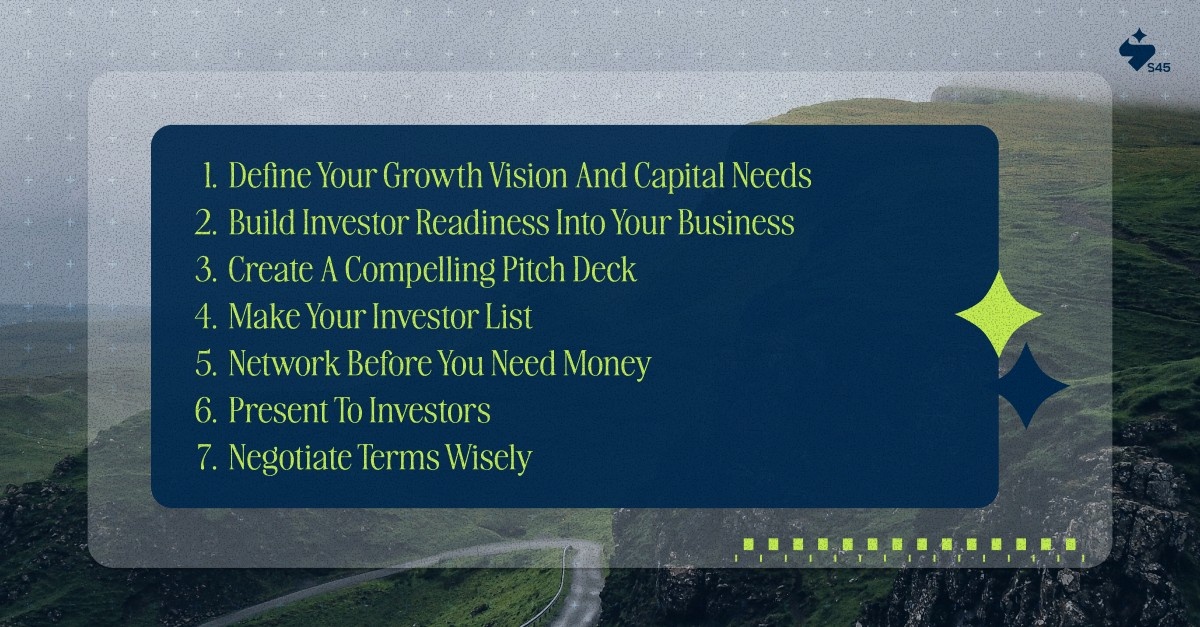
How to Raise Funding for Your MSME: A Step-by-Step Guide

Strategic preparation matters more than speed. Here’s how to approach fundraising effectively.
Step 1: Define Your Growth Vision and Capital Needs
Before seeking investment, be clear on your business goals and capital requirements.
Growth Goals:
- Where do you want the business in 3, 5, and 10 years?
- What does success look like beyond revenue?
- How much ownership are you willing to share?
- What parts of your business are non-negotiable?
Capital Needs:
- How much do you need?
- What exactly will the funds cover? (e.g., ₹X crores for machinery, ₹Y crores for expansion)
- What ROI and timeline do you expect?
- What’s your backup plan if you raise less—or more?
Investors respect founders who can clearly allocate capital and plan for different scenarios.
Step 2: Build Investor Readiness into Your Business
Make your MSME more attractive to investors with solid preparation.
Clean Financial Records:
- Regular audits
- Clear revenue, expenses, and profitability tracking
- Transparent tax compliance
Documented Systems & Processes:
- Standard operating procedures
- Quality control and supply chain documentation
- Sales and marketing processes
Strong Management Team:
- Fill key roles beyond just the founder
- Clear structure and succession planning
- Talent development strategies
Growth Metrics:
- Consistent revenue growth or a clear explanation of fluctuations
- Improving margins and customer acquisition/retention data
These steps will strengthen your business whether or not you raise capital.
Step 3: Create a Compelling Pitch Deck
A concise, clear pitch can make all the difference. Stick to these key slides:
- Slide 1: The Problem: What specific pain does your business solve?
- Slide 2: Your Solution: How does your product/service address this pain?
- Slide 3: Market Opportunity: Size of your addressable market (bottom-up calculation).
- Slide 4: Business Model: How do you make money? What are your unit economics?
- Slide 5: Traction: Revenue history, customer growth, operational milestones.
- Slide 6: Competitive Landscape: Who’s your competition and what makes you stand out?
- Slide 7: Go-to-Market Strategy: How will funding accelerate customer acquisition?
- Slide 8: The Team: Who’s building this? Highlight relevant experience.
- Slide 9: Financial Projections: 3-5 year projections with clear assumptions.
- Slide 10: The Ask: How much are you raising, and what will it fund?
Keep it short—10-12 slides max.
Step 4: Make Your Investor List
Focus on quality over quantity when selecting potential investors.
Target Investors Who:
- Have invested in businesses similar to yours
- Invest at your stage and ticket size
- Understand your sector and geography
- Share your values and growth philosophy
Where to Find Them:
- Portfolio research on their websites
- Crunchbase, industry events, founder networks
- Platforms like S45, AngelList
Step 5: Network Before You Need Money
The best funding relationships start long before you need capital.
How to Build Relationships:
- Attend industry events
- Join founder communities (TiE, YPO, etc.)
- Share your journey through content or speaking gigs
Warm intros are far better than cold emails.
Step 6: Present to Investors
The first impression counts. Be prepared and clear in your presentation.
Initial Meetings:
- Tell your story, focusing on problem-solution-traction-ask
- Be ready for deep questions on financials and operations
- Take notes on their feedback
Follow-Up:
- Send requested materials quickly
- Address concerns raised during the meeting
- Provide regular updates
Due Diligence:
- Be transparent about challenges
- Have your documents organized and ready
- Use this process to learn and strengthen your business
Step 7: Negotiate Terms Wisely
Key terms shape your future. Negotiate wisely.
Focus on Key Terms:
- Valuation: Important, but not the only factor
- Liquidation preference: Who gets paid first in an exit?
- Board composition: How much control will you retain?
- Veto rights: What decisions require investor approval?
- Anti-dilution protection: How is your stake protected in down rounds?
- Exit timelines: Alignment on exit goals and timing
Work with a lawyer experienced in MSME deals. The right legal guidance saves you from costly mistakes.
Remember, the best deals happen when both sides feel it’s fair. If something feels off, walk away. There’s always more capital, but only one chance to build your business right.
Partner with S45 Club: Capital + Capability for Your MSME Growth
If you're serious about scaling your MSME thoughtfully, S45 is here to help. We don’t push tech metrics onto traditional businesses. We focus on what matters: profitability, efficiency, market position, and sustainable growth potential.
Our principles are:
- Sustainable Growth Focus: We partner with founders who aim to build enduring businesses, not chase quick exits.
- Founder Partnership Approach: We work alongside you, respecting your vision and values. You make the decisions; we provide the capital and expertise to help you execute better.
- Regional and Inclusive: We’re committed to supporting MSMEs in Tier 2 and Tier 3 cities, where some of India's best businesses thrive.
We provide more than just funding; we offer hands-on support on:
- Optimizing manufacturing and operations
- Driving market expansion strategy
- Talent acquisition and team building
- Strengthening financial governance and systems
- Leveraging industry connections
Let’s create India’s next generation of enduring enterprises, together. Schedule an exploratory conversation with us.