
April 1, 202612 min read
Traditional vs Alternative Investments: What You Need to Know Before Going Public
By Aman Singh
Investopedia

Scaling a business requires more than strong operations or loyal customers; it requires access to structured, reliable capital. This is where capital markets play a crucial role.
Capital markets act as a bridge between businesses seeking funds and investors seeking opportunities. They are the foundation on which economies grow, businesses expand, and value is created across industries.
For ambitious Indian SMEs, understanding how these markets work is essential. It not only helps founders raise funds but also builds institutional discipline and long-term credibility.
This article explores the key functions of capital markets, their relevance for Indian enterprises, and how businesses can leverage them effectively for sustainable scale.
Capital markets are financial systems where savings and investments meet.
They help businesses raise funds by issuing securities and allow investors to earn returns by buying and selling those securities.
A capital market is a platform where companies, governments, and institutions raise long-term funds to finance growth, infrastructure, or expansion.
In simple terms, capital markets make it possible for entrepreneurs to access financial resources without relying only on internal profits or traditional loans.
Type | Purpose | Example |
Primary Market | Where new securities (shares, bonds) are issued for the first time. | An SME is listed on NSE Emerge to raise ₹50 crore. |
Secondary Market | Where existing securities are traded between investors. | Buying or selling company shares on NSE or BSE. |
Together, these two segments ensure both capital creation and liquidity, making the market efficient and dynamic.
Capital markets involve multiple stakeholders who keep the system balanced and trustworthy.
Each participant plays a role in maintaining integrity, confidence, and flow within the financial ecosystem.
At S45 Club, we guide founders to understand how capital markets function as a strategic growth enabler, not merely a financial mechanism. This literacy prepares them for structured capital access and sustainable scaling.
Also Read: Growth Capital vs Venture Capital: Key Differences Explained
Capital markets perform several important functions that keep an economy dynamic, transparent, and growth-oriented. For Indian SMEs, these functions directly influence access to funds, governance standards, and investor confidence.
Here are the key functions, and what they mean for growing businesses:
Function | Relevance to SMEs | Outcome |
Capital Formation | Raises long-term funds | Enables business expansion |
Liquidity Creation | Allows easy trading | Improves investor confidence |
Price Discovery | Reflects company value | Enhances market credibility |
Risk Diversification | Spreads investment risk | Encourages stable growth |
Resource Allocation | Rewards efficiency | Promotes innovation |
Governance Promotion | Strengthens accountability | Builds investor trust |
Economic Growth | Expands opportunity | Fuels jobs and innovation |
Capital markets channel household and institutional savings into productive use. This process, known as capital formation, helps businesses raise funds for expansion, innovation, and asset creation.
Why it matters:
Capital markets provide liquidity by allowing investors to buy or sell securities easily. Liquidity makes investments more attractive and reduces the risk of being “locked in.”
For businesses:
Element | Impact |
Market Activity | Easier entry and exit for investors |
SME Benefit | Enhanced investor interest and trust |
Long-Term Effect | Stable valuations and lower cost of capital |
The market determines the price of securities based on demand and supply. This process, known as price discovery, ensures transparency and fairness in valuation.
For SMEs:
Capital markets offer various instruments, equity, debt, derivatives, and mutual funds, that allow investors to spread risk.
Why it matters:
S45 Club mentors founders on using diverse instruments and partnerships, balancing growth ambitions with responsible financial planning.
By directing funds toward high-performing companies, capital markets ensure that capital flows where it’s most effective.
SME takeaway:
Listing and trading in capital markets require businesses to meet regulatory and reporting standards.
Benefits include:
This governance culture becomes a competitive advantage for scale-ready Indian SMEs.
Capital markets are not just financial mechanisms; they are engines of national growth.
They:
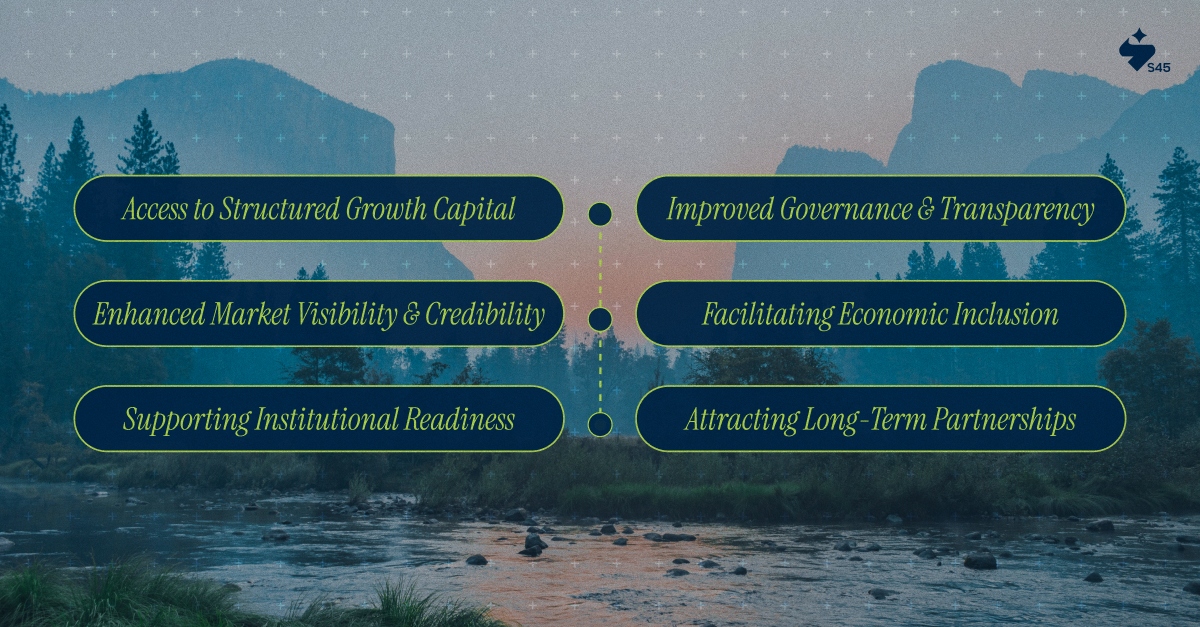
Capital markets are often viewed as complex or distant, designed for large corporations or global investors. In reality, they play an equally vital role for India’s small and mid-sized enterprises (SMEs) that aim to grow sustainably and institutionally.
When understood and used correctly, capital markets can help these businesses scale without over-reliance on debt or short-term funding.
Capital markets offer long-term financing through equity or bonds, helping businesses fund expansion, technology, or acquisitions.
For example, several Indian manufacturing and tech SMEs have listed on NSE Emerge to raise between ₹10 crore and ₹50 crore, fuelling regional and national growth.
Through its Capital Markets Platform, S45 Club guides founders in identifying the right funding routes, ensuring capital access is structured, sustainable, and governance-led.
Listing on a capital market encourages stronger internal systems. Companies adopt better accounting, audit, and reporting standards to meet investor and regulatory expectations.
This shift:
Being part of a regulated exchange gives businesses national visibility and legitimacy.
For founders, this visibility is not just reputation; it becomes a growth multiplier.
Capital markets connect local entrepreneurs to a global investment network. They enable businesses to:
Impact Area | Outcome |
Funding Access | Equity and debt options beyond traditional loans |
Governance | Better compliance, transparency, and investor trust |
Market Visibility | Stronger reputation and valuation potential |
Economic Impact | Encourages entrepreneurship and innovation |
For SMEs with ₹100+ crore revenue, the next leap often requires institutional discipline, board oversight, transparency, and investor engagement. Capital markets act as a training ground for this transition.
S45 Club’s mentorship ecosystem helps growth-ready SMEs build this institutional readiness step by step, preparing them not just to raise funds but to manage them effectively.
When governance, growth, and capital align, businesses naturally draw interest from private equity, strategic investors, and lenders.
Capital markets act as a credibility filter, attracting serious, long-term partners who value structured performance over short-term gains.
At S45 Club, we view capital markets as more than funding channels; they are growth ecosystems. By guiding entrepreneurs in governance, mentorship, and capital access, S45 Club helps SMEs participate confidently in India’s evolving financial landscape.
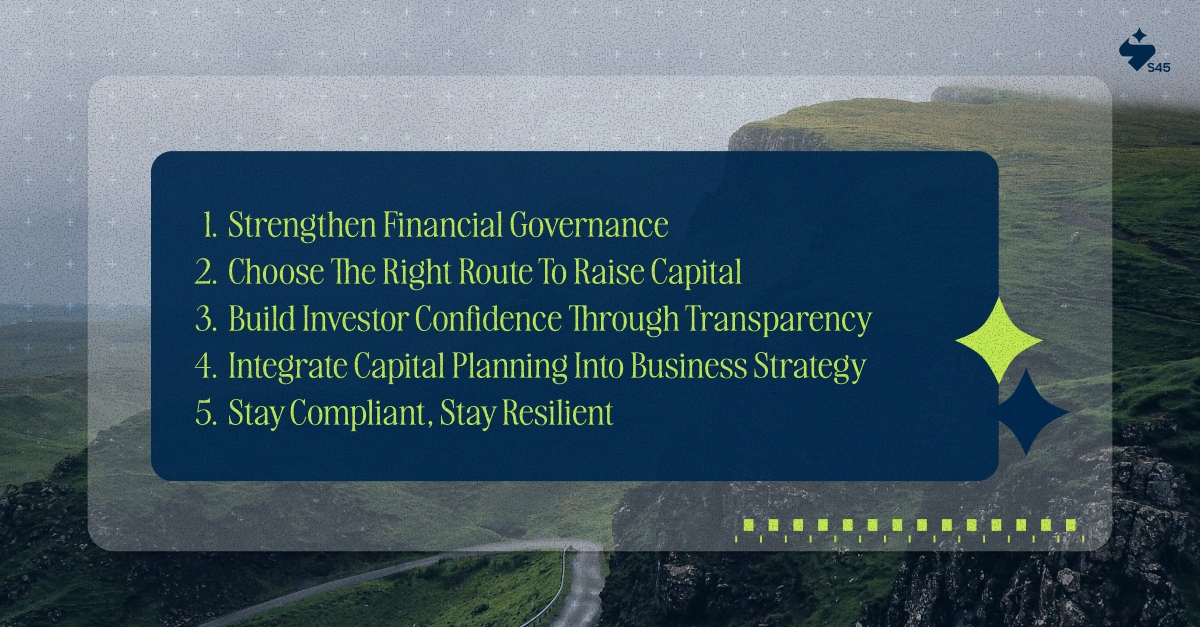
For Indian SMEs, capital markets are not only about raising funds; they’re about building credibility, governance, and long-term stability. To leverage them effectively, founders must approach market participation as a strategic journey rather than a financial shortcut.
Before raising external capital, businesses should ensure their financial and governance systems are investor-ready. Key steps include:
There are multiple market options for SMEs, depending on their size, goals, and readiness level.
Market Type | Purpose | Example Platform |
SME Exchanges | For small and mid-sized firms seeking growth capital | NSE Emerge, BSE SME |
Main Boards | For larger firms aiming for IPOs and institutional listing | NSE, BSE |
Private Placement | For limited strategic investors | Institutional or Angel rounds |
Debt Instruments | For lower-risk capital needs | Bonds, debentures |
When businesses are ready to access markets, choosing the right route, whether SME exchanges, main boards, or pre-IPO placements, becomes critical. Each path serves a different stage of growth and readiness.
To help founders understand these options better, S45 Club recently released a podcast — S45: Gateway to Curated IPO & Pre-IPO Deals — where experts break down how businesses can prepare, participate, and benefit from structured market opportunities.
The episode offers actionable insights into IPO readiness, deal curation, and strategic fundraising for Indian SMEs aiming to build institutional credibility.
Investors invest in clarity, not uncertainty. To attract serious capital, SMEs should:
Through its community network of mentors and investors, S45 Club helps founders craft investor narratives rooted in transparency and accountability.
Capital markets are not one-time events; they work best when integrated into the long-term vision. SMEs should link capital access to:
This ensures capital fuels sustainable outcomes, not temporary growth spurts.
Capital market participation comes with regulatory responsibilities. By maintaining compliance, SMEs reduce penalties and strengthen trust.
Also Read: Indian Startup Valuations and Funding Trends

While capital markets offer significant advantages, many SMEs hesitate to participate due to misconceptions or structural barriers. Recognising and addressing these challenges early is essential for successful engagement.
Many SMEs underestimate how capital markets function or overestimate the complexity of participation.
Solution:
S45 Club’s events and workshops help founders understand capital access, turning technical concepts into actionable growth strategies.
Listing or raising funds requires adherence to SEBI and exchange rules, which can seem overwhelming.
Solution:
SMEs often struggle to justify valuation due to informal governance or inconsistent reporting.
Solution:
By improving governance maturity, S45 Club helps SMEs project stronger valuations and attract aligned investors.
Price fluctuations can discourage smaller firms or new investors.
Solution:
Without structured mentorship, many SMEs find capital-market processes confusing.
Solution:
Through its mentor-led ecosystem, S45 Club connects SMEs with capital-market professionals who guide them from readiness to execution.
India’s capital markets are evolving rapidly, becoming more inclusive, transparent, and tech-driven. For growth-ready SMEs, this evolution represents an unprecedented opportunity.
Dedicated SME exchanges like NSE Emerge and BSE SME have created direct pathways for mid-sized companies to raise equity efficiently.
New-age platforms are also enabling private placements and debt instruments with greater ease and lower compliance barriers.
For founders: This means easier entry into the market, broader investor access, and faster capital mobilization.
From AI-based analytics to blockchain-led record keeping, digital transformation is making capital markets more efficient and accessible.
Online trading, instant disclosures, and investor dashboards have replaced outdated manual systems, promoting trust and participation.
S45 Club integrates technology and governance frameworks to help businesses prepare for this digital-first capital environment, ensuring transparency and readiness from day one.
Investors increasingly value environmental, social, and governance (ESG) factors when choosing where to invest. SMEs that adopt responsible practices will enjoy stronger valuations and investor appeal.
Key Trend: SMEs that focus on ethics, sustainability, and transparency will stand out in India’s maturing capital ecosystem.
Indian businesses are gaining visibility in international markets. Foreign investors and institutional funds are showing growing confidence in well-governed Indian enterprises.
For SMEs: This opens new doors for cross-border funding, joint ventures, and global expansion, provided they meet global governance standards.
Through its global mentorship network, S45 Club helps founders prepare for international investor expectations while retaining their business identity and values.
As India aims to become a $5 trillion economy, capital markets will play a pivotal role in driving business innovation, job creation, and institutional scale. For founders, the message is clear: market literacy today builds market leadership tomorrow.
Also Read: Growth of Capital Market in India: Trends and Overview
Capital markets reward discipline, transparency, and vision, and serve as essential growth ecosystems for Indian SMEs. For Indian SMEs, understanding how these markets function is the first step toward structured, scalable success.
When business leaders grasp the principles of capital access, governance, and investor alignment, they move closer to sustainable independence, scaling responsibly and strategically.
At S45 Club, we walk beside ambitious founders, guiding them to access structured capital, strengthen governance, and scale sustainably.
Because the journey from strong foundations to greater heights always begins with clarity, confidence, and the right guidance.
Discover more insights on similar topics