
April 9, 202611 min read
What Is a PPM in Private Equity? Guide to Capital Raises Done Right
By Abhishek Bhanushali
Venture Capital

Private equity has become a vital growth engine for ambitious businesses, offering more than just capital; it brings structure, governance, and long-term partnership.
But behind every private equity fund are two distinct players who shape its success: the General Partner (GP) and the Limited Partner (LP).
Understanding the difference between these two roles is essential for founders and investors alike. Whether you are raising capital, evaluating a fund, or considering long-term partnerships, knowing how GPs and LPs operate helps you make informed decisions.
This article explains who they are, what they do, how they differ, and why their partnership model matters for business leaders preparing to scale sustainably.
A General Partner (GP) is the manager and decision-maker of a private equity fund. The GP is responsible for raising capital, investing it into portfolio companies, managing operations, and delivering returns to investors, the Limited Partners.
In simple terms, the GP acts as the active leader of the fund, while LPs are passive investors.
Responsibility | Description | Example |
Fundraising | GPs raise capital from institutional and individual investors (LPs). | A GP secures ₹1,000 crore from pension funds and family offices. |
Deal Sourcing | Identify promising businesses for investment. | Finding a growing Indian logistics SME with strong EBITDA performance. |
Due Diligence | Evaluate company performance, governance, and financial health. | Conducting financial audits and market assessments before investing. |
Portfolio Management | Work with portfolio companies to drive operational efficiency and growth. | Helping a manufacturer expand into new export markets. |
Exit Strategy | Decide when and how to exit an investment for maximum returns. | Selling a stake through IPO or strategic acquisition after 5 years. |
Each step requires not just financial expertise but also strategic leadership and governance discipline.
At S45 Club, we guide founders on both sides of this structure, whether they are raising growth capital or preparing to partner with private equity funds. Understanding the GP’s role helps businesses communicate effectively, build trust, and align expectations for long-term success.
GPs earn in two main ways:
This model incentivises GPs to maximize fund performance and deliver meaningful returns for investors.
GPs carry a higher risk because they are responsible for fund performance, compliance, and execution.
In return, successful GPs gain reputation, performance fees, and opportunities to launch larger funds in the future.
Also Read: Growth Capital vs Venture Capital: Key Differences Explained
A Limited Partner (LP) is the capital provider in a private equity fund. LPs commit money to the fund, trusting the General Partner (GP) to invest it, manage it responsibly, and generate returns.
Unlike GPs, LPs do not participate in daily fund management. Their role is primarily financial; they supply the fuel that powers the private equity engine.
LPs are typically institutional or high-net-worth investors with long-term investment horizons.Common examples include:
Example: A family office in Mumbai commits ₹200 crore to a growth equity fund managed by a GP investing in Indian manufacturing and logistics companies.
Aspect | Description |
Role | Passive investor providing capital commitments |
Decision Power | Limited — bound by partnership agreement |
Liability | Limited to the amount of capital committed |
Returns | Earn based on the fund’s performance after fees |
Time Horizon | Typically 7–10 years (fund life cycle) |
Information Rights | Regular performance reports and audits |
Commitment Process | Funds are drawn down by GPs as needed for investments |
LPs typically review quarterly or annual reports and rely on GPs for transparency and performance insight.
For Indian founders who may engage with private equity, understanding LP expectations helps build stronger relationships with investors. Transparency, consistent growth, and sound governance make businesses more attractive to both GPs and LPs.
Also Read: Private vs Public Equity: Key Differences Explained
While both GPs and LPs are vital to the private equity ecosystem, their roles, risks, and rewards differ significantly. This balance between active management and capital commitment creates the structure that drives private equity funds.
Below is a detailed comparison:
Parameter | General Partner (GP) | Limited Partner (LP) |
Primary Role | Manages the fund and makes all investment decisions | Provides capital and receives returns |
Nature of Involvement | Active and operational | Passive and financial |
Capital Commitment | Contributes a small share (1–5%) to align interests | Provides the majority of the fund’s capital |
Control and Decision-Making | Full control over fund management and deal execution | Limited control; cannot influence day-to-day decisions |
Revenue and Compensation | Earns management fees and carried interest | Earns a share of fund profits after fees |
Risk Exposure | High exposed to fund performance and reputation | Low — limited to invested capital |
Legal Liability | Unlimited liability (often mitigated through fund structures) | Limited liability under a partnership agreement |
Time Horizon | Involved from fundraising to exit (entire fund lifecycle) | Engaged primarily during capital commitment and distribution stages |
Key Motivation | Deliver returns, build a track record, and raise larger funds | Earn consistent returns through diversified private equity exposure |
For growing companies and investors, this distinction highlights where value and accountability lie.
When both align on goals, timelines, and governance, private equity becomes one of the most efficient engines for business growth.
At S45 Club, we help founders understand how to engage with both sides, building investor trust like an LP, and operating with strategic rigor like a GP. This dual understanding enables better fundraising, stronger governance, and sustainable partnerships.
Also Read: Difference Between Angel Investors and Venture Capitalists

For many Indian SMEs, scaling beyond ₹100 crore revenue requires more than operational excellence; it demands structured capital, governance, and strategic partnerships.
Understanding how GPs and LPs function helps founders prepare for the world of private equity, where institutional capital meets entrepreneurial ambition.
When an SME engages with a private equity fund, it is effectively partnering with a GP.The GP’s responsibility is to invest, manage, and grow that capital, often bringing more than money:
Meanwhile, behind the scenes, the LPs are the investors funding the GP’s activities. Understanding this dynamic helps founders align their communication and expectations.
When pitching to a fund, remember that you are not just convincing the GP — you are representing an opportunity that must resonate with the LP’s goals as well.
GPs are accountable to their LPs for fund performance. This means that portfolio companies must maintain high levels of transparency, financial discipline, and board governance. For founders, adopting these standards early builds credibility and investor confidence.
What this means for SMEs:
These steps not only make a company attractive to private equity funds but also prepare it for future IPOs and international partnerships.
Private equity partnerships are not just about funding; they are about transformation. GPs bring experience in scaling, market entry, technology adoption, and value creation.
When founders understand the GP’s objectives, they can better leverage this expertise for faster and more sustainable growth.
At S45 Club, we help founders build this readiness, from aligning financial systems to developing governance playbooks that match institutional investor expectations.
As Indian SMEs mature, founders find themselves engaging with both GPs and LPs, directly or indirectly. Understanding how to do this effectively can determine the quality and success of these partnerships.
When approaching a GP for investment, founders must think like partners, not borrowers.A GP looks for:
Checklist for engaging a GP:
Example: A manufacturing SME seeking ₹150 crore growth capital should present its scalability story, compliance maturity, and 5-year expansion plan, aligning with the GP’s investment thesis.
Although LPs rarely engage directly with portfolio companies, founders increasingly meet them during investor conferences or fund roadshows.
When that happens, it’s crucial to understand what LPs care about:
LP Focus Area | Founder Talking Point |
Long-term sustainability | Discuss how your business plans for steady, risk-managed growth |
Governance | Share how your board and audit processes function |
Impact & ESG alignment | Highlight responsible practices, workforce policies, or sustainability goals |
Return on investment | Explain your scalability and market differentiation clearly |
When founders can confidently address LP concerns, they position themselves as institution-ready leaders, not just entrepreneurs seeking funding.
The most successful partnerships arise when founders, GPs, and LPs share a common understanding of:
When everyone rows in the same direction, capital becomes a catalyst, not a constraint.
S45 Club bridges these worlds, guiding founders to speak the language of investors and helping funds identify businesses ready for scale, discipline, and impact.
Private equity partnerships can unlock transformational growth, but without clarity, they can also lead to friction, delays, or lost value.
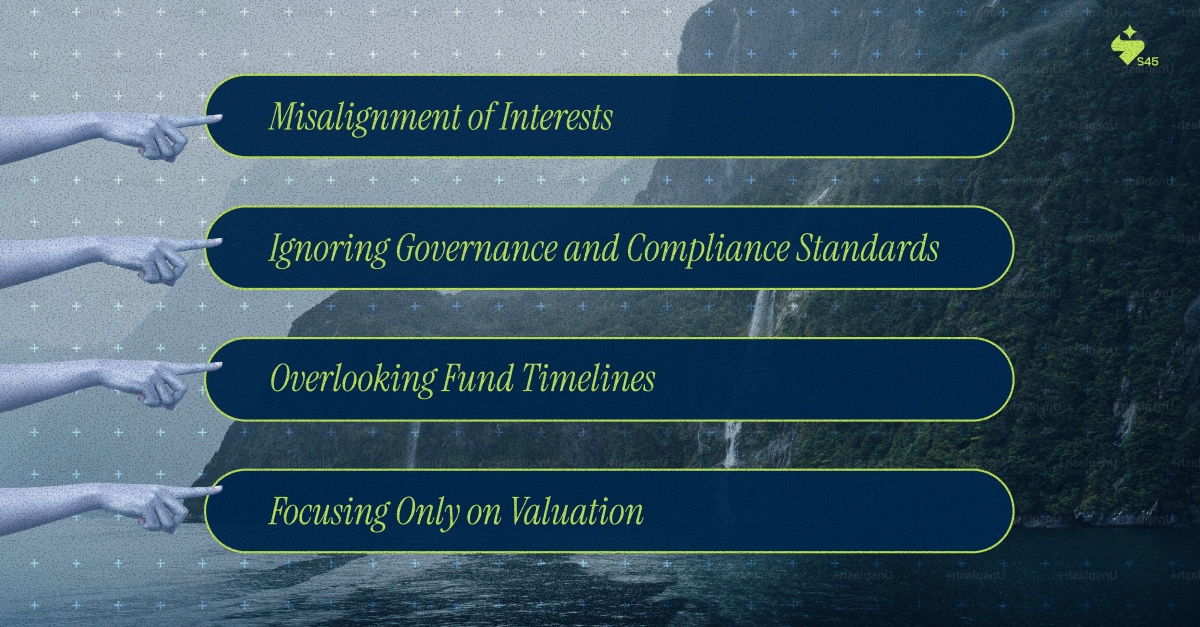
Many businesses enter the GP–LP ecosystem without fully understanding the expectations, timelines, or governance obligations involved. Here are some of the most common pitfalls, and how founders can avoid them.
When GPs, LPs, and portfolio companies pursue different goals, partnerships become strained.
How to avoid it:
At S45 Club, we encourage founders to think beyond capital, focus on building shared intent and long-term alignment with investors.
Many growing businesses underestimate the importance of investor-grade governance. Without robust compliance systems, even profitable firms can struggle to secure funding or maintain confidence.
How to avoid it:
Good governance is not a legal requirement alone; it is a mark of maturity that attracts the right partners.
Private equity funds operate on defined lifecycles, usually 7 to 10 years. GPs aim to invest, manage, and exit within this period. Founders who expect indefinite partnerships often face pressure when the fund nears its exit window.
How to avoid it:
Our advisory work often begins with timeline mapping, ensuring founders and investors have a shared calendar for milestones and exits.
High valuations can be exciting but may not always reflect sustainable value creation.Some founders prioritize valuation over strategic compatibility with the GP.
How to avoid it:
A right-fit investor at a fair valuation creates more value than an overvalued deal with the wrong partner.
Private equity works best when every participant, GP, LP, and founder, understands their role and responsibilities clearly.
The General Partner drives execution and performance.
The Limited Partner supplies capital and oversight.
And the founder of a portfolio company translates that capital into real, measurable growth.
When these roles align, value creation becomes predictable and sustainable.
Know who you are engaging with and what they expect. Whether you are working with a GP or indirectly backed by LPs, clarity, transparency, and governance are your strongest allies.
At S45 Club, we see every capital relationship as a climb, one that demands trust, discipline, and shared purpose.
Through our capital platform, mentorship, and growth playbooks, we help Indian founders engage confidently with the world of private equity, from commitment to execution.
Discover more insights on similar topics