
April 9, 202611 min read
What Is a PPM in Private Equity? Guide to Capital Raises Done Right
By Abhishek Bhanushali
Venture Capital

You’ve built a ₹5-10 crore business with efficient operations and a loyal customer base. But now, expansion requires capital you don’t have. Bank loans need collateral you’ve already used, and family and friends can’t provide more support. So, you’re left asking: Is venture capital an option for businesses like yours?
The truth is, you're caught in the middle. Too established for angel investors, but not large enough for private equity. And VCs, focused on tech startups, may seem out of reach.
That’s where micro venture capital comes in. The Indian micro VC ecosystem has grown rapidly, from 29 funds in 2014 to over 228 in 2024, with many investing in sectors such as manufacturing, B2B services, agritech, and healthcare—beyond the big metros.
The real question isn’t whether micro VCs are available, but whether pursuing them is right for your business. Before you consider funding, you need to know what investors are truly looking for, something most founders miss.
Disclaimer: This content is for educational purposes only and should not be considered as financial advice. Every business situation is unique, and we recommend consulting with qualified financial advisors before making important business decisions.
Micro venture capital (micro VC) is a relatively new niche in India’s funding ecosystem, emerging just over a decade ago. Micro VCs are funds that:
Here’s a quick comparison to clarify the differences:
Factor | Angel Investors | Micro VCs | Traditional VCs |
Investment Size | ₹10-50 lakh | ₹50 lakh - ₹7.5 crore | ₹20-100 crore |
Stage Focus | Pre-seed, early seed | Seed to pre-Series A | Series A onwards |
Decision Speed | Days to weeks | Weeks to 2 months | 2-6 months |
Money Source | Personal wealth | Pooled fund from LPs | Large institutional funds |
Involvement Level | Advisory, less structured | Hands-on, structured mentorship | Board-level, strategic |
Portfolio Size | 10-30 investments | 30-100 investments | 10-20 investments |
Exit Timeline | Flexible (3-10 years) | 5-7 years | 7-10 years |
For MSMEs with ₹5-15 crore in revenue, angel investors are too small, and traditional VCs are too large. Micro VCs strike the perfect balance.
Understanding micro VCs is just the beginning. What matters is why they’re now everywhere and how this creates unique opportunities for your business.
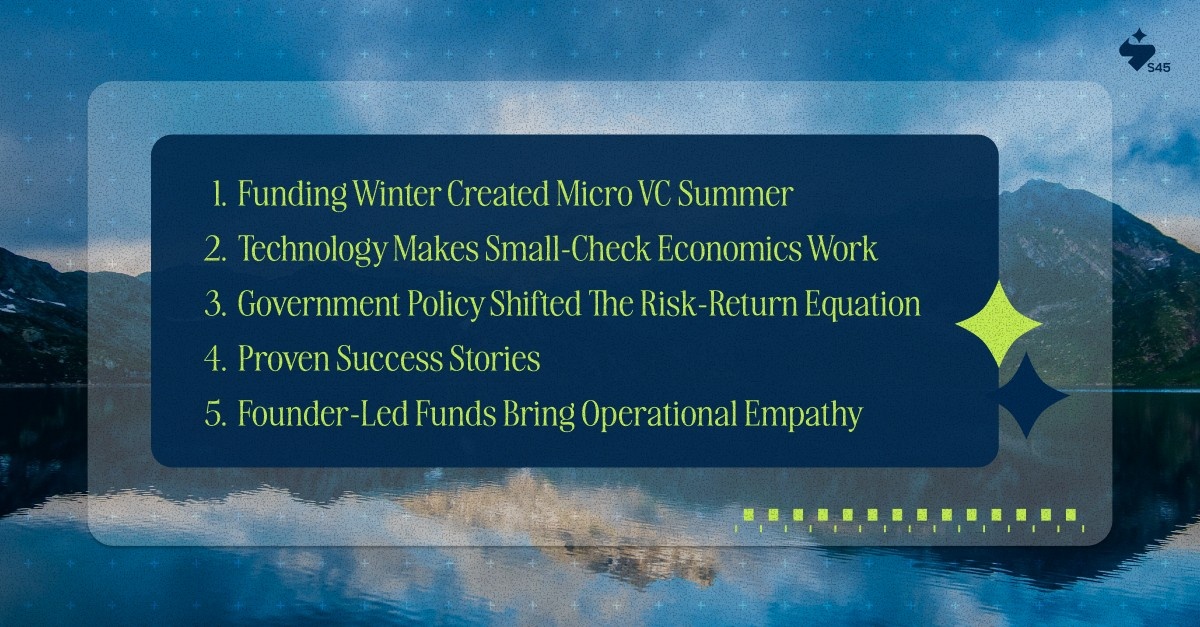
India’s micro VC ecosystem has grown significantly—from just 29 funds in 2014 to over 228 in 2024, with 23 new funds launched in 2024 alone. This surge is no accident; it’s driven by several factors reshaping early-stage funding.
In the wake of the 2022-2023 funding slowdown, larger VCs pulled back, creating a gap at the seed and pre-Series A stages. Micro VCs quickly filled this void with smaller, more agile funds that could focus on early-stage businesses.
A decade ago, managing a 50-100 company portfolio would have been operationally impossible for a small team. Today, data platforms, digital due diligence, and automation tools make smaller investments more feasible, allowing micro VCs to invest in MSMEs that need ₹1-2 crore, not ₹20 crore.
Policies like Startup India, PLI schemes, and Digital India have reduced risk for early-stage investors, created new market opportunities, and clarified exit paths—making MSMEs more attractive to micro VCs.
At S45, we help MSMEs leverage PLI-eligible innovations and government schemes to make their business more appealing to micro VCs. This is tailored, MSME-specific guidance in a complex ecosystem.
Early micro VC investments have delivered strong returns with companies like Ola, boAt, BharatPe, and CRED. These successes have created a flywheel: more successful exits attract more capital, fueling further growth in the micro VC space.
Many micro VCs are run by former entrepreneurs or startup executives who understand the realities of building a business in India. They focus on innovation within traditional sectors, not just tech disruption.
Now that you know what micro VCs are and why they’ve grown, let’s focus on the key benefits they offer over other funding sources—and the potential downsides founders often overlook.
Micro VCs bring more than just capital. Here’s how they stand out:
But, before approaching investors, you must understand what they’re looking for in MSMEs like yours. Most founders get this part wrong.
Most articles tell you that micro VCs invest $50,000 to $1 million at the seed stage. That’s true, but it’s not enough. What matters is why they’d pick your MSME over the hundreds of others they see every year.
Here’s the reality: profitability, growth, and strong customer relationships aren’t enough. Micro VCs focus on four key questions.
Your business might be profitable now, but can it grow 10x without draining resources? Micro VCs want repeatable sales processes, technology-driven leverage, and an addressable market that justifies the risk. At S45, we help founders identify scalability opportunities before seeking investment.
As a bootstrapped business, you’re ahead of the game. Micro VCs want specifics: where will their money go? Think beyond vague “expansion”, be clear, like buying three new CNC machines to cut per-unit costs by 23%. Show unit economics that work, not just future projections.
Micro VCs aren’t just betting on your business—they’re betting on you. Are you open to feedback and willing to pivot? Can you evolve beyond your current model? It’s about learning quickly, adopting new technologies, and adapting to market shifts.
Timing matters. What external factors are making this the right moment for investment? Whether it's government schemes, digital infrastructure, or the post-COVID shift in manufacturing, micro VCs need to see why now is the right time to back you.
If you’ve chosen micro VC, don’t just send cold emails. Success starts months before reaching out, with a specific sequence that boosts your chances.

If micro VC feels like the right fit, don’t treat it as a one-off fundraising event. Think of it as a 12-18-month strategic shift for your business. Rushing this process leads to predictable rejections.
Get your house in order. Micro VCs will conduct thorough due diligence, so better to spot the issues first:
This isn’t about perfection, but showing you take governance seriously. Every month of delay is a missed opportunity to approach investors.
The biggest mistake? Not connecting “we make great products” to “we can be a ₹100 crore business.” You need a compelling narrative.
Use this framework:
This is your pitch. Not a 30-slide deck, but a clear, compelling story you can tell in 10 minutes.
Forget cold emailing 50 micro VCs with a generic pitch. Focus on 5-8 funds that invest in your sector, stage, and geography. Get there through warm introductions.
How to get warm intros:
At S45, we connect you to micro VCs focused on capital-efficient, profitability-driven MSMEs, not just tech plays. This increases your chances dramatically by bypassing the “we only invest in SaaS” filter.
When you reach the term sheet stage, things get tricky. Unlike straightforward bank loans, the terms you agree to now will shape whether you’ll still be running your company in three years.
You’ve secured an investor and received the term sheet. It’s 15 pages of dense legal jargon, and your first instinct is to sign quickly and get the money. That instinct could cost you your company.
Everyone focuses on valuation, but these clauses will shape your future:
Micro VCs often want a board seat.
Standard is 1x non-participating: the investor gets their money back first, then everyone shares the rest.
You’ll likely face drag-along and tag-along rights.
Expect 4-year vesting with a 1-year cliff.
The bottom line is to hire a lawyer who specializes in venture deals. A ₹1.5-2 lakh investment in expert legal advice can save you millions in the long run.

Raising funds for your MSME isn’t just about securing capital; it’s about finding the right partners who understand your vision and can help you scale. At S45, we don't just help you secure funding; we guide you through the entire process, ensuring you're prepared and well-positioned for sustainable growth.
We take a hands-on approach to help you build a business that’s ready for investors and long-term success:
With S45, you’re not just raising capital, you’re positioning your business for the next phase of growth. Let us help you navigate the complexities of funding with confidence, whether it’s through micro VC, strategic partnerships, or smart reinvestment.
Schedule your free consultation and let’s explore the best path for your business. Together, we’ll build a plan that works for you.
Discover more insights on similar topics