
February 13, 202610 min read
Private Equity: A Comprehensive Pros and Cons Guide
By Abhishek Bhanushali
Debt & Equity Financing

Disclaimer: This content is for educational purposes only and should not be considered as financial advice. Every business situation is unique, and we recommend consulting with qualified financial advisors before making crucial business decisions.
If you are preparing for an IPO in India, you already know where traditional financing breaks.
Bank credit committees take months to approve. NBFCs demand collateral that your growth-stage balance sheet cannot support. Public bond markets require credit ratings that your unlisted entity does not possess. Meanwhile, private equity investors seek board seats and veto rights, which complicate your listing narrative.
This is not a capital availability problem. This is a structural mismatch between how Indian enterprises grow and how traditional lenders operate.
The gap widens precisely when you need capital most: during the 12–18 months before SEBI filing, when your balance sheet must demonstrate institutional readiness, but your existing debt structures carry restrictive covenants that prevent the operational flexibility required for public market preparation.
Private equity lenders have emerged to occupy this space, not as alternative financiers but as institutional credit providers who understand the mechanics of capital-market transitions. They structure debt that complies with Indian corporate law, SEBI disclosure requirements, and the operational realities of mid-market enterprises preparing for listing.
This is not about filling financing gaps with expensive money. This is about accessing capital designed for the specific phase of corporate evolution you are in.
Firms like S45 have observed this pattern across dozens of pre-IPO capital structures: enterprises that treat private credit as tactical bridge financing fail. Those who integrate it into institutional capital market preparation succeed. The difference lies not in the capital itself, but in how it aligns with SEBI readiness, documentation discipline, and listing execution.
Banks operate under Basel III norms and RBI exposure limits that prioritize low-risk lending. For a ₹200 crore revenue company with 40% growth, this creates a problem: too large for MSME schemes, too small for corporate banking, and too growth-focused for risk committees that measure creditworthiness by historical performance.
NBFCs face constraints following the 2018 liquidity crisis and regulatory tightening. Their cost of capital has increased, risk appetite has contracted, and their ability to provide flexible financing has diminished.
The result is a credit vacuum in the ₹80–800 crore revenue segment, precisely where India's future listed companies operate.
According to S&P Global research, India's private credit market stood at US$25–30 billion as of March 2025, representing just 0.6% of GDP. EY India data shows private credit investments reached US$9.0 billion across 79 deals in H1 2025, a 53% increase from H1 2024.
This growth is structural, not opportunistic.
Private equity lenders are not PE firms making debt investments. These are dedicated credit platforms, structured as Category II AIFs under SEBI regulation, whose core business is institutional-grade debt to companies outside traditional lending parameters.
They deploy capital through NCDs, structured term loans, mezzanine facilities, and asset-backed instruments. Unlike banks, they take no deposits. Unlike PE firms, they seek no equity ownership.
Their model centres on three capabilities:
For IPO-ready enterprises, this translates to capital deployed when listing windows open, structured to avoid SEBI disclosure conflicts, and priced to reflect pre-listing growth financing risk.
Understanding how private equity lenders deploy capital reveals why they have become essential to India's pre-IPO ecosystem. Each strategy addresses a specific regulatory or structural constraint that traditional lenders cannot navigate.

The RBI restricts bank lending for equity acquisitions. If promoters seek to increase stakes, buy out minorities, or acquire complementary businesses, traditional credit is unavailable. Private equity lenders structure acquisition loans secured by target assets, cash flows, or promoter guarantees, which are critical for consolidating ownership or strengthening listing narratives before an IPO.
Family-owned enterprises approaching listing face a constraint: promoters hold equity value but limited liquid capital. Diluting equity is strategically undesirable. Private equity lenders structure loans against promoter equity holdings, with repayment linked to post-listing secondary sales, providing growth capital without immediate dilution.
Mezzanine sits between senior debt and equity, carrying higher rates and subordinate ranking. For pre-IPO companies, it provides growth capital without dilution whilst creating clear refinancing paths post-listing through step-up structures and embedded call options.
The IPO path involves significant expenses: legal, audit, underwriting, and compliance infrastructure. Private equity lenders provide bridge loans for listing costs, repayable from IPO proceeds, avoiding dilution from pre-IPO equity rounds during critical preparation phases.
The decision to access private credit is not about capital availability; it is about structural alignment. When S45 conducts IPO readiness assessments, a recurring pattern emerges: companies with the strongest capital market outcomes are those that deployed private credit strategically, not opportunistically.
Four factors drive this alignment:
Speed and flexibility come with a trade-off: institutional rigour that many promoters underestimate until their first covenant testing cycle.
Private credit requires different institutional standards:
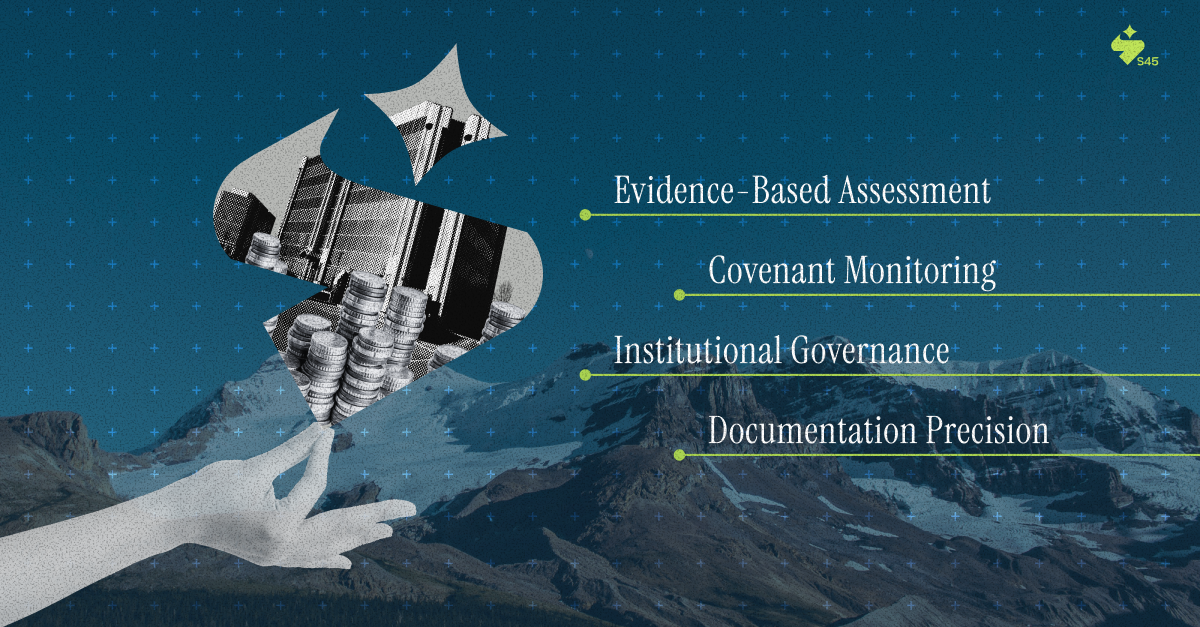
For promoters accustomed to relationship banking, this discipline can feel constraining. But it is precisely this rigour that allows private equity lenders to provide non-standard structures.
The mechanics of integrating private credit into IPO timelines require precision. Investment banks like S45 that execute AI-driven DRHP drafting see this clearly: enterprises that structure private debt before initiating SEBI documentation move 40–60% faster through regulatory approval because their capital structure disclosures are pre-validated, evidence-linked, and institutionally coherent.
Three integration points matter most:
Private credit's structural advantages create corresponding risks that promoters must evaluate against their specific capital market timeline and operational capacity.
Five constraints demand attention:
Not all private equity lenders operate with the same institutional discipline or sectoral expertise. Selection criteria should mirror the due diligence standards these lenders themselves apply to credit underwriting.
Four factors separate institutional credit partners from transactional financiers:

India's private credit trajectory is not speculative; it follows structural patterns visible in every maturing capital market. Understanding these drivers helps promoters time their engagement with private equity lenders strategically rather than reactively.
Four structural drivers persist:
This evolution creates opportunity: institutional-grade debt now stands as a standard, with pricing that improves competition. But expectations rise. Lenders demand institutional reporting, evidence-based narratives, and governance that meets public standards. Success requires institutional readiness, exactly what S45's preparation framework embeds.
Private equity lenders occupy the space where enterprises need flexible capital, institutional discipline, and structures aligned with capital market transitions.
For Indian companies with ₹80–800 crore revenue and 18–24 month listing ambitions, private credit offers growth capital without dilution, acquisition financing banks cannot provide, and capital structure optimisation before SEBI filing.
But accessing these advantages requires institutional preparation. Private equity lenders demand evidence-based assessments, rigorous monitoring, and public company governance. Documentation burden is significant. Performance expectations exacting. Cost higher than traditional debt.
The question is not whether private credit is "better" than bank loans. The question is whether your capital requirements, growth timeline, and institutional readiness align with what private equity lenders provide.
If preparing for IPO, this alignment determines the valuation multiples, investor appeal, and post-listing flexibility you achieve.
Before structuring debt that defines your capital market trajectory, as here, an enterprise's institutional standing, typically, S45's IPO Readiness Scan provides evidence-based clarity on capital structure gaps, regulatory weaknesses, and documentation deficiencies that affect both credit terms and listing outcomes.
Discover more insights on similar topics