
April 10, 202611 min read
Angel vs. Seed Funding: What Every Indian Founder Must Know Before Raising Capital
By Abhishek Bhanushali
Startup Funding

You’ve built something people want. Your product works. Customers are paying. Your team believes in the vision.
But growth needs capital. Runway is shrinking, opportunities are slipping, and you can’t move fast enough. Startup fundraising is the key, but where do you start? Which investors should you target? How much should you raise? What documents matter?
Fundraising can feel like a black box. Some founders close rounds in weeks, others burn months with nothing to show. The difference lies in understanding what investors look for, how to position your business effectively, and recognizing the mistakes that can potentially kill deals.
This guide provides a step-by-step roadmap to understanding fundraising in India, building an investor pipeline, and approaching your next round with clarity.
Startup fundraising means securing external capital to grow, scale, or sustain your business. You exchange equity, debt, or future revenue for the funds needed to reach your next milestone.
Fundraising usually happens in stages. Early rounds prove your concept, while later rounds fuel expansion. Distinct investor expectations, terms, and types of capital accompany each stage of development.
The goal is to raise sufficient funds to achieve key milestones while maintaining control and avoiding high-risk debt. Strategic timing, the right type of funding, and investor alignment all improve the chances of successful rounds.
Every funding type solves a different problem. Some help you grow without giving up control. Others bring in capital with support and accountability. Understanding these options enables you to choose the proper structure based on your stage, risk tolerance, and growth plans.
Here are the primary funding types available to Indian founders in 2025:
Equity funding means selling a share of your company to investors in exchange for capital.
Use this when:
Debt funding is borrowed capital that you repay with interest.
You keep full ownership, but repayment is mandatory. If revenue dips, debt can increase risk.
Use this when:
Convertible instruments are temporary agreements that turn into equity during a future round.
Use this when:
Non-dilutive funding provides capital without requiring the sale of equity or the assumption of debt. Government grants and crowdfunding are some options for this type of funding. However, these options can be slower to access and often come with eligibility requirements or operational constraints.
Use this when:
Bootstrapping refers to building a startup using your own savings or revenue generated from customers. There are no external investors or loans involved in this project.
Use this when:
Many founders in Tier 2 and Tier 3 cities use this approach. It avoids pressure from outside investors and supports sustainable growth. Communities like S45 Club support such founders with strategic guidance and access to flexible capital.
With a clear view of funding options, you can match your needs to the right sources. Next, let’s break down the step-by-step process to begin your fundraising.
Fundraising is a process that demands preparation, strategy, and execution. Most founders who struggle with fundraising skip crucial early steps or approach the wrong investors at the wrong time.
This guide will walk you through each phase, from confirming you're ready to close the round and stay compliant. Follow these steps to run a focused, efficient fundraising process.
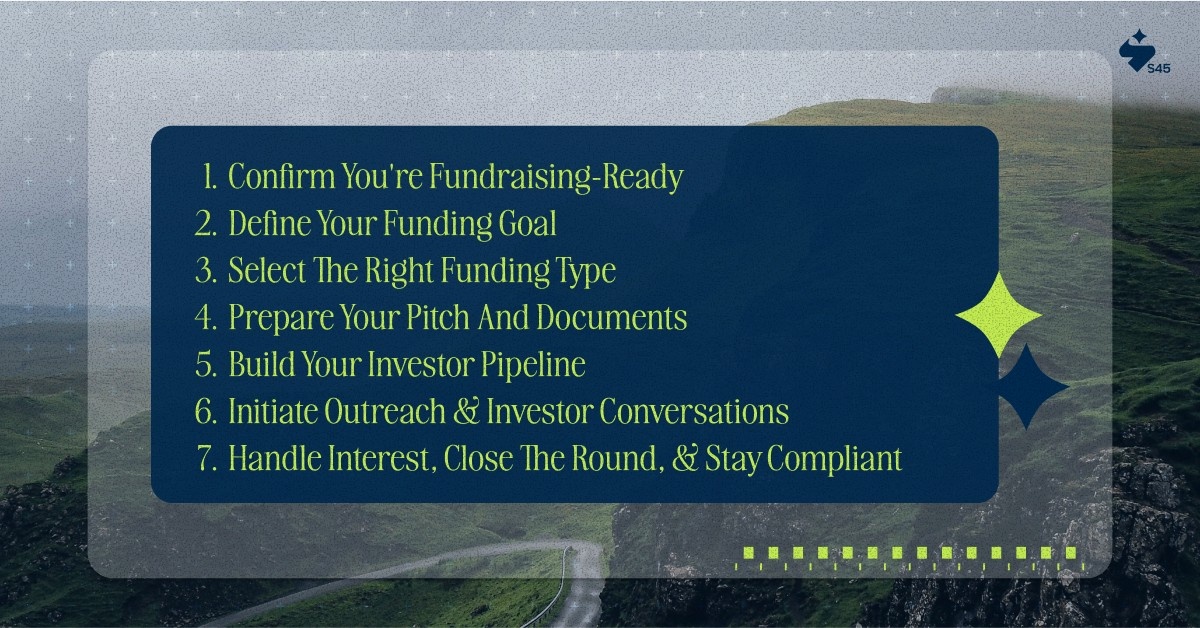
Before you reach out to a single investor, ask yourself: Are you actually ready to raise?
Investors don't fund ideas. They fund traction, teams, and proof that your business can scale. If you're missing these, you'll waste months chasing investors who aren't interested.
What investors look for:
If you're missing these elements, focus on building them before you fundraise.
Your funding goal should be based on specific milestones you need to reach before your next round. Calculate your burn rate, how much cash you spend each month, and multiply it by the number of months you need to hit those milestones. Add a buffer for delays.
Key considerations:
It's essential to be realistic. Overestimating your needs leads to unnecessary dilution.
Choosing the right funding type is one of the most important decisions in your fundraising journey. The kind of capital you raise should align with your stage, business model, and growth objectives. Picking the wrong path can create pressure you’re not ready for.
How to match funding to your stage:
Your pitch deck and supporting documents are the proof investors need to assess your business. Keep your story concise, numbers clear, and key information easily accessible.
Include the following:
Organize everything in a secure, easily shareable folder so investors can review without friction.
Raising capital is truly a numbers game. You'll need to talk to 50-100 investors to close a round. Begin by compiling a list of active, relevant, and suitable investors for your stage, sector, and geographic location.
How to qualify investors:
Utilize different platforms to research potential investors. If you don't want to go through such hassle, then a platform like S45 club can help you research portfolios and shortlist investor preferences.
Cold emails rarely work. Investors get hundreds of pitches every month. Warm introductions cut through the noise.
Ask your network, advisors, co-founders, or portfolio founders for introductions to investors. A single line from a trusted source can make your email worth reading.
Tips on crafting your outreach:
Once investors express interest, you'll receive a term sheet. This document outlines the investment amount, valuation, ownership stake, and key terms.
Key terms to watch:
Negotiate carefully. Get a lawyer who understands startup deals. Bad terms can haunt you in future rounds.
Now that you know the steps to prepare, pitch, and close investors, the next question is where to find them. Targeting the right sources makes your efforts more efficient and effective.
Securing funding requires knowing where to look. India has a strong ecosystem of investors, platforms, and programs. The key is targeting the right sources for your stage and sector.
Here are the most reliable funding sources for Indian startups in 2025.

Angel investors are individuals who invest their own money, typically in early-stage startups. They invest in people as much as they do in ideas. If you're a first-time founder with limited traction, finding an angel who believes in you personally can be the best way to get started.
Venture capital firms invest institutional money in high-growth startups. They target companies with the potential to scale rapidly and generate significant returns.
VC firms typically invest in rounds, expecting aggressive growth, strong unit economics, and a clear path to exit.
Crowdfunding is a method of raising small amounts of capital from a large number of people, typically through online platforms. It works best for product-focused startups, social ventures, or businesses with a strong community following. You set a funding goal, share your story, and provide rewards or early access to attract backers.
Incubators and accelerators provide early-stage funding, mentorship, and resources in exchange for equity. They help startups refine their business models, build products, and prepare for future funding.
Corporate venture arms are investment divisions of large companies. They invest in startups that align with their strategic goals, either to access new technologies, expand into new markets, or acquire talent.
These funding sources offer multiple paths to raise capital, tailored to your specific stage, sector, and growth needs. Once you know where to look, the next step is understanding government-backed schemes that can supplement or accelerate your fundraising efforts.
Government-backed funding is one of the most credible and accessible sources for Indian startups. These schemes provide capital, grants, and guarantees without the pressure of aggressive growth targets or quick exits. They're designed to support innovation, job creation, and entrepreneurship across sectors.
Let’s look at how you can access the most prominent government funding schemes.
The Fund of Funds Scheme (FFS) is a ₹10,000 crore initiative by the Small Industries Development Bank of India (SIDBI). It doesn't invest directly in startups. Instead, it provides capital to SEBI-registered Venture Capital Funds and Alternative Investment Funds (AIFs), which then invest in startups.
The Startup India Seed Fund Scheme provides early-stage funding of up to ₹50 lakhs to startups for proof of concept, prototype development, product trials, and market entry. SISFS works through incubators.
Startup India Investor Connect is a free platform that matches startups with a network of investors, including angels, VCs, and family offices. It's a discovery tool that provides startups with visibility to investors actively looking to deploy capital.
The Credit Guarantee Scheme for Startups (CGSS) provides collateral-free debt to startups through participating banks and financial institutions. They guarantee up to 85% of the loan, reducing the lender's risk. Startups can borrow working capital, purchase equipment, or expand their operations.
With a clear view of where to find funding, you can focus on the trends shaping investor priorities and position your startup effectively.
The fundraising environment shifts every year. Understanding current trends enables you to position your startup effectively, anticipate investor expectations, and identify opportunities that others may overlook.
Here’s what’s driving fundraising in India in 2025.

The era of "growth at all costs" is over. In Q3 2025, Indian startup funding dropped 38% year-over-year to $2.1 billion, with investors focusing on larger, growth-oriented rounds. Investors now prioritize unit economics, the path to profitability, and sustainable business models over vanity metrics such as GMV or user growth.
Startups that can prove they're building capital-efficient businesses with clear routes to positive cash flow are winning funding. If you're burning cash without a plan to break even, fundraising will be challenging.
More late-stage startups are raising pre-IPO rounds to prepare for public listings. These rounds attract crossover funds, hedge funds, and strategic investors looking for near-term liquidity events.
If you're a mature startup with substantial revenue and profitability, consider whether a pre-IPO round makes sense before heading to the public markets. These rounds provide capital for final scaling efforts and validate your valuation before the IPO.
Smaller funds are struggling to raise capital, while larger, established VCs are getting stronger. Mega-funds like Sequoia, Accel, and Lightspeed continue to dominate, writing bigger checks and backing fewer companies.
For founders, this means competition for funding is tighter. Investors are more selective, and due diligence is more rigorous. Building relationships early and demonstrating strong traction is more important than ever.
India now has 498,000 startups and 118 unicorns, with total funding reaching $581 billion across all rounds. Government-backed schemes are gaining popularity as founders seek low-pressure, credible funding sources.
These schemes are particularly beneficial for startups in Tier 2 and Tier 3 cities. If you qualify, consider exploring these options before pursuing VC funding.
Investor interest rotates across sectors. In 2025, fintech, healthtech, climate tech, and AI-driven businesses are attracting strong interest. Consumer tech and edtech are seeing slower funding activity.
If you're in a hot sector, leverage it. If you're in a slower sector, focus on strong fundamentals and profitability to stand out.
Investors are conducting more thorough due diligence on governance, legal compliance, and the founder's background. Recent scandals and startup failures have made VCs cautious about backing companies with unclear financials or questionable practices.
Clean up your cap table, ensure all legal filings are up to date, and maintain transparent financial records to maintain accurate and up-to-date information.
Understanding market trends and investor expectations is one thing, but having guidance, connections, and frameworks can make the journey far easier. That’s where support from the S45 Club comes in.
S45 Club is a community and advisory platform designed for Indian founders who have moved past the startup phase and are looking to scale profitably. It combines investor access, operator mentorship, and practical growth frameworks to help you manage fundraising, governance, and operational challenges.
Here’s how S45 Club supports founders like you:
S45 Club equips you with connections, expertise, and frameworks to approach fundraising and growth with clarity and informed decision-making.
Startup fundraising in 2025 can feel overwhelming, but understanding your options and preparing strategically changes the game. Align your funding with your growth stage, focus on the right investors, and maintain control of your business. With S45 Club, you can gain access to investor connections, mentorship from experienced founders, and practical frameworks to make informed decisions.
Ready to approach fundraising with clarity and confidence? Join the S45 Club to connect with peers, exchange insights, and strengthen your path to successful funding.
Discover more insights on similar topics