
April 10, 202611 min read
Angel vs. Seed Funding: What Every Indian Founder Must Know Before Raising Capital
By Abhishek Bhanushali
Startup Funding

Disclaimer: This content is for educational purposes only and does not constitute financial, legal, or tax advice. Tax laws and ESOP regulations are subject to change. Consult qualified professionals before making equity compensation decisions.
You've built a thriving business. Revenue is climbing, the team is expanding, and talent is knocking at your door. But how do you compete with bigger players who can offer higher salaries and perks?
Ownership can be a game-changer. Over 78% of Indian startups now use ESOPs as part of their compensation, typically with 4-year vesting periods. This approach lets you reward employees with a stake in the company while preserving cash for growth.
The ESOP vesting period determines when your employees truly become co-owners of the business they're helping build. Understanding this can make all the difference between retaining your top performers and losing them prematurely.
In this blog, we walk you through the ESOP vesting period in India, show how different vesting schedules work, explain what happens when employees leave, cover tax implications, and provide practical guidance, so you can structure plans that reward commitment while supporting your company’s growth.
The vesting period is the time an employee must remain with your company before they earn the right to exercise their stock options and convert them into actual shares.
Think of it like a savings bond that matures over time. When you grant ESOPs to an employee, they don't own those shares immediately. Instead, the shares "vest" or become available to them gradually, usually over several years. In India, companies are legally required to implement a minimum 12-month cliff period, meaning no options vest until the employee completes at least one full year.
Here's what this looks like in practice. You hire a talented product manager and grant them 10,000 stock options with a 4-year vesting schedule. During their first year, none of these options vest. Once they cross the one-year mark (the cliff), 25% of their options (2,500 shares) vest immediately.
After that, the remaining options typically vest monthly or quarterly over the next three years.
During the vesting period, employees don't technically own the shares. They only gain that right after vesting is complete. This waiting period ensures that equity is allocated to individuals who make meaningful contributions to your company's growth, rather than those who leave after a short period.
The vesting schedule creates a timeline where ownership and contribution move in parallel. Your team members earn their stake in the business as they help build it. For SMEs scaling toward significant milestones, platforms like S45 Club offer guidance on structuring plans that meet both governance requirements and talent retention goals.
Understanding the timeline of ESOP events helps founders structure better plans and helps employees know exactly what to expect. Three dates matter most in this journey.
The grant date is when the company formally offers stock options to an employee. The ESOP agreement is signed on this date, specifying the number of options, exercise price, vesting schedule, and other terms. No shares change hands yet; this is the moment when the right to purchase shares in the future is created.
The exercise price (or strike price) is typically set at the fair market value (FMV) on the grant date and remains locked for the employee, regardless of how high the valuation rises later.
The vesting date (or multiple dates) marks when options become eligible to exercise. Many startups follow a four-year schedule with a one-year cliff, meaning no options vest during the first year, and thereafter vesting continues monthly or quarterly.
For instance, if an employee has 12,000 options under a four-year plan, 3,000 may vest at the one-year mark, followed by 250 each month or 750 each quarter for the next three years. After the cliff, vesting can also be tied to performance milestones or targets, depending on the company’s policy.
The exercise date is when the employee chooses to convert vested options into actual shares by paying the exercise price. This is when ownership formally transfers. Companies typically set a window (often 3–6 months) for exercising options after vesting or departure.
The gap between vesting and exercise is crucial. Just because options have vested doesn't mean the employee owns shares yet. They still need to pay the exercise price to convert options into actual equity.
With the timeline in perspective, we can explore concrete examples to see how vesting unfolds step by step in real scenarios.
The mechanics of vesting might sound complex on paper, but the process follows a straightforward logic. Let's walk through how it works in real scenarios.

Most Indian startups adopt this structure because it balances retention with fairness. Here's how it unfolds step by step.
You hire a senior engineer and grant them 12,000 stock options on January 1, 2025. The exercise price is set at ₹100 per share (the FMV at grant). The vesting schedule is 4 years with a 1-year cliff and monthly vesting thereafter.
At this point, the engineer has zero vested options. They can't exercise anything.
For the first 12 months, no options vest. This is the cliff, the all-or-nothing threshold that Indian law requires as a minimum period before any stock options can vest. Your engineer works through this year, building products, hitting milestones, and proving their value.
On January 1, 2026 (exactly one year later), they cross the cliff. Suddenly, 25% of their total grant vests immediately. That's 3,000 options now available to exercise.
After the cliff, the remaining 9,000 options vest gradually over the next 36 months. With monthly vesting, that's 250 options every month. With quarterly vesting, it's 750 options every three months.
If the company is performing well and the share value has increased from ₹100 to ₹300 by year two, those vesting options become increasingly valuable. But the exercise price remains ₹100 per share, locked at the grant date.
Let's say by January 2027 (two years in), the engineer has 6,000 vested options (3,000 from the cliff, plus 3,000 from monthly vesting). They decide to exercise 5,000 of these options.
They pay ₹5,00,000 (5,000 options × ₹100 exercise price) to the company and receive 5,000 shares. If the current FMV is ₹300 per share, the value of these shares is ₹15,00,000. This is where taxation comes into play, but we'll cover that later.
So, at the end of the fourth year, the engineer owns the right to purchase all 12,000 shares at the locked-in exercise price of ₹100, regardless of current market value.
This structure incentivizes staying through the full term. Leaving at year two means walking away with only 6,000 options, losing the remaining 6,000 that would have vested in years three and four.
Examples make it tangible, but not every employee or startup follows the same approach. Let’s look at the different types of vesting schedules.
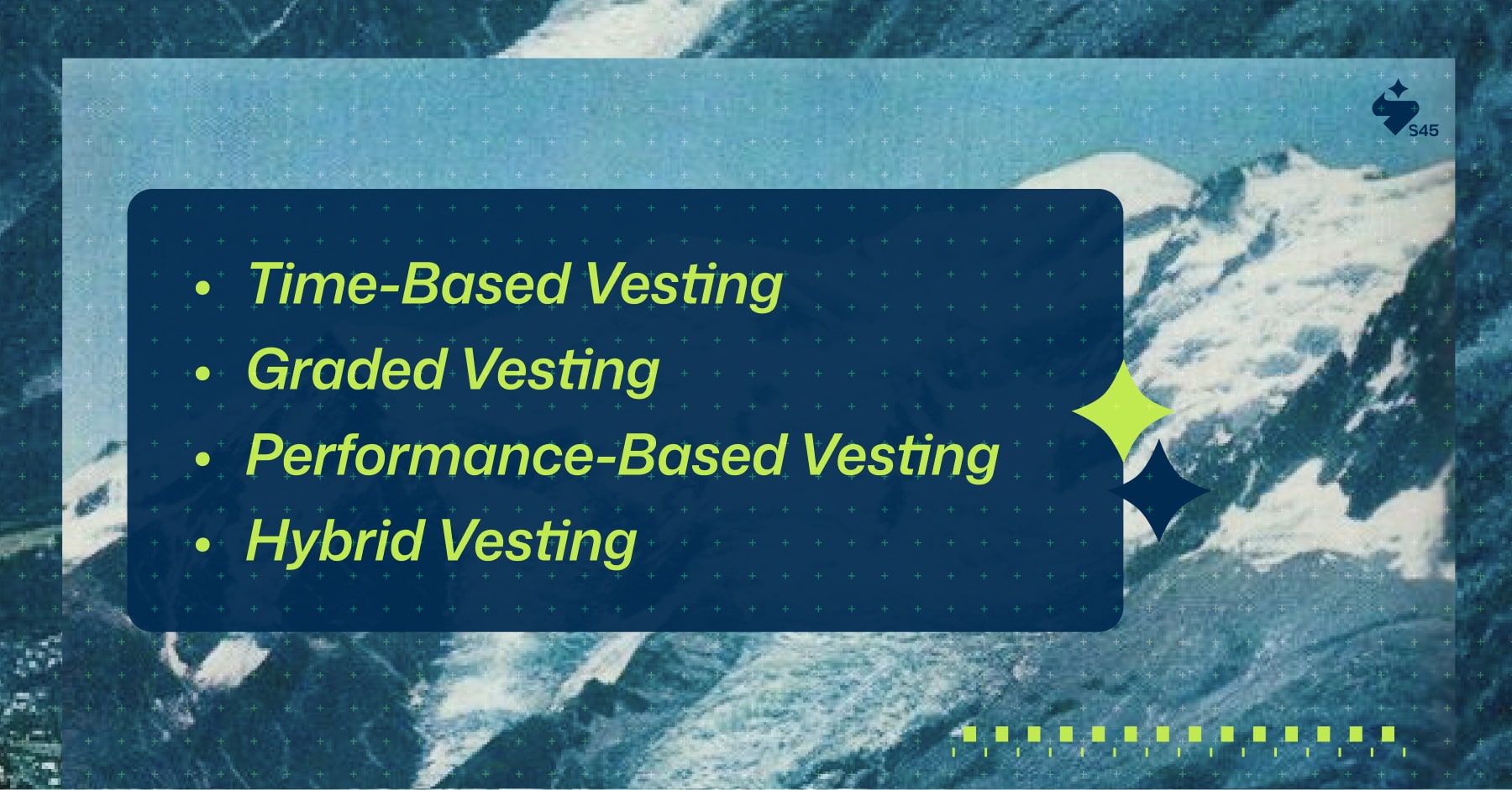
Not all vesting schedules are created equal. While the 4-year time-based model dominates Indian startups, founders have several options depending on their goals, stage, and team composition.
This is the most common approach, where options vest purely based on tenure. It’s the simplest and most common model, ideal for creating steady retention. Some startups add multiple cliffs (for instance, 25% at year one, another 25% at year two, then monthly thereafter) to balance commitment and reward.
Graded vesting distributes options more evenly without cliffs. For example, instead of a cliff at year one, options might vest 10% every six months over five years. This creates a smoother curve, making it more attractive to candidates who want to see ownership sooner.
However, pure graded vesting without any cliff is rare in India because it doesn't provide strong early retention incentives.
Some startups tie vesting to specific milestones or achievements rather than time alone. This structure works well for key roles where outcomes matter more than tenure.
Performance-based vesting might look like this: your VP of Sales gets 20,000 options that vest in tranches of 4,000 options each time the company hits ₹10 crore in ARR milestones (₹10Cr, ₹20Cr, ₹30Cr, ₹40Cr, ₹50Cr).
The advantage is clear: it directly ties equity to value creation. The challenge lies in setting fair and achievable milestones that account for market conditions and the company's stage. If milestones are too aggressive, they can be demotivating. If they're too easy, they don't serve their purpose.
Performance vesting is most effective for senior leadership or specialized roles where individual impact is measurable and significant.
Hybrid schedules combine time and performance elements, offering flexibility while maintaining fairness. A typical hybrid structure might be: 50% of options vest based on time, while the other 50% vests based on hitting specific KPIs or company milestones.
This approach balances retention (through time-based vesting) with performance incentives (through milestone-based vesting). It acknowledges that simply showing up is insufficient, but also recognizes that market conditions and team efforts influence individual outcomes.
For instance, your head of product might have 10,000 options, with 5,000 vesting over four years and a one-year cliff, and the remaining 5,000 vesting when the product reaches 100,000 active users or achieves product-market fit metrics.
Different schedules can be applied depending on your startup’s stage and team composition, which leads us to how vesting periods vary across Indian startups.
While vesting principles are universal, practical implementation varies based on company stage, role seniority, and market dynamics. Understanding these patterns helps you structure competitive offers.
The stage of your startup heavily influences vesting structure. Here’s how it typically plays out:
At this stage, cash is tight and equity is your primary currency. Vesting periods tend to be strict, but the percentage of equity offered is often higher. Early employees might receive 0.5% to 2% of the company, reflecting the higher risk they're taking.
Some founders implement accelerated vesting upon exit (acquisition or IPO), rewarding early team members for taking the risk. For instance, if the company gets acquired in year three, all remaining unvested options might vest immediately.
As the company matures and cash compensation improves, equity percentages typically decrease, but the absolute value often remains attractive because of higher valuations. Vesting structures might become more nuanced at this stage.
Senior hires might negotiate for partial acceleration on exit or performance-based tranches. The 4-year baseline remains, but additional provisions protect both parties.
When an IPO is on the horizon (typically 12-18 months out), vesting schedules face a unique challenge. New hires might be hesitant to commit to a full 4-year schedule if liquidity is scarce. Some companies offer shorter vesting periods (2-3 years) or accelerated schedules tied to the IPO event itself.
However, shorter vesting can create issues if the IPO timeline shifts. Founders can incorporate flexibility into their plans, such as a 3-year schedule with provisions to extend if the IPO is delayed beyond expected timelines.
Not every role warrants the same vesting structure.
The key is consistency within bands. If your senior engineers all have 4-year schedules with 1-year cliffs, deviating from this for one hire can create resentment and complicate equity conversations.
While the stage and role influence vesting, it’s also crucial to know what happens if someone leaves before fully vesting their options.
This is where theory meets reality. Despite best intentions, people leave. Understanding what happens to unvested and vested options during exits is crucial for both founders and employees.
Once an employee crosses the cliff and has vested options, those options typically remain theirs even after they leave. The unvested portion, however, is immediately forfeited and returns to the company pool.
Let's revisit our earlier example: an engineer with 12,000 options on a 4-year schedule leaves after two years. They've vested 6,000 options (3,000 at the cliff, plus 3,000 over the next 12 months). When they resign, the remaining 6,000 unvested options are forfeited.
But just because options are vested, it doesn't mean they're exercised. The employee now has a limited window to decide whether to exercise their 6,000 vested options by paying the exercise price. Exercise windows are typically 3 to 6 months after departure. If they fail to exercise within this window, they will lose even their vested options.
This forces a difficult decision. If the company is private and the current share value is ₹500, but the exercise price is ₹100, the employee must pay ₹6,00,000 (6,000 × ₹100) to own shares worth ₹30,00,000 on paper. But there's no liquidity yet. If the company fails or the valuation drops before an exit, that ₹6,00,000 is lost.
ESOP agreements often include good leaver and bad leaver provisions that determine treatment of vested shares upon exit.
Although it is important to remember that not every exit fits neatly into “good” or “bad.” For example, an employee who resigns abruptly before completing key deliverables may not qualify as a bad leaver, but also doesn’t earn full leniency.
This is why clear definitions in the ESOP agreement are critical. You need to document leaver scenarios explicitly to avoid disputes and ensure fairness, especially before liquidity events like acquisitions or IPOs.
Taxation is where the excitement of equity compensation meets the reality of the Indian Income Tax Act. In India, ESOP taxation happens in two stages:
When an employee exercises options, the difference between the fair market value (FMV) on the exercise date and the exercise price is taxed as a perquisite, treated as salary income.
Suppose your employee exercises 5,000 options with an exercise price of ₹100 per share when the FMV is ₹400 per share.
So the employee pays ₹5,00,000 to exercise the options, plus potentially ₹4,50,000 in taxes (assuming 30% tax bracket), for a total outlay of ₹9,50,000. In return, they receive shares worth ₹20,00,000 on paper.
The challenge is that this tax is due even though no actual cash has been received. The shares are illiquid (can't be sold immediately in a private company), but the tax bill is very real. Companies are required to withhold this tax through TDS, which means employees must arrange cash to pay both the exercise price and the tax liability.
When ESOP shares are eventually sold, the transaction is subject to capital gains tax, classified as either Short-Term Capital Gains (STCG) or Long-Term Capital Gains (LTCG).
Shares sold within 36 months of exercising attract short-term capital gains, taxed at the individual's income tax slab rates, while long-term capital gains on shares held beyond 36 months are taxed at 20% with indexation benefits.
Continuing the example: if the employee sells their 5,000 shares after 4 years (long-term) at ₹600 per share, the capital gains calculation is: Sale price (₹600) minus cost of acquisition. The cost of acquisition for ESOP shares is the FMV on the exercise date, which was ₹400.
To handle these tax complexities, professional guidance is essential. For growth-stage SMEs preparing for capital market transitions, governance advisors with ESOP expertise can be invaluable. Platforms like S45 Club offer advice and insights to help founders structure ESOPs, manage compliance, and plan liquidity events, thereby supporting both talent retention and capital market readiness.

Getting your ESOP vesting structure right from the start saves headaches later and protects both your equity pool and team morale. Here are practical guidelines for founders.
Now that you have a clear understanding of how ESOP vesting works, expert guidance can help you implement it smoothly as your company grows.
For founders managing fast-growing SMEs, structuring ESOPs involves decisions around vesting schedules, cliffs, and exercise windows that impact both talent retention and company equity. S45 Club provides expert insights that help founders approach these decisions thoughtfully.
Founders can draw on insights from the S45 Club in areas such as:
By following such structured approaches, founders gain clarity and a framework to manage ESOPs effectively while keeping both governance and team alignment in focus.
An ESOP vesting period influences the alignment of ownership and contribution within a growing company. Structuring it thoughtfully ensures equity rewards meaningful effort while keeping the cap table flexible and transparent.
For founders preparing for scaling milestones or planning governance frameworks, S45 Club provides expert support to structure ESOPs effectively and maintain clarity across teams.
Secure your equity strategy with S45 Club. Request a consultation today.
Discover more insights on similar topics