Viability Gap Funding Scheme In India

Viability Gap Funding Scheme In India: A Founder's Guide

By Abhishek Bhanushali
December 8, 2025
11 min read
Startup Funding

Key Takeaways

  • The Viability Gap Funding (VGF) Scheme offers capital grants to make socially important but financially unviable infrastructure projects viable for private developers.
  • Funding varies by project type, 40% for economic infrastructure, up to 60% for social sector projects, and up to 80% for pilot healthcare and education projects.
  • MSMEs can benefit from VGF through direct project leadership, consortium partnerships, or supply-chain participation in sectors like water, waste, healthcare, renewable energy, and BESS.
  • Key eligibility requirements include PPP structure, competitive bidding, user charge mechanisms, and demonstrated economic viability, but commercial non-viability.
  • To maximize benefits, combine VGF with other MSME schemes, build strategic partnerships with S45, and focus on long-term operational sustainability beyond the grant.

Disclaimer: This content is for educational purposes only and should not be considered as financial advice. Every business situation is unique, and we recommend consulting with qualified financial advisors before making important business decisions.If you're an MSME founder, you've likely encountered this frustration: a project idea that could transform your community, backed by solid economics, but the numbers don't convince traditional lenders. 

The revenue projections are real but modest. The payback period stretches beyond what banks prefer. The social impact is undeniable, yet financial returns fall short of investor expectations. This is where the viability gap funding scheme becomes your bridge from vision to viable business.

Understanding the viability gap funding scheme matters because infrastructure opportunities represent some of the most sustainable, long-term business models available to MSMEs today. Through this guide, you'll learn how the scheme actually works, where MSMEs fit in the ecosystem, and how to build infrastructure businesses that create generational wealth.

What is Viability Gap Funding (VGF)?

The Viability Gap Funding scheme provides upfront capital grants to infrastructure projects that serve the public good but face a profitability gap. A sewage treatment plant might be desperately needed and operationally sustainable, but the tariffs users can afford won't generate returns that excite conventional investors. 

The scheme bridges this gap by providing one-time capital support to reduce the effective project cost for private developers.

Key Facts:

  • Administered by: Department of Economic Affairs, Ministry of Finance
  • Current Budget: ₹8,100 crore until FY 2024-25
  • Launch Timeline: 2006, revamped November 2020
  • Track Record: 67 projects approved with ₹45,802 crore total project cost; ₹4,847 crore already disbursed

Why This Scheme Exists

India's infrastructure deficit isn't just a funding problem. It's a viability problem. Water systems, healthcare facilities, and waste management require massive upfront capital with 15 to 25-year payback periods. User charges must remain affordable, limiting revenue potential. 

Traditional investors seek 12% to 15% returns, which these projects can't deliver without support. The viability gap funding scheme solves this by reducing effective project cost by 40% to 80%, making returns acceptable while keeping services affordable.

For MSME founders thinking beyond trading margins and service contracts, this represents a fundamental shift. If you're evaluating whether infrastructure aligns with your growth vision, S45's strategic advisory helps founders assess fit between their capabilities and infrastructure opportunities before committing resources to complex project structuring.

Now that you understand what the viability gap funding scheme is and why it exists, the critical question becomes: how much support can you actually access, and what determines your eligibility?

How the VGF Scheme Works: Funding Structure

The viability gap funding scheme isn't one-size-fits-all. The 2020 revamp introduced differentiated support based on what you're building and the sector you're entering. Understanding these tiers determines whether your project idea qualifies and how much capital support you can realistically plan for.

For Economic Sector Projects

These cover traditional infrastructure like roads, highways, ports, and transport systems, where revenue models are more established.

  • Total Support: Up to 40% of Total Project Cost
  • Central Government: Maximum 20%
  • State Government/Sponsoring Entity: Maximum 20%
  • Applicable to: Roads, ports, logistics infrastructure, transport connectivity

For Social Sector Projects (Sub-Scheme 1)

This is where MSME opportunities concentrate. Social infrastructure projects receive preferential treatment because of their community impact.

  • Total Support: Up to 60% of Total Project Cost
  • Central Government: Maximum 30%
  • State Government/Sponsoring Entity: Maximum 30%
  • Critical Condition: Must demonstrate 100% operational cost recovery from user charges or tariffs
  • Eligible Sectors: Water supply systems, wastewater treatment, solid waste management, healthcare facilities, educational institutions

For Pilot/Demonstration Projects (Sub-Scheme 2)

These support innovative approaches in health and education, where operational models are still being proven.

  • Capital Support: Up to 80% of Total Project Cost
  • Central Government: Maximum 40%
  • State Government/Sponsoring Entity: Maximum 40%
  • Operations Support: Up to 50% of O&M costs for the first 5 years (25% Centre + 25% State)
  • Eligibility Threshold: Minimum 50% operational cost recovery required
  • Focus Areas: Innovative healthcare delivery models, new education infrastructure concepts

Recent Sector-Specific Initiatives

The government has launched targeted viability gap funding schemes for strategic sectors, signaling where future opportunities will concentrate.

1. VGF for Battery Energy Storage Systems (BESS)

With India targeting 500 GW of renewable capacity by 2030, grid-scale battery storage has become critical infrastructure.

  • Initial Allocation: ₹3,760 crore for 13,200 MWh capacity
  • Expansion Announced: Additional ₹5,400 crore for 30 GWh capacity
  • Total Projected Capacity: 43.2 GWh by FY28
  • Purpose: Renewable energy integration, grid stability during non-solar hours
  • Administered by: Ministry of Power through Central Electricity Authority
  • MSME Angle: Component manufacturing, EMS software (must be indigenous), installation services

2. VGF for Offshore Wind Energy

India's first major offshore wind initiative aims to kickstart a new sector entirely.

  • Total Allocation: ₹7,453 crore
  • Target Capacity: 1 GW (500 MW off Gujarat coast + 500 MW off Tamil Nadu)
  • Objective: Establish the offshore wind sector, reduce power costs, and create domestic supply chains
  • Timeline: Projects under development, tenders expected through 2025-26

Understanding these funding tiers helps you position your project correctly. A water treatment facility targeting 100% cost recovery qualifies for 60% support. An innovative telemedicine network might access 80% capital support plus five years of operational assistance. 

But funding percentages only matter if you're eligible. Let's examine who actually qualifies and where MSMEs fit in this ecosystem.
VGF Eligibility: Who Can Benefit?

VGF Eligibility Who Can Benefit

Eligibility for the viability gap funding scheme isn't just about meeting criteria on paper. It's about understanding where you realistically fit in the infrastructure ecosystem and how to position your MSME for participation. Most founders assume this scheme is only for large infrastructure players. That's not accurate, but the entry pathways differ based on your scale and capabilities.

Primary Eligibility Criteria

These are non-negotiables that every viability gap funding project must satisfy, regardless of sector or size.

  • PPP Structure Mandatory: Projects must be implemented through the Public-Private Partnership model with clearly defined concession agreements
  • Competitive Selection Process: Private sector partners selected through transparent, competitive bidding (no direct negotiations)
  • Economic Justification Required: Must demonstrate clear socio-economic benefits, even if financially marginal, without support
  • User Charge Mechanism: Projects need predetermined tariff structures or user charge systems
  • Project Stage Matters: Greenfield and brownfield projects qualify; ongoing projects do not
  • Financial Viability Threshold: Must prove the project is economically desirable but commercially unviable without grant support

MSME Participation Opportunities

Here's where strategy matters more than size. MSMEs access the viability gap funding scheme through three distinct pathways, each requiring different capabilities and risk appetites.

Direct Project Leadership:

For established MSMEs with project execution track records, leading small to mid-scale infrastructure projects offers the most control and upside.

  • Ideal Project Range: ₹10 crore to ₹50 crore total project cost
  • Requirements: Proven technical expertise in the sector, financial capacity for 20% to 40% equity contribution, ability to secure debt financing, operational capability for 15 to 20-year concession periods
  • Best Sectors: Waste management facilities, small water treatment plants, primary healthcare centers, skill development infrastructure
  • Reality Check: This path demands significant financial commitment and operational maturity. Most first-time infrastructure founders aren't ready for this level.

Strategic Partnerships and Consortia:

This is the most practical entry point for MSMEs with specialized expertise but limited capital.

  • Your Role: Bring technical know-how, local market knowledge, or sectoral expertise, while larger partners provide financial muscle
  • Structure: Consortium arrangements where you hold 20% to 40% equity with clear operational responsibilities
  • Advantage: Access to projects beyond your individual financial capacity while building infrastructure experience
  • Partner Types: Established infrastructure developers, impact investors, state infrastructure corporations

Supply Chain Integration:

The highest-volume opportunity for MSMEs lies in serving viability gap funding projects rather than leading them.

  • Equipment Manufacturing: Pumps, valves, treatment systems, monitoring devices, renewable energy components
  • Technology Solutions: Software platforms, IoT sensors, data analytics, process automation, EMS systems for BESS
  • Specialized Contracting: Civil works, electrical installations, specialized treatment technologies
  • Operations and Maintenance: Post-commissioning O&M contracts, facility management, technical support
  • Consulting Services: Environmental compliance, social impact assessment, community engagement, technical advisory

Sectors with High MSME Potential

Not all viability gap funding sectors offer equal MSME accessibility. Focus on where barriers to entry align with MSME strengths.

  1. Waste Management: Segregation technologies, composting systems, waste-to-energy solutions, collection infrastructure, recycling units
  2. Water and Wastewater Treatment: Decentralized treatment systems, water quality monitoring equipment, purification technologies, pipeline solutions, STPs for smaller municipalities
  3. Healthcare Infrastructure: Diagnostic equipment supply, hospital management systems, medical waste management, telemedicine infrastructure, primary health unit development
  4. Education and Skill Development: E-learning platforms, laboratory equipment, vocational training center infrastructure, skill development facilities
  5. Renewable Energy and BESS: Solar installations, battery storage components, grid integration solutions, energy management systems, indigenous EMS software development

Suppose you're evaluating which pathway suits your MSME's current capabilities and where infrastructure opportunities align with your growth vision. In that case, S45 provides strategic assessments that map your strengths to viable entry points. 

But how do you maximize viability gap funding benefits while building a sustainable business that thrives beyond the grant period?
Maximizing VGF Benefits: Strategic Approach for MSMEs

Maximizing VGF Benefits Strategic Approach for MSMEs

Most founders focus entirely on securing the grant and neglect the operational reality that follows. This section addresses the strategic decisions that separate successful infrastructure businesses from failed experiments.

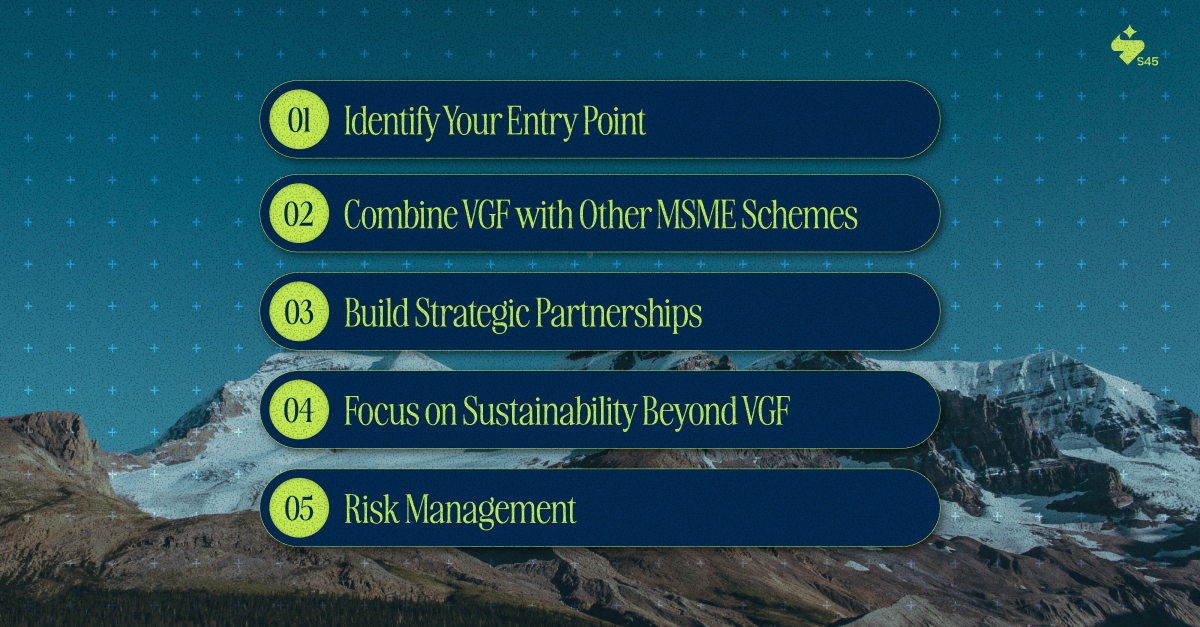
1. Identify Your Entry Point

Before pursuing any viability gap funding opportunity, assess where you realistically fit in the infrastructure value chain right now.

Critical Assessment Questions:

  • Can your MSME lead a small-scale project under ₹50 crore with 20% to 30% equity contribution?
  • Do you have 15 to 20 years of operational commitment for a concession-based model?
  • Is a partnership with larger developers more viable, given your current financial capacity?
  • What specific supply chain role can you fulfill in viability gap funding infrastructure without overextending?
  • Does your team have the technical depth to manage complex PPP agreements and regulatory compliance?

If you're capital-constrained but technically strong, consortium partnerships make more sense than solo ventures. If you have specialized technology capabilities, supply chain integration offers volume without execution risk.

2. Combine VGF with Other MSME Schemes

Smart founders layer multiple support mechanisms to minimize personal capital exposure while maintaining control.

Complementary Funding Options:

  • PMEGP (Prime Minister's Employment Generation Programme): Up to ₹25 lakh for manufacturing, ₹10 lakh for services (funds your equity portion)
  • MUDRA Loans: Up to ₹10 lakh without collateral for working capital needs during the construction phase when cash flows are negative.
  • Credit Guarantee Schemes (CGTMSE): Reduce bank risk, improving debt access for non-viability gap funding portions
  • State MSME Schemes: Capital subsidies, 3% to 5% interest subventions, additional grants

The viability gap funding scheme becomes the anchor, not the sole funding source.

3. Build Strategic Partnerships

Infrastructure projects don't succeed in isolation. It needs technical partners (technology providers, O&M contractors), financial partners (infrastructure funds, impact investors, co-promoters), and government relationships (State Infrastructure Development Boards, PPP cells, sectoral ministries).

4. Focus on Sustainability Beyond VGF

The viability gap funding scheme helps you start. Your business model must sustain you for the next two decades.

Key Strategies:

  • Diversify revenue streams (waste projects: tipping fees + compost sales + RDF production)
  • Build tariff escalation mechanisms linked to inflation from day one
  • Invest in automation and technology for operational efficiency
  • Plan preventive maintenance rigorously, and budget realistically for O&M costs
  • Think asset appreciation, not just cash flows (land value, operational track record, replication potential)

Successful projects attract acquisition interest from larger infrastructure funds seeking operational assets.

5. Risk Management

Understanding what can go wrong is as important as planning what should go right.

Common Pitfalls to Avoid:

  • Underestimating Operational Costs: Social sector projects especially face unpredictable O&M expenses. Budget 15% to 20% above initial estimates.
  • Over-Dependence on Government Grant: If your project only works with maximum viability gap funding support, your business model is fragile. Build buffers.
  • Inadequate Technical Expertise: Winning the bid doesn't mean you can operate the facility. Assess your O&M capabilities honestly before bidding.
  • Poor Risk Allocation in PPP Agreements: Don't accept all risks. Negotiate reasonable risk sharing, particularly for force majeure, demand risk, and regulatory changes.

The difference between accessing viability gap funding and building a lasting infrastructure business lies in these strategic choices. Grant capital gets you started. Operational excellence, financial architecture, and strategic partnerships determine whether you're still operating profitably in year fifteen.

How S45 Supports Sustainable MSME Growth Beyond Government Grants

Securing viability gap funding support is one checkpoint in your journey. Building infrastructure businesses that compound value across decades while creating community impact is the real summit.

This is where most generic consultants stop, and where S45's approach fundamentally differs. We don't view viability gap funding as an endpoint. We see it as foundation capital for legacy building. 

Our work with MSME founders spans the entire infrastructure journey: 

  • Assessing which opportunities align with your capabilities and risk appetite
  • Modeling financial structures that optimize viability gap funding with complementary MSME schemes
  • Designing projects for operational excellence and long-term value creation
  • Building governance frameworks that support multi-project scaling
  • Connecting infrastructure assets to broader capital strategies as your portfolio matures.

We walk beside you, not above you. Connect with S45 to explore how infrastructure opportunities fit your legacy vision.

Frequently Asked Questions

Stay Connected with S45

Get startup insights and connect with our community